Guest Posting Websites List: Top 10 Sites for 2026 How to Choose the Right Fit

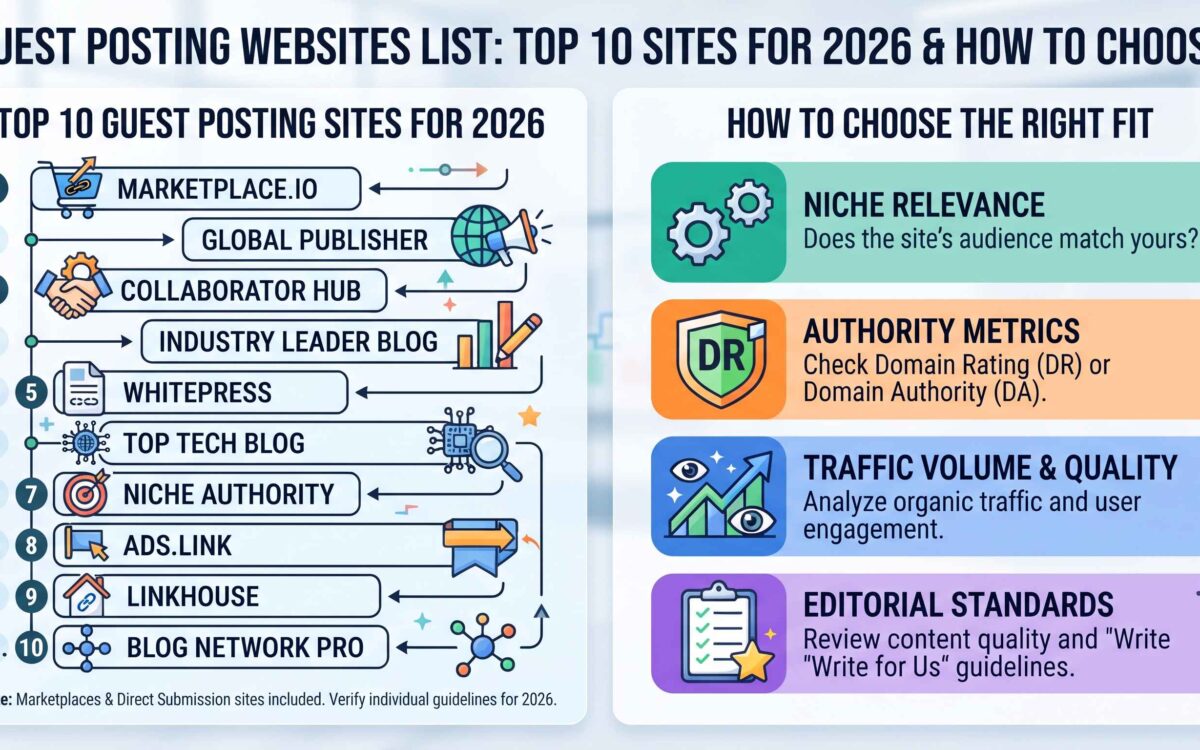
Guest posting can put useful expertise in front of readers who may never find your own site. But a long list of publishing opportunities is only a starting point: the best choice depends on audience fit, editorial standards, cost, and what you want the article to achieve. A Guest Posting Websites List: Top 10 Sites for 2026 can help you build a shortlist, while careful research helps you decide which sites are worth approaching.
Start With the Readers, Not the Metrics
Before reviewing domain scores or estimated monthly visits, define the audience you want to reach. A small-business technology article, for example, could suit a publication read by founders, IT managers, or general consumers—but each group brings a different context and set of questions. A site’s broad category is not enough to establish relevance.
Read several recent posts on each publication. Look at the topics it covers, how deeply it treats them, and whether its tone is practical, technical, or opinion-driven. Consider whether your proposed article would answer a real question for those readers. If it would feel out of place beside the site’s existing work, a high traffic estimate is unlikely to make it a strong match.
How to Evaluate a Guest Posting Website
Use the same checks for every potential publisher so you can compare opportunities consistently:
- Topic alignment: Does the site regularly publish material related to your expertise?
- Audience location: Are its readers in the country or market you intend to reach?
- Recent activity: Are articles published regularly, and do they appear to be maintained?
- Editorial quality: Are posts useful, clear, and edited, or do they read like a collection of unrelated promotions?
- Publishing terms: Are fees, link policies, disclosure rules, revisions, and publication timelines clear?
- Likely outcome: Are you seeking referral visits, brand recognition, professional credibility, or a relationship with a new audience?
Traffic and authority tools can add context, but their figures are estimates rather than a publisher’s private analytics. Compare sites using the same tool and measurement period. Look at trends and geography as well as totals, and treat a sudden spike or decline as something to investigate rather than a definitive verdict.
Review the Site’s Content and Publishing Process
A credible opportunity should have a clear editorial process. Check whether the publication accepts original contributions, what subjects it considers, and whether it reviews drafts before publication. Ask how much editing may occur and whether the article will remain accessible over time. If a publisher promises guaranteed results or offers little information about its readership, pause before committing.
Pay attention to the balance of the site. A publication that carries a steady range of relevant articles may provide a more natural setting for your contribution than one dominated by thin, repetitive posts. Check whether bylines are consistent and whether the articles offer substance beyond a sales pitch. The goal is to contribute something readers can use, not simply to place a link.
Prepare a Pitch That Fits
Once you have a shortlist, develop a specific idea for each site instead of sending the same generic pitch to every editor. A concise proposal can include a working headline, the reader problem it addresses, a short outline, and a sentence explaining why the topic suits that publication. Mention relevant experience only where it supports the proposed article.
Keep the contribution focused. Explain important terms, give readers steps they can apply, and use examples that clarify the subject rather than pad the word count. Any links should make sense in context and support the reader’s next step. Follow the publisher’s guidelines on formatting, citations, images, and promotional language.
Plan the Work and the Budget
Guest posting takes more than drafting. Research, editing, fact-checking, outreach, and follow-up all require time. If you hire help, agree on the scope before work begins: clarify the audience, article length, sources, revision process, deadline, and who has final approval. A low initial price may not be the least expensive option if it excludes revisions or produces work that needs substantial rewriting.
Freelance marketplaces can be one way to find writers, editors, or researchers for defined tasks. When comparing options, review portfolios and relevant experience rather than choosing on price alone. Osdire is one marketplace to consider; its overview of how it compares with Fiverr describes its pricing and order process. Whichever route you use, provide a clear brief and review the work before approving delivery.
Measure Results Realistically
Decide in advance how you will assess a placement. Referral visits, time on page, relevant enquiries, newsletter sign-ups, and conversations with potential partners may all be useful, depending on your goal. Record a baseline and review results after publication, but avoid expecting one article to produce an immediate or easily attributable sales increase.
Some benefits are indirect: a contribution can help establish expertise, create a relationship with an editor, or give your team a useful piece to share. These outcomes are harder to reduce to a single number, so use both analytics and practical feedback. If a placement attracts the wrong audience or the publishing experience is poor, include that information when refining your next shortlist.
Conclusion
A guest posting list is most useful when it helps you find publications to investigate, not when it is treated as a ready-made ranking. Match each site to your audience and subject, check its recent content and terms, and pitch an article with a clear reader benefit. With a defined goal, realistic expectations, and a consistent evaluation process, guest posting can become a considered part of a broader content strategy rather than a numbers-driven exercise.