How to Start Freelancing With No Experience: A Practical 2026 Roadmap

Every freelancer hears the same catch-22: clients want proof you can do the work, but you can’t get proof without a client. The good news is that this loop is easier to break than it looks. Clients don’t actually hire “experience.” They hire confidence that their problem will be solved.
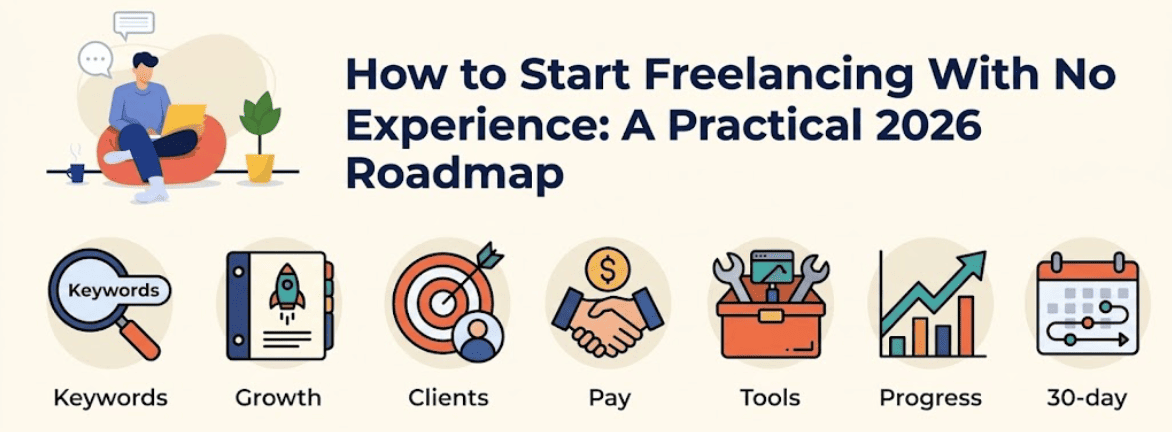
In this guide you’ll learn how to start freelancing with no experience using a step-by-step system: how to pick a skill, create proof without clients, find your first job, write a pitch that gets replies, price your work, and get paid safely. Everything here is meant to be done in order, so you can follow along and track your progress.
Can You Really Start Freelancing With No Experience?
Yes, you can. Freelancing is one of the few careers where clients rarely ask for a degree, a CV or a job history before you start. A client mainly cares about three things: can you do the work, will you deliver on time, and are you easy to work with?
“No experience” usually means one of three situations:
- You have a skill but no paid client work yet.
- You are still learning a skill and have nothing to show.
- You have a job in another field and want to switch.
All three can start freelancing. The difference is only in how long the preparation takes. If you already have a skill, you can be pitching within a week or two. If you are learning from zero, expect roughly 4 to 8 weeks of focused practice before your first pitch.
Be realistic as well. Your first few weeks are about proof and momentum, not high income. Treat the first client as your launchpad, not your final destination.
How to Start Freelancing With No Experience: The 9-Step Roadmap
Below is the exact order to follow. Finish each step before moving to the next. If you already have a basic skill, you can have proof of work, a profile and real client conversations within about a month. If you are starting from zero, add 4 to 8 weeks of learning at the beginning.
Step 1: Pick One Beginner-Friendly Freelance Skill
The biggest beginner mistake is trying to offer everything. A client searching for help wants a specialist, not someone who “does a bit of everything.” Pick one service, get decent at it, and expand later.
Use this simple filter to choose:
- Can I learn the basics in 4 to 8 weeks?
- Do businesses already pay for it? Browse freelance marketplaces and see how many job posts exist for that skill.
- Can I show results visually or in writing? Skills with easy-to-share samples are faster to sell.
- Do I enjoy it enough to do it daily? Interest keeps you going when replies are slow.
Here are beginner-friendly options and what suits each:
| Skill | Best for people who… | Easy first project idea | Learning time (basics) |
|---|---|---|---|
| Content / blog writing | Enjoy research and writing | A 1,000-word blog post for a small business | 2–4 weeks |
| Copywriting | Like persuasion and sales psychology | Rewrite a weak landing page | 4–6 weeks |
| Social media management | Understand trends and platforms | A 2-week content calendar | 2–4 weeks |
| Graphic design | Have a visual eye | Logo, social post and banner set | 4–8 weeks |
| Virtual assistance | Are organized and reliable | Inbox, calendar and research tasks | 1–2 weeks |
| Video editing | Like storytelling and pacing | Edit a short reel from raw footage | 4–8 weeks |
| Data entry / research | Pay attention to detail | Build a clean lead list in a spreadsheet | 1–2 weeks |
| Transcription and translation | Know two languages well | A cleaned-up transcript or translation | 1–3 weeks |
| SEO basics | Like analyzing and problem solving | A keyword and on-page audit | 4–8 weeks |
| AI-assisted services | Are comfortable with new tools | Automating a simple repetitive workflow | 3–6 weeks |
Several freelance marketplaces have publicly reported rising demand for AI-related skills such as AI integration, chatbot setup and AI-assisted content and video work (check the latest figures on the platform you plan to use). That doesn’t mean everyone should chase AI. It does mean that combining a basic skill (writing, design, admin) with smart use of AI tools can make a beginner faster and more valuable, as long as you check the quality of every output yourself.
Tip: If you are unsure, start with the skill that has the lowest learning barrier and the highest number of job posts. You can always specialize later once you know what you enjoy.
Step 2: Practice With Real-World Sample Projects
Learning videos alone won’t make you hireable. Practice does. Instead of endless courses, learn just enough to start doing, and then complete small projects that look like real client work.
A simple practice method:
- Take a real business (a local shop, a small brand you admire, or a made-up one).
- Define a realistic brief, such as “write three product descriptions” or “design a menu.”
- Complete it to a professional standard, as if a client were paying.
- Time yourself so you learn how long tasks really take, which helps with pricing later.
Aim for at least 3 solid projects, and up to 5 if you can. Quality matters more than quantity, because a potential client will usually look at only two or three of your samples.
Free and low-cost ways to learn include YouTube tutorials, free courses from big learning platforms, official tool documentation (Canva, Figma, Google Analytics, WordPress), and community forums. Choose one structured path and finish it rather than jumping between ten.
Step 3: Build a Portfolio Without Clients
A portfolio is simply proof. It does not have to come from paid clients. Clients mainly want to see that you can produce work similar to theirs.
Here are portfolio ideas that work even if you have never been hired:
- Spec work: Create work for an imaginary or real brand without being asked. Clearly label it as a concept or sample.
- Redesign or rewrite: Show a “before and after” of a weak web page, flyer or social post (without claiming the brand hired you).
- Volunteer projects: Help a local charity, school or neighbor’s small business for free or at a low rate in return for a testimonial.
- Personal projects: A blog, a niche Instagram page, a YouTube channel or a mini website you built shows initiative and skill at once.
- Case-study format: Even for sample work, explain the problem, your approach and the result. This shows how you think.
Where to host it: a simple one-page website, a Google Drive folder with a public link, a Behance or Dribbble profile (for designers), a Notion page, or a LinkedIn “Featured” section. A free option is fine at the beginning. Polished presentation matters more than an expensive domain.
If you’d like a deeper walkthrough with examples and templates, read our full guide on how to build a freelance portfolio from scratch. (Add the link to that guide here.)
Step 4: Set Up a Profile That Looks Professional
Before you pitch anyone, make sure that a client who Googles you finds a clear, trustworthy picture.
Your profile checklist:
- A clear headline that says who you help and how. Formula: [Skill] for [type of client] who want [result]. For example: “Blog writer for small SaaS companies who want search traffic.”
- A friendly, professional photo. A clean, well-lit headshot is enough.
- A short bio (80 to 120 words) focused on the client’s problem, not your life story.
- Your portfolio samples linked or attached.
- A professional email address, ideally with your name.
- Consistent branding across LinkedIn, your marketplace profile and any social accounts you use for work.
Also set up the basics early: a way to receive payments, a simple invoice template, and a folder system for client files. Doing it now prevents panic when your first client says yes.
Step 5: Choose Where to Find Your First Client
There are two main routes for beginners, and you can use both.
Route A: Freelance marketplaces
Platforms such as Upwork, Fiverr and Freelancer put you in front of clients who are already looking to hire. Note that they work differently: on Upwork and Freelancer you mostly send proposals to job posts, while on Fiverr you mostly create a service listing (a “gig”) and wait for clients to find it, so the proposal advice below applies mainly to the first two.
Pros: Clients and payment protection are built in; good for learning how projects are scoped; plenty of entry-level jobs.
Cons: Heavy competition; platform fees; profiles may need approval; early proposals can go unanswered.
How to improve your odds on marketplaces:
- Apply early. Fresh job posts tend to receive many of their proposals in the first hours.
- Choose jobs that match your samples closely.
- Be selective. Ten tailored proposals beat fifty copy-pasted ones.
- Avoid jobs with red flags: unclear scope, “urgent” with tiny pay, or requests for free test work that is actually the real project.
Not sure which platform fits you? See our comparison of the best freelancing websites for beginners before you commit time to a profile. (Add the link to that guide here.)
Route B: Direct outreach
Contacting businesses directly (email, LinkedIn or a short message) avoids marketplace competition and often leads to better pay.
Where to look:
- Your own network: friends, family, former classmates and colleagues (many first clients come from someone you already know).
- Local businesses with weak websites, outdated social pages or no blog.
- Startups and small agencies that outsource overflow work.
- Online communities and groups where business owners ask for recommendations.
Direct outreach takes more effort upfront, but one good reply can lead to repeat work.
Step 6: Pitch and Write Proposals That Get Replies
Most beginner pitches fail for one reason: they talk about the freelancer instead of the client. Flip that.
A simple pitch structure:
- Personal opener: One line showing you looked at their business.
- Problem: Name one specific issue you noticed.
- Solution: Say how you would fix it, in one or two sentences.
- Proof: Link to one relevant sample.
- Easy next step: Ask a small question or offer a short call.
Example cold email (adapt it, don’t copy it blindly):
Subject: Quick idea for your product pages
Hi Dawood, I was browsing your store and loved the new leather range. I noticed a few product descriptions are only one line long, which can make it harder for customers to decide. I write short, benefit-focused product copy and put together a sample for two of your items here: [link]. If you like it, I’d be happy to rewrite five more pages at a small introductory price so you can judge the difference. Would that be useful?
Tips that raise your reply rate:
- Keep it under 120 words.
- Send one clear offer, not a menu of services.
- Follow up once after 3 to 5 days. Many replies come from the follow-up.
- Track your outreach in a simple spreadsheet (name, date, reply, next step).
- Set a realistic habit: 5 to 10 quality pitches per day if you are working on this full-time, or 5 to 10 per week if you are fitting it around a job or studies. Rejection is normal; volume plus improvement is the formula.
If you plan to use marketplaces, learn how to write proposals that stand out in our guide on writing a winning Upwork proposal. (Add the link to that guide here.)
Step 7: Set Your First Freelance Rates
Pricing feels scary when you have no track record. A few principles help.
- Start slightly below the market, not at the bottom. Very low prices attract difficult clients and signal low quality.
- Choose a pricing model. Per project or per deliverable (for example, per article or per logo) is usually easier for beginners to sell, because clients know the total cost upfront. The risk is underquoting, so use your practice timings to estimate how long the work really takes. Hourly rates can work for open-ended tasks such as virtual assistance.
- Use your practice timings. Estimate hours per project, decide the hourly income you want, and quote accordingly.
- Define scope clearly. State the number of revisions, the delivery date and what is not included.
- Plan to raise your rates. After your first 3 to 5 successful projects, increase prices for new clients.
A quick pricing formula: (Hours needed × your target hourly rate) + 15–20% buffer for revisions and communication = project quote.
Rates differ widely by skill, country and client type, so check what similar beginners are charging on the platform you use and set your range from real examples, not guesses.
Step 8: Deliver, Collect Proof and Get Paid Safely
Your first client matters more for reputation than for money. So aim to over-deliver within reason.
During the project:
- Confirm the scope in writing before starting.
- Communicate early if you expect a delay.
- Deliver slightly ahead of the deadline.
- Add one small bonus that costs you little but helps the client (an extra headline option, a bonus format, a short summary).
After delivery:
- Ask for a short testimonial or review while they are happy.
- Ask if they have colleagues or contacts who could use your service.
- Save the work (with permission) as a real case study.
Getting paid safely:
- Use a simple written agreement or the marketplace’s contract system.
- For direct clients, ask for a 30–50% deposit on larger projects.
- Send a clear invoice with payment terms.
- Choose a payment method that works in your country. Popular options include bank transfer, Payoneer, Wise, PayPal (where available) and the marketplace’s own payout system.
- Never pay money to “get a job,” and be careful with clients who refuse to use any protected payment method or insist on moving to unknown chat apps immediately.
Even careful freelancers meet the occasional late or non-paying client. Protect yourself with deposits, milestones and good instincts, and don’t let one bad experience stop you.
Step 9: Grow Beyond the First Client
Once you have one or two satisfied clients, you can build momentum.
- Ask for referrals and repeat work. Existing clients are the cheapest source of new income.
- Upgrade your portfolio by replacing practice samples with real client work.
- Niche down. “Content writer for fitness brands” is easier to sell than “writer.”
- Add related services once you are confident (for example, a writer adding email newsletters or basic SEO).
- Build visibility by sharing what you learn on LinkedIn or another platform where your clients spend time.
- Raise your rates gradually as demand and reviews grow.
Keep repeating the cycle: pitch, deliver, collect proof, raise your rates.
Common Mistakes Beginners Should Avoid
- Waiting to feel “ready.” You’ll learn faster by doing real projects.
- Offering too many services. Specialists get hired faster.
- Pricing too low for too long. Low rates can trap you in a cycle of exhausting work.
- Copy-pasting proposals. Clients can tell instantly.
- Ignoring contracts and scope. Vague agreements lead to endless revisions.
- Quitting after a few rejections. Many freelancers go through weeks of silence before their first yes.
- Leaving your full-time job too early. Build income on the side first when possible.
- Skipping the money side. Track income, expenses and any taxes that apply in your country.
Your 30-Day Action Plan
This plan assumes you already have the basics of one skill. If you are learning from zero, spend 4 to 8 weeks on Weeks 1 and 2 first, then follow the rest.
| Week | Focus | What to finish |
|---|---|---|
| Week 1 | Choose and learn | Pick one skill; complete a beginner course or tutorial path (or brush up your basics); list 10 target client types |
| Week 2 | Create proof | Finish at least 3 sample projects; set up a simple portfolio page |
| Week 3 | Get visible | Optimize your profile; set up your marketplace account; draft your pitch template; build a lead list of 30 prospects |
| Week 4 | Pitch and apply | Send 5–10 pitches or proposals per day (or per week if you are part-time); follow up; refine based on replies |
Don’t aim for perfection. Aim to finish each week’s tasks and adjust from feedback.
Final Thoughts
Learning how to start freelancing with no experience is less about talent and more about process. Pick one skill, create proof, present yourself clearly, pitch consistently and treat every project as a stepping stone. Your first client may take longer than you’d like, but each pitch, sample and lesson makes the next one easier.
Start today with one small action: choose your skill, write your first sample brief, or send your first pitch. Momentum beats waiting every time.