What Are Epic Connectors and How Should Third-Party Apps Prepare for the March 2027 Rollout?

For years, integrating a third-party application into Epic meant living inside a strict box: pull patient demographics via SMART on FHIR, render an iframe inside Hyperspace, or build expensive custom HL7 interfaces. Clinicians and operational staff still had to toggle between multiple tabs to finish basic tasks.
In late 2026, Epic fundamentally shifted that paradigm. Following its October announcement of Epic Connectors and a major follow-up reveal at HLTH USA 2026 regarding bidirectional AI access Epic is turning its EHR into an active orchestration layer. Starting in March 2027, health systems will be able to discover, vet, and activate developer-built Connectors directly inside the Epic Showroom.
If you are a health-tech founder, product manager, or integration engineer, waiting until next spring to adapt will put your product behind. Here is what Epic Connectors actually do, why the architecture matters, and how your engineering team should prepare right now.
What Are Epic Connectors?
Epic Connectors are standardized, pre-configured integration bridges that allow Epic’s native AI assistants and custom agents built by hospitals to retrieve real-time data from external applications and execute tasks inside them without forcing users to leave the EHR.
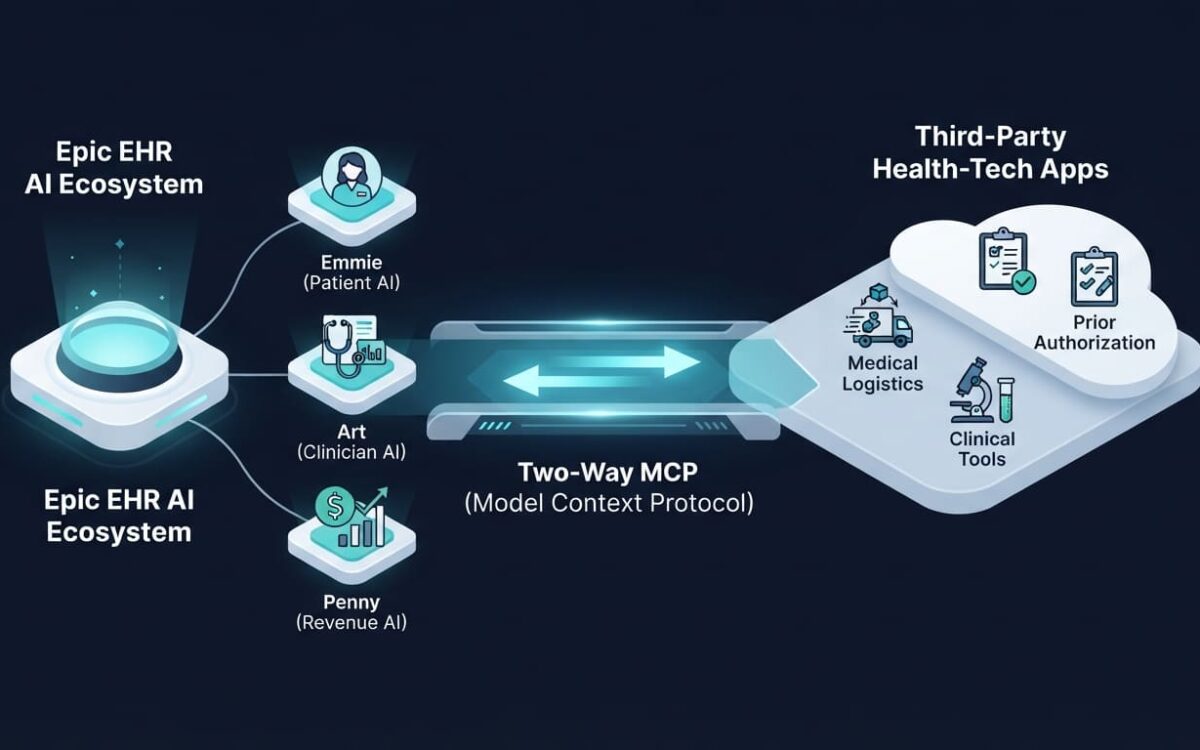
Rather than acting as passive data pipes, Connectors allow Epic’s AI ecosystem to trigger cross-platform workflows across four core engines:
-
- Emmie (Patient-Facing AI): Can pull external hospital wayfinding routes, check local weather for transit planning, or place inpatient meal orders in a third-party dietary app.
- Art (Clinician AI): Can query external medical equipment trackers to verify assistive device availability before surgery or pull live ambulance ETA data into the emergency department.
- Penny (Revenue Cycle & Operations AI): Can verify claim statuses via clearinghouses like Availity or coordinate prescription supply logistics with platforms like VPLRx.
- Agent Factory (Custom Hospital Agents): Lets health systems build bespoke, multi-step AI workflows that combine internal EHR context with multiple third-party Connectors.
The Detail Most Summaries Miss: Two-Way MCP Support
When Epic first unveiled Connectors in October 2026, the focus was purely outgoing: Epic’s AI reaching out to third-party apps. However, during a November 2026 panel at HLTH USA, Epic’s leadership confirmed that the company is simultaneously building incoming Model Context Protocol (MCP) capabilities on the same early-2027 timeline.
Why this changes your architecture:
Epic chose Model Context Protocol (MCP) an open standard for connecting AI models to external data sources and tools as its foundational protocol rather than inventing a closed, proprietary format. By Q1/March 2027, communication will flow both ways:
-
- Outbound: Epic’s AI calls your app’s MCP server to fetch live operational status or execute a discrete action.
- Inbound: Authorized external AI agents operating inside your platform will be able to query Epic’s EHR data through standardized MCP endpoints.
Because MCP is an open standard, the engineering work you put into exposing clean MCP tools for Epic can also be reused across Oracle Health (Cerner) and ambulatory EHR integrations.
Key Technical & Commercial Realities for Developers
Before writing code, product teams must account for three structural constraints built into the Connectors rollout:
-
- Zero Autonomous Clinical Actions: Epic has explicitly stated that Connectors do not grant AI agents unchecked autonomy. Every Connector must expose granular, well-documented read/write permissions. Health system IT and compliance teams will review and toggle individual capabilities on or off at the local level, keeping human-in-the-loop (HITL) oversight mandatory for clinical or financial changes.
- Showroom Distribution Fees: While Open.Epic provides over 1,000 free APIs without requiring approval, distributing a pre-configured Connector through Epic Showroom will carry commercial listing fees. Exact pricing tiers have not been publicly fixed, meaning startups should budget for additional Showroom governance and maintenance overhead alongside standard Vendor Services costs.
- Early Partner Advantage: Early launch partners including Availity, Gozio Health, and VPL are already testing Connectors with select health systems ahead of the broader March 2027 general availability.
5 Steps to Prepare Your App Before March 2027
To position your application as an essential partner rather than a redundant point solution, execute these five steps over the coming quarter:
1. Audit Your APIs for “Agent-Ready” Granularity
Traditional REST and FHIR endpoints often return massive, nested JSON payloads designed for UI rendering. AI agents choke on bloated responses and burn unnecessary tokens. Refactor your core read/write endpoints into deterministic, single-purpose functions (e.g.,
check_device_inventory or verify_prior_auth_status) with strict input schemas and concise outputs.2. Stand Up an MCP Server Wrapper
Do not wait for Epic’s March 2027 Showroom portal to begin testing. Build a lightweight Model Context Protocol (MCP) server on top of your existing backend APIs. Define clear tool descriptions, parameter constraints, and predictable error states so an LLM orchestrator knows exactly when to invoke your app and when to escalate to a human user.
3. Separate “Read” Scopes from “Action” Scopes
Hospital CIOs and CISOs will scrutinize every permission your Connector requests. Package your Connector into modular capability tiers. Allow health systems to enable low-risk read-only context retrieval immediately (such as surfacing real-time delivery ETAs or bed availability) while keeping write/execute actions (such as placing orders or modifying billing records) behind separate, auditable authorization scopes.
4. Harden Token Validation and Audit Logging
When an AI agent triggers an action across systems, traditional user-session context can blur. Ensure your authentication layer enforces strict OAuth scope checks, prevents broken object-level authorization (IDOR) vulnerabilities, and logs an immutable audit trail distinguishing whether a request came from a human clinician, an Epic AI assistant (Emmie, Art, Penny), or a custom Agent Factory workflow.
5. Reposition Your Value Proposition Around Deep Domain Execution
If your app only displays a basic dashboard inside Hyperspace, Epic’s native AI tools risk absorbing your UI. Shift your product positioning from passive data visualization to specialized execution. Position your Connector as the indispensable domain engine that executes complex, multi-system tasks (like prior authorization appeals, specialty pharmacy routing, or post-acute care handoffs) that Epic’s native EHR database cannot perform alone.
The Bottom Line
The March 2027 rollout of Epic Connectors marks the transition from app-centric EHR marketplaces to agent-centric healthcare workflows. Developers who expose clean, secure, MCP-compatible actions early will turn Epic’s native AI assistants into their biggest distribution channel while apps stuck behind legacy iframes risk being bypassed altogether.