Top 5 Taxi App Development Companies in the USA for 2027

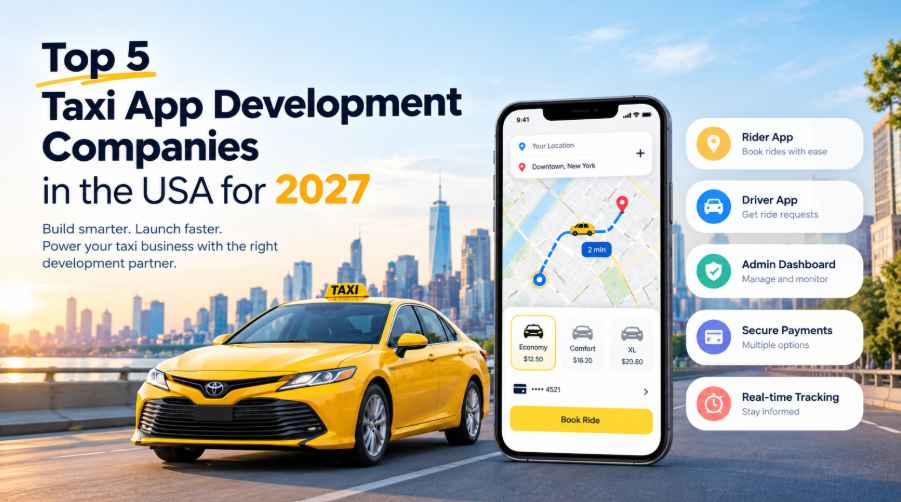
The way people book taxis has changed significantly over the last few years. Customers now expect to book a ride from their phones, see the driver’s location in real time, receive an estimated fare, make digital payments, and get updates throughout the trip.
For businesses, building a taxi booking platform means creating much more than a passenger-facing mobile app. A complete solution typically needs a rider app, driver app, dispatch system, admin dashboard, payment integrations, GPS tracking, notifications, and a backend capable of handling real-time activity.
That is why choosing the right taxi app development company can have a major impact on how quickly a transportation business can launch and scale.
In this guide, we compare five companies worth considering for taxi app development in 2027 based on their mobility solutions, technical capabilities, development approach, and suitability for different business models.
What Should You Look for in a Taxi App Development Company?
Before selecting a development partner, businesses should look beyond the visual design of an application.
A capable taxi app development company should understand both the technology and operational side of ride-hailing.
Important capabilities include:
- Passenger and driver applications
- Real-time GPS tracking
- Driver matching and dispatch
- Fare calculation
- Digital payments
- Scheduled rides
- Multiple vehicle categories
- Driver onboarding and verification
- Ratings and reviews
- Push notifications
- Admin and fleet management
- Analytics and reporting
- Multi-city support
- Security and data protection
Businesses should also consider whether they need a completely custom application or a white-label solution that can be branded and launched faster.
With these factors in mind, here are five companies to consider in 2027.
1. Triple Minds
Triple Minds is positioned as a technology partner for businesses looking to launch taxi and ride-hailing platforms.
Its taxi offering covers passenger, driver, dispatch, and administration components, allowing the different parts of a taxi operation to work together through one platform. The company offers both custom development and white label taxi booking app development, giving businesses two different approaches depending on their budget, launch requirements, and desired level of customization.
The white-label approach can be useful for businesses that want to enter the taxi market without developing every core feature from scratch. Branding, supported features, integrations, and configuration can be adapted to the business requirements, while custom development can be considered when a company has specialized dispatch rules or a more differentiated business model.
Key Taxi App Features from Triple Minds
The platform can include features for different users and operational roles.
Passenger app:
- Ride booking
- Pickup and destination selection
- Fare estimates
- Scheduled rides
- Live driver tracking
- Multiple payment options
- Booking history
- Ratings and feedback
- Push notifications
Driver app:
- Driver registration
- Vehicle and document management
- Online/offline status
- Ride requests
- Navigation
- Earnings tracking
- Trip history
- Driver ratings
Admin and dispatch:
- Driver and passenger management
- Live trip monitoring
- Ride assignment
- Pricing configuration
- Commission management
- Payment and refund records
- Operational analytics
Triple Minds also lists optional AI capabilities such as demand forecasting, driver matching recommendations, unusual activity detection, and AI-powered support workflows.
Why Consider Triple Minds?
Triple Minds can be a suitable option for businesses that want flexibility between a white-label launch and a custom taxi platform. The company also provides integrations, UI/UX design, maintenance, and post-launch development, which can be useful when the application needs to evolve after the initial launch.
Best for: Startups, fleet operators, transportation businesses, and entrepreneurs looking for custom or white-label taxi app development.
2. Burj Code
Burj Code is a Dubai-based mobile engineering studio that works across iOS, Android, cross-platform applications, and mobility solutions.
The company states that it has shipped more than 250 applications and serves clients across the UAE and wider GCC region. Its transportation capabilities include work involving RTA, Dubai Taxi, Careem-style mobility, real-time dispatch, and transportation-related applications.
Burj Code’s experience is particularly relevant for businesses that need more than a simple booking interface. Its transportation technology capabilities include real-time dispatch and mobility-focused application development.
The company also offers white-label app development, which can be relevant to agencies and businesses looking to launch branded applications for their own customers.
Key Capabilities
Businesses considering Burj Code can look at areas such as:
- iOS development
- Android development
- Cross-platform development
- Real-time mobility applications
- Dispatch systems
- GPS and location-based functionality
- White-label applications
- Backend development
- Enterprise applications
Best for: Businesses looking for a mobile engineering partner with transportation and mobility experience, particularly those targeting the GCC or broader international markets.
3. Make An App Like
Make An App Like focuses heavily on ready-made and white-label application solutions.
Its ride-hailing offering includes a white-label taxi platform with rider and driver applications, a web-based dispatch dashboard, matching and surge functionality, ratings, payments, and other ride-hailing components.
The company’s approach is aimed at businesses that want to avoid building a taxi platform completely from the ground up. It states that its ride-hailing solutions can be branded and customized for different markets and business models.
What Does the Platform Include?
The ride-hailing solution includes features such as:
- Rider app
- Driver app
- Admin dashboard
- Dispatch and matching engine
- Fleet management
- Corporate booking
- Wallet and payments
- Driver verification
- Live GPS tracking
- Surge pricing
- Multiple ride categories
- Scheduled rides
- Ratings and reviews
Make An App Like also states that its ride-hailing solutions support multi-city deployment, configurable pricing, different vehicle categories, driver onboarding, and third-party integrations.
Best for: Entrepreneurs and businesses looking for a ready-made or white-label taxi platform with a faster route to market.
4. Space-O Technologies
Space-O Technologies is another established mobile application development company that works on on-demand and transportation applications.
Its taxi app development approach covers the core components required for a ride-booking platform, including rider applications, driver applications, administration, GPS tracking, booking, payments, and fleet-related functionality.
For businesses building a taxi platform, this type of experience can be useful when the application needs to support multiple operational roles rather than functioning as a basic booking interface.
Areas to Consider
Space-O’s taxi development capabilities include:
- Passenger applications
- Driver applications
- Admin dashboards
- GPS tracking
- Online payments
- Ride scheduling
- Fare calculation
- Driver management
- Fleet management
- Ratings and reviews
Best for: Taxi operators and startups looking for a custom mobile application with standard ride-hailing functionality.
5. Hyperlink InfoSystem
Hyperlink InfoSystem is a broader software and mobile app development company with capabilities across mobile development, AI, cloud, IoT, and on-demand applications.
For taxi businesses, a wider technology stack can become useful when the platform needs to integrate with other business systems or add advanced functionality over time.
A taxi application may begin with booking, tracking, and payments but later require analytics, AI-based features, connected devices, fleet management, or automated support.
Key Capabilities
Potential areas include:
- iOS and Android development
- Cross-platform applications
- Backend development
- AI and machine learning
- Cloud solutions
- IoT
- On-demand applications
- API integrations
- Analytics
Best for: Businesses that expect their transportation application to become part of a broader technology ecosystem.
How Much Does Taxi App Development Cost in 2027?
The cost of developing a taxi app depends heavily on the development approach and the scope of the platform.
A basic taxi application may only require booking, profiles, GPS, payments, and an admin panel. A larger platform can require driver applications, automated dispatch, multiple vehicle categories, corporate accounts, advanced analytics, multi-city operations, and complex integrations.
The major factors affecting the budget include:
- Custom or white-label development
- Number of applications required
- iOS and Android support
- UI/UX complexity
- Real-time GPS and dispatch
- Payment integrations
- Driver verification
- Admin functionality
- Third-party APIs
- AI features
- Multi-city support
- Post-launch maintenance
For businesses testing a new market, white-label development can reduce the initial development workload because many core workflows already exist. Custom development can make more sense when the business needs unique pricing, dispatch, fleet, or customer workflows.
Essential Features of a Taxi App in 2027
A modern taxi application should be designed around the complete ride journey rather than only the booking screen.
Real-Time GPS Tracking
Passengers should be able to see where their driver is and receive an estimated arrival time. Dispatch teams also need visibility into active trips and driver locations.
Smart Driver Matching
The platform can assign rides based on factors such as driver proximity, availability, vehicle type, location, and business rules.
Multiple Payment Options
Depending on the target market, businesses may support cards, wallets, digital payment services, or cash.
Scheduled Rides
Scheduled bookings are particularly useful for airport transfers, corporate transportation, and customers who need rides at specific times.
Driver Management
The driver side should support registration, document verification, availability, ride requests, earnings, trip history, and support.
Admin and Dispatch Dashboard
The administration team needs control over drivers, passengers, bookings, pricing, payments, cancellations, service areas, and reporting.
Safety Features
SOS functionality, trip sharing, driver verification, contact masking, and trip monitoring can help improve passenger and driver safety.
Analytics
Analytics can help businesses understand ride volume, revenue, driver utilization, cancellations, popular locations, and customer behavior.
White Label vs Custom Taxi App Development
One of the first decisions a business needs to make is whether to use a white-label platform or develop a taxi application from scratch.
White-Label Taxi App
A white-label platform starts with an existing taxi application that can be branded and configured for the business.
Advantages:
- Faster starting point
- Lower initial development effort
- Existing booking workflows
- Pre-built rider and driver functionality
- Easier initial market testing
However, businesses should check licensing terms, customization limitations, source-code rights, hosting, integrations, and ongoing costs before signing an agreement.
Custom Taxi App
A custom application is designed around the company’s own requirements.
Advantages:
- Greater customization
- Unique business workflows
- Custom dispatch rules
- Flexible integrations
- Greater control over future development
The trade-off is that custom development generally requires more planning, development time, testing, and investment.
How to Choose the Right Taxi App Development Company
The cheapest quote is not necessarily the best option for a taxi platform.
Before choosing a development company, businesses should evaluate:
1. Previous Mobility Experience
Look for experience with location-based applications, real-time systems, dispatch, payments, and driver management.
2. Development Approach
Decide whether you need a white-label product, a custom application, or a combination of both.
3. Feature Scope
Ask for a clear breakdown of what is included in the first release.
4. Technology Stack
Understand which technologies, databases, APIs, cloud services, and third-party integrations will be used.
5. Ownership
For custom development, clarify source-code ownership and data rights. For white-label platforms, understand exactly what the license includes.
6. Post-Launch Support
A taxi platform needs ongoing maintenance because operating systems, payment APIs, mapping services, and security requirements change over time.
7. Scalability
The application should be able to support more drivers, passengers, rides, service areas, and transactions as the business grows.
Final Thoughts
The taxi industry is becoming increasingly technology-driven, and businesses entering the market in 2027 have several development approaches available.
Triple Minds stands out for businesses looking for a choice between custom and white label taxi booking app development, while Burj Code brings mobility and mobile engineering experience. Make An App Like is particularly relevant for businesses interested in ready-made and white-label ride-hailing platforms. Space-O Technologies and Hyperlink InfoSystem provide broader mobile and software development capabilities that can also suit transportation projects.
The right choice ultimately depends on the business model, launch timeline, budget, required features, and how much control the company wants over its technology.
Rather than selecting a development partner based only on price, businesses should compare the actual product scope, customization options, ownership terms, integrations, support, and ability to scale.
That approach can make it easier to build a taxi platform that works not only for launch day but also for the next stage of growth.