What Is an Algorithm? A Simple Guide with Types and Examples

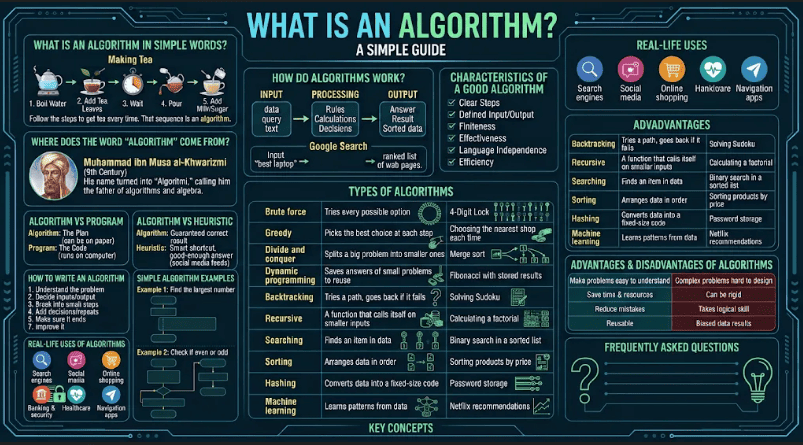
An algorithm is a finite, step-by-step set of clear instructions that turns an input into a useful output. It works like a recipe: follow the steps in order and you reach the result. Computers, phones, search engines and even people use algorithms every day.
What Is an Algorithm in Simple Words?
Think about making tea. You boil water, add tea leaves, wait, pour, and add milk or sugar. Follow those steps and you get tea every time. That sequence is an algorithm.
In computer science, the idea is the same, only the “recipe” is written for a machine. The algorithm definition has three parts: it takes some input (data), follows defined steps (logic), and gives an output (result). It must also stop at some point instead of running forever.
Where Does the Word “Algorithm” Come From?
The word comes from the name of Muhammad ibn Musa al-Khwarizmi, a Persian mathematician from the 9th century. His books on calculation were translated into Latin in the 12th century, and his name turned into “Algoritmi.” Over time this became the word we use today. This is why he is often called the father of algorithms, and also of algebra.
How Do Algorithms Work?
Every algorithm follows the same basic flow:
- Input: The algorithm receives data, such as numbers, text or a search query.
- Processing: It applies rules, comparisons and calculations to that data.
- Output: It returns an answer, a decision or a sorted result.
For example, when you search for “best laptop” on Google, the search algorithm takes your words as input, checks thousands of signals about web pages, and returns a ranked list as output.
Characteristics of a Good Algorithm
A proper algorithm should have these qualities:
- Clear steps: Each instruction has only one meaning.
- Defined input and output: You know what goes in and what comes out.
- Finiteness: It ends after a limited number of steps.
- Effectiveness: Every step is simple enough to actually be carried out.
- Language independence: The logic works whether you code it in Python, Java or on paper.
- Efficiency: It uses as little time and memory as possible.
Types of Algorithms
| Type | How it works | Everyday example |
|---|---|---|
| Brute force | Tries every possible option | Guessing a 4-digit lock code |
| Greedy | Picks the best choice at each step | Choosing the nearest shop each time |
| Divide and conquer | Splits a big problem into smaller ones | Merge sort |
| Dynamic programming | Saves answers of small problems to reuse | Fibonacci with stored results |
| Backtracking | Tries a path, goes back if it fails | Solving Sudoku |
| Recursive | A function that calls itself on smaller inputs | Calculating a factorial |
| Searching | Finds an item in data | Binary search in a sorted list |
| Sorting | Arranges data in order | Sorting products by price |
| Hashing | Converts data into a fixed-size code | Password storage |
| Machine learning | Learns patterns from data | Netflix recommendations |
Algorithm vs Program: What Is the Difference?
An algorithm is the plan, and a program is the code that carries out the plan. The same algorithm can be written in many programming languages. Also, an algorithm can exist on paper, while a program only runs on a computer.
Algorithm vs Heuristic
An algorithm gives a guaranteed correct result if you follow it. A heuristic is a smart shortcut that gives a good-enough answer when a perfect one is too slow or does not exist. Many social media feeds are called “algorithms,” but they really rely on heuristics, because there is no single “correct” post to show you.
How to Write an Algorithm: Step by Step
- Understand the problem clearly.
- Decide the inputs and the expected output.
- Break the work into small, simple steps.
- Add decisions (if/else) and repeats (loops) where needed.
- Make sure it ends.
- Test it with a few sample inputs.
- Improve it if a step is wasted or unclear.
Simple Algorithm Examples
Example 1: Find the largest number in a list
Start
Take the first number as "largest"
Check each remaining number
If a number is bigger than "largest", replace it
After the last number, show "largest"
End
Example 2: Check if a number is even or odd
Start
Input number N
If N divided by 2 leaves remainder 0, print "Even"
Otherwise, print "Odd"
End
Ways to Represent an Algorithm
- Plain language: Written like normal sentences.
- Pseudocode: Code-like text without strict syntax.
- Flowchart: Shapes and arrows that show the flow.
- Programming code: Python, Java, C++ and others.
How Do We Measure an Algorithm?
Two things matter: time complexity (how running time grows as data grows) and space complexity (how much memory it needs). Programmers describe these using Big O notation, such as O(n) or O(log n). A binary search, for example, is much faster than checking items one by one in a large sorted list.
Real-Life Uses of Algorithms
- Search engines: Rank web pages for your query.
- Social media: Decide which posts and videos you see first.
- Online shopping: Suggest products and detect fake reviews.
- Banking and security: Encrypt payments and flag suspicious activity.
- Healthcare: Help analyze scans and spot patterns in medical data.
- Navigation apps: Find the fastest route using live traffic.
Algorithms in AI and Machine Learning
Traditional algorithms follow fixed rules written by a person. Machine learning algorithms are different, because they learn patterns from data and improve with experience. Modern AI tools like chatbots and image generators are built on such learning algorithms, which is why understanding the basics helps you understand AI too. For a deeper look, read our guide on [INTERNAL LINK 1: Artificial Intelligence / Machine Learning article].
Advantages and Disadvantages of Algorithms
| Advantages | Disadvantages |
|---|---|
| Make problems easy to understand | Complex problems need long, hard-to-design steps |
| Save time and resources | Can be rigid and not adapt to new situations |
| Reduce mistakes | Writing a good one takes logical skill |
| Reusable in many programs | Biased data can give biased results |
Why Should You Learn Algorithms?
Learning algorithms builds problem-solving and logical thinking. It is also the base of programming, data science and AI careers. If you are just starting, begin with [INTERNAL LINK 2: Programming basics / Python for beginners article] and then move to [INTERNAL LINK 3: Data structures / Big O notation article].
Frequently Asked Questions
What is an algorithm in one line?
It is a finite list of clear steps that solves a problem or completes a task.
What is an example of an algorithm in daily life?
A cooking recipe, the steps to withdraw cash from an ATM, or the route a GPS app picks.
Who invented the algorithm?
The concept is ancient, but the word comes from al-Khwarizmi, whose 9th-century work shaped it. Ada Lovelace wrote the first algorithm meant for a computer in the 1840s.
What are the main types of algorithms?
Brute force, greedy, divide and conquer, dynamic programming, backtracking, recursive, searching, sorting, hashing and machine learning algorithms.
What is the difference between an algorithm and a flowchart?
An algorithm is the set of steps, while a flowchart is a picture of those steps.
Can an algorithm run forever?
By definition, a proper algorithm must finish. A process that never ends is usually a bug or a different kind of system.
Conclusion
An algorithm is simply a clear plan for solving a problem step by step. From tea recipes to Google search and AI, algorithms sit behind almost everything digital. Once you understand input, steps, output and efficiency, the rest becomes much easier to learn.