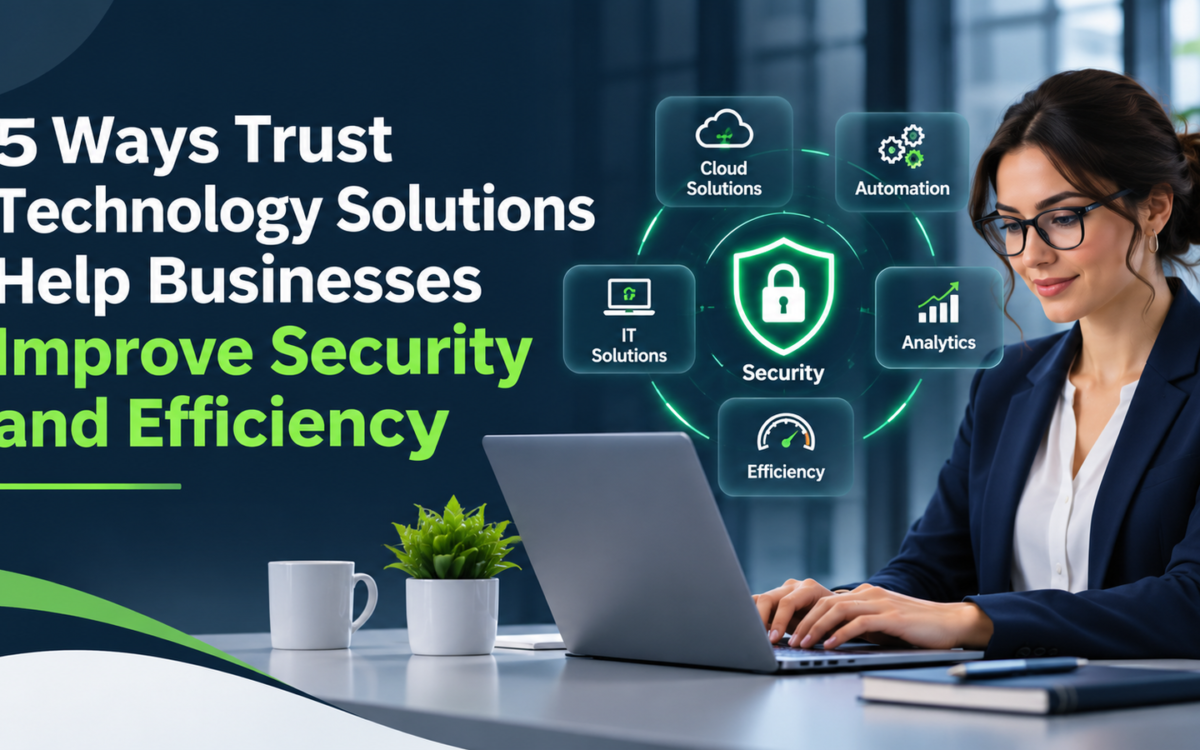
5 Ways Trust Technology Solutions Help Businesses Improve Security and Efficiency

Technology plays an important role in how modern businesses operate. Companies depend on digital tools to manage information, communicate with customers, support employees, and protect important data. However, keeping these systems reliable and secure requires proper planning and ongoing attention.
**Trust technology solutions** can help organizations address these needs through services such as IT consulting, cybersecurity, cloud computing, automation, data analytics, and managed IT support.
Rather than adopting technology simply because it is popular, businesses should focus on solutions that address their operational challenges and support long-term goals.
## What Are Trust Technology Solutions?
Trust technology solutions refers to technology services and resources that help organizations improve their digital infrastructure, strengthen security, and manage business operations.
These solutions may include:
– IT consulting and infrastructure management
– Cybersecurity and data protection
– Cloud computing and migration
– Artificial intelligence and automation
– Data analytics and business intelligence
– Enterprise IT modernization
– Managed IT services
– System integration and technical support
The exact services depend on an organization’s size, industry, security requirements, and operational priorities.
## 1. Improve Business Operations Through Technology
Outdated systems and disconnected applications can slow down everyday business activities. Employees may spend unnecessary time handling repetitive tasks, searching for information, or switching between different platforms.
Technology consulting can help businesses identify these problems and determine where improvements are needed.
For example, integrating business applications can make it easier for departments to share information. Updating outdated infrastructure can also improve system performance and reduce interruptions.
The objective is to make technology work alongside existing business processes rather than create additional complexity.
## 2. Strengthen Cybersecurity and Data Protection
Cybersecurity is an important concern for organizations that store customer information, financial records, employee data, and confidential business documents.
A single security incident can interrupt operations and damage customer confidence. Businesses therefore need appropriate safeguards to reduce their exposure to cyber threats.
Technology solutions may include:
Also read: How Growing Businesses Protect Profit Margins During Economic Uncertainty
– Network security and monitoring
– Identity and access management
– Endpoint protection
– Data backup and recovery
– Security risk assessments
– Employee cybersecurity awareness
– Incident response planning
No single tool can prevent every security incident. Organizations should combine technical controls, employee training, clear policies, and regular security reviews.
## 3. Use Cloud Computing to Support Flexible Operations
Cloud computing allows organizations to access applications, storage, and computing resources through internet-based platforms.
It can reduce dependence on certain physical systems and support collaboration between employees working from different locations.
Businesses may use cloud services for file storage, application hosting, data backup, communication, and business operations.
However, cloud adoption requires careful planning. Organizations should consider access permissions, data protection, regulatory requirements, service costs, and recovery procedures before moving important systems.
A suitable cloud strategy helps businesses select services that match their needs while maintaining appropriate security controls.
## 4. Increase Productivity With Automation and AI
Many business processes involve repetitive activities that take time away from more important work.
Automation can help manage tasks such as data entry, report generation, appointment reminders, document processing, and routine notifications.
Artificial intelligence can also support certain activities, including information analysis, customer service assistance, and workflow management.
However, businesses should evaluate these technologies before implementation. They need to consider accuracy, privacy, employee requirements, integration, and the level of human oversight each process requires.
When organizations apply automation to suitable tasks, employees can spend more time on work that requires judgment, communication, and problem-solving.
## 5. Prepare IT Infrastructure for Future Growth
Technology requirements often change as businesses expand. More employees, customers, applications, and locations can place additional pressure on existing systems.
IT modernization helps organizations review their current infrastructure and identify areas that need improvement.
Also read: How to Choose the Best SEO Agency in Pakistan (2027)
This process may involve upgrading hardware, replacing outdated software, improving network capacity, moving selected workloads to the cloud, or integrating disconnected applications.
Planning ahead can help businesses avoid rushed upgrades and unexpected costs.
A scalable technology environment should support current operations while leaving room for future changes.
## Choosing the Right Technology Solutions Provider
Selecting a technology provider requires more than comparing prices. Businesses should understand what services a provider offers and whether those services match their requirements.
Consider the following factors:
Relevant experience: Look for experience with the technologies and challenges that matter to your organization.
Clear service scope: Understand what the provider will deliver, which responsibilities remain with your team, and what ongoing support includes.
Security practices: Ask how the provider approaches data protection, access management, risk assessment, and incident response.
Communication: Choose a provider that explains technical issues clearly and keeps stakeholders informed.
Scalability: Consider whether the proposed solutions can support changes in business size and operational requirements.
A reliable provider should recommend practical solutions based on business needs rather than encourage unnecessary technology purchases.
The right choice depends on the organization’s requirements. Some businesses need routine technical support, while others need a broader approach that includes modernization, security, and strategic planning.
## Why a Practical Technology Strategy Matters
Buying new software or upgrading infrastructure does not automatically improve business performance. Organizations need to understand how each technology investment supports their objectives.
Also read: What Is Crackstube? Is It Safe, and Is It Legit? (2026 Guide)
A practical technology strategy begins with an assessment of current systems, employee requirements, security risks, and future plans.
Businesses can then prioritize improvements based on their urgency, cost, and expected value.
Regular reviews also help organizations identify outdated tools, new security concerns, and opportunities to improve existing workflows.
## Frequently Asked Questions
### What are trust technology solutions used for?
Trust technology solutions can support IT operations, cybersecurity, cloud computing, automation, data management, system integration, and technology modernization.
### Can small businesses benefit from technology solutions?
Yes. Small businesses can use cloud platforms, managed IT support, cybersecurity tools, and automation to improve operations without maintaining a large internal technology department.
### How do technology solutions improve business security?
They can help protect systems and information through access controls, network monitoring, endpoint security, backups, employee training, and incident response planning.
### Is cloud computing suitable for every business?
Cloud computing can benefit many organizations, but suitability depends on security requirements, costs, regulatory obligations, existing systems, and operational needs.
### How often should businesses review their technology?
Organizations should review their technology regularly and whenever major changes occur, such as business expansion, new security requirements, system upgrades, or changes in employee needs.
## Final Thoughts
Technology should help businesses work more efficiently, protect important information, and respond to changing requirements. The right approach depends on selecting services that solve real problems and fit the organization’s long-term plans.
Trust technology solutions can support these goals through IT consulting, cybersecurity, cloud computing, automation, data analytics, and managed IT services.
By reviewing existing systems and making informed technology decisions, organizations can build a more reliable digital environment and prepare for future business needs.