Zanus AI System for Healthcare: Features, Pricing & HIPAA

In this article
- What Is the Zanus AI System for Healthcare?
- The Three Parts of Zanus AI, Explained Simply
- What Can Zanus AI Actually Do in a Clinic?
- Does Patient Data Stay On-Premises? The Real Answer
- Is Zanus AI HIPAA Compliant?
- How Much Does Zanus AI Cost in 2026?
- How Long Does Setup Take?
- Zanus AI vs Janus Health, Zana AI and Zanium
- Which Practices Should Choose Zanus AI?
- 12 Questions to Ask Before You Sign
- Frequently Asked Questions
- Start Your Evaluation Now
Healthcare teams want the speed of AI, but most cannot paste patient notes into a public chatbot. That gap is exactly where the Zanus AI system for healthcare positions itself. Instead of renting AI from the cloud by the user, a practice buys a private AI server, plugs it into its own network and lets staff use AI on internal records without that data leaving the building.
This guide explains what the Zanus AI system for healthcare really does, which parts run on-premises and which run in the cloud, what it costs, how HIPAA fits in, and how to decide whether it is right for your clinic, dental office or hospital department.
What Is the Zanus AI System for Healthcare?
Zanus AI is a South Florida company that sells private AI systems to businesses, with a dedicated line of products for healthcare and medical organizations. Its healthcare offer is built around one main idea: keep protected health information (PHI) on hardware the practice controls.
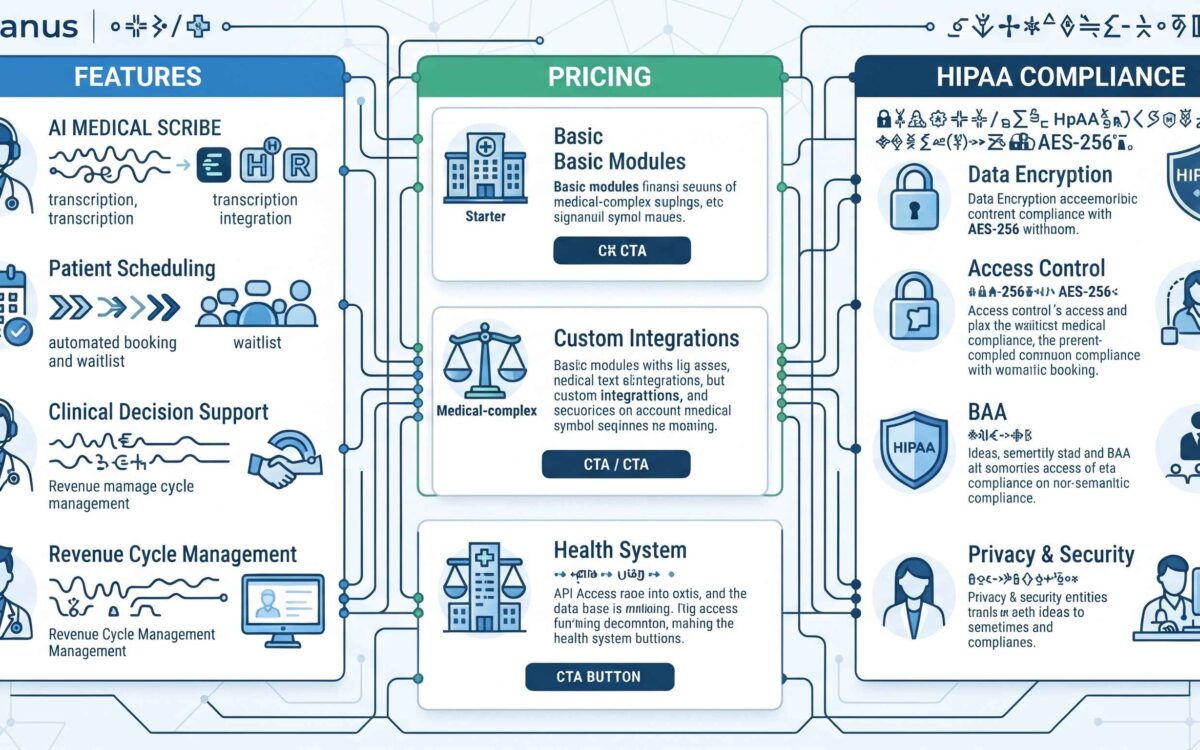
According to Zanus AI’s healthcare page, the system includes more than 15 built-in healthcare modules, including:
- Clinical documentation support
- Patient follow-up and scheduling
- Patient records search
- A patient portal chatbot
- Medical document and compliance report generation
- Patient outreach campaigns
- Task and deadline tracking
- Secure clinical messaging
- Staff training, which the company says cuts onboarding “from weeks to days”
Zanus AI is not a diagnostic tool. It is a private workflow and documentation system for healthcare teams.
Simple definition: On-premises AI means the AI model runs on a physical server inside your building, not on a vendor’s cloud. Cloud AI means your data travels over the internet to the vendor’s servers to be processed.
The Three Parts of Zanus AI, Explained Simply
Most confusion about the Zanus AI system for healthcare comes from the fact that the company sells three different things. Here is how they fit together:
| Product | What It Does | Where It Runs |
|---|---|---|
| Back Office AI | Internal work: protocols, charts, referral letters, prior-auth packets, report drafting | On the practice’s own server, or a private hosted tenant |
| Front Office AI | Patient-facing: phone answering, website chat, email, web forms, booking | Hosted in the cloud, or a dedicated private environment |
| AI Servers | The physical hardware that runs Back Office AI locally | Inside your building, connected to your network |
🔑 Key insight: “On-premises” applies to the Back Office and the AI Server. The Front Office that answers patient calls is a hosted service. If your compliance team requires every piece of patient data to stay in the building, you need to discuss the Front Office separately with Zanus AI.
What Can Zanus AI Actually Do in a Clinic?
Here are the real workflows Zanus AI describes for healthcare, grouped by who uses them.
For clinicians: faster paperwork
- Referral letters: The system drafts a referral letter using details pulled from the patient’s chart.
- Visit summaries: It turns clinical notes into patient-friendly summaries.
- Prior-authorization packets: It prepares prior-auth requests with relevant record excerpts attached, using the practice’s own letterhead and templates.
- Record summaries: It summarizes long records before a visit.
For staff: instant answers from internal documents
Staff can ask questions about clinical protocols, formularies and office policies, and the answer links back to the source document. This works like a private search engine for the practice’s own files.
For patients: 24/7 front desk
The Front Office AI answers calls, chats and emails around the clock, books appointments from the practice calendar and transfers callers to staff. Zanus AI says it supports 40 languages. When the answer is not in the approved knowledge base, it takes a message, schedules a callback or transfers the caller instead of guessing.
The safety rule: a clinician approves everything
On Zanus AI’s Back Office healthcare page, AI-drafted documents go into an “Output awaiting review” queue, and nothing clinical is sent until a clinician approves it. The company also states the tool is not a diagnostic device. This human-in-the-loop design is important for patient safety and liability.
The AI drafts. The clinician decides. That rule is the heart of safe healthcare AI.
Does Patient Data Stay On-Premises? The Real Answer
Many summaries online, including some AI-generated answers, describe Zanus AI as entirely on-premises. The full picture is more detailed:
- Back Office AI on an AI Server: Patient records, protocols and internal documents are processed on the server in your building. Zanus AI says the server can even run air-gapped, meaning fully offline.
- Back Office AI in a private tenant: A hosted but isolated option for practices that do not want hardware on site.
- Front Office AI: Patient calls and chats are handled by hosted software. For organizations with strict policies, Zanus AI offers a dedicated private environment instead of shared hosting.
There is another practical point. Phone calls reach any AI receptionist through a phone carrier, so the real privacy questions for call handling are: where are recordings and transcripts stored, who can read them, and for how long?
Is Zanus AI HIPAA Compliant?
This is the most searched question about the Zanus AI system for healthcare, so it deserves a careful answer.
Zanus AI’s healthcare marketing uses strong wording, such as “100% HIPAA-Compliant.” Elsewhere, its pages use softer phrases like “HIPAA-ready architecture,” “supports HIPAA compliance” and “HIPAA-conscious.” That difference matters, because no software is HIPAA compliant on its own. HIPAA compliance depends on how a practice configures, uses and documents a system.
Simple definition: A Business Associate Agreement (BAA) is a contract that HIPAA requires when a vendor handles PHI on your behalf. It defines how the vendor protects that data and what happens if there is a breach.
Here is how to think about it:
- Fully on-premises, air-gapped server: If the vendor never accesses your PHI, your risk profile is lower, but you still need your own HIPAA policies, access controls and audit logs.
- Private tenant or hosted Front Office: The vendor or its providers may touch PHI, so you should request a signed BAA before going live.
- Remote support and updates: Ask whether Zanus AI staff ever connect to your server, and how that access is logged.
The U.S. Department of Health and Human Services explains business associate rules on its official HIPAA business associates guidance page. Review it with your compliance officer before signing any AI contract.
⚡ Quick win this week: Email Zanus AI and ask three things in writing: (1) Will you sign a BAA for every product we use? (2) Does anyone at Zanus AI ever access our server or data? (3) Where are call recordings and transcripts stored, and for how many days? The answers will tell you more than any sales demo.
Zanus AI also includes role-based access control (RBAC), which means each staff member only sees the data their role allows. For example, front desk staff can see schedules without seeing clinical notes.
How Much Does Zanus AI Cost in 2026?
Zanus AI prices per company, not per user. Here are the published figures from its pricing pages as of September 2026:
| Plan or Item | Price | What You Get |
|---|---|---|
| AI Phone | $99/month | One number, one staff phone, about 100 minutes of calls |
| AI Answer | $329/month | Phone, chat, email, web forms, booking and avatar, with two staff phones |
| Extra staff phone | $49/month each | Additional transfer line |
| Extra call minutes | About $0.39/minute | Paid in credits at 1 cent each, about 39 credits per minute |
| Done-for-You Launch | $995 one-time | Optional setup help for AI Answer |
| AI Private | From $2,495/month (billed yearly) | Complete Front Office on its own isolated environment |
| AI Software for Small Business | $19,900 one-time license | Runs on a Zanus AI Server |
| AI Servers | Custom quote | Sized to the practice; request a demo for pricing |
Yearly billing on the monthly plans works out to 12 months for the price of 10, and there is a 7-day free trial with no credit card required for the Front Office. Prices change often, so always confirm on the official Zanus AI website.
Is a one-time AI server cheaper than cloud AI?
Zanus AI argues that practices commonly spend $3,000 to $15,000 per month on software subscriptions, and that cloud AI tools cost $30 to $75 per user per month per tool. It claims most practices recoup the cost in 3 to 6 months. Treat that payback figure as a vendor estimate and run your own numbers.
Example calculation: A dental group with 40 staff paying $50 per user per month for two cloud AI tools spends 40 × $50 × 2 = $4,000 per month, or $48,000 per year. If a private server plus software costs less than that over two to three years, the on-premises model can make financial sense, especially because there are no per-seat fees.
Zanus AI also notes that AI hardware may qualify for an IRS Section 179 deduction in the United States, but you should confirm this with a tax professional.
How Long Does Setup Take?
Based on Zanus AI’s own pages:
- Server delivery: The AI Server arrives pre-configured.
- Connection: It connects to your network with a single Ethernet cable.
- Integration: It links to existing systems through HL7, FHIR and API connectors. No specific EHR brands are named publicly, so bring your EHR details to the demo.
- Go-live: The company says most practices are operational in 3 to 5 business days.
For the Front Office, setup is self-serve. Its assistant reads your website, asks about anything missing and runs test calls before the line goes live. You keep your existing number by forwarding it.
Simple definitions: HL7 and FHIR are standard formats that healthcare systems use to exchange patient data. An EHR (electronic health record) is the main software where a practice stores patient charts.
Zanus AI vs Janus Health, Zana AI and Zanium
Several healthcare AI companies have similar names, and search engines often mix them up. Here is a quick guide:
| Company | Main Focus |
|---|---|
| Zanus AI | Private on-premises AI servers, back-office automation and an AI receptionist |
| Janus Health (JanusIQ) | AI for hospital revenue cycle management, such as claims and prior authorizations |
| Zana AI | Voice AI for digital health companions and voice-based health monitoring |
| Zanium | Clinical workflow platform for post-acute and home health care |
If you are searching for a revenue cycle or billing platform, you may actually be looking for Janus Health, not Zanus AI.
Which Practices Should Choose Zanus AI?
Zanus AI is a strong fit if:
- You have about 5 to 200 staff, the range Zanus AI targets.
- You run a dental, chiropractic, physical therapy, behavioral health, dermatology, ophthalmology, urgent care, surgical or veterinary practice.
- Your policy says patient records must never be processed by public cloud AI.
- You are tired of paying per-seat fees for multiple AI tools.
- You want a 24/7 AI front desk with a published monthly price.
Consider alternatives if:
- You need a deep, certified integration with a specific EHR such as Epic, and Zanus AI cannot confirm it in writing.
- Your main need is billing and claims automation, where revenue cycle tools may fit better.
- You need clinical diagnosis support. Zanus AI states it is not a diagnostic device.
- You have no IT support to manage on-site hardware.
Buy the AI that matches your biggest daily pain, not the one with the most features.
12 Questions to Ask Before You Sign
Use this checklist during your Zanus AI demo, or with any healthcare AI vendor:
- Will you sign a BAA for every product we use?
- Which EHR systems have you already integrated with, and can we speak to a reference customer?
- Does anyone at your company access our server remotely, and is that access logged?
- Where are call recordings and transcripts stored, and for how long?
- What happens to our data if we cancel?
- Which AI models run on the server, and how are they updated?
- What are the full hardware specifications and the server price?
- What independent security audits or certifications do you hold?
- How does the clinician review queue work, and can we set approval rules?
- What is the support response time if the server goes down?
- How many minutes of calls does a practice our size typically use per month?
- Can we run a pilot on real, non-sensitive workflows before full rollout?
Frequently Asked Questions
What is the Zanus AI system for healthcare?
It is a private AI platform for medical practices that runs on a dedicated server inside the practice. It helps with documentation, internal questions, referral letters and prior-auth packets, while a separate cloud product handles patient calls and bookings.
Is Zanus AI HIPAA compliant?
Zanus AI says its system is built for HIPAA, but compliance depends on how your practice uses it. Ask for a signed BAA for any product that may touch patient data.
Does Zanus AI work without the internet?
Yes, for the Back Office. Zanus AI says its server supports air-gapped, fully offline operation. The Front Office phone and chat product needs a connection because it is hosted.
How much does Zanus AI cost?
AI Phone starts at $99 per month and AI Answer at $329 per month. On-premises AI Servers are quoted per practice, and a small business software license is listed at $19,900.
Can Zanus AI diagnose patients?
No. Zanus AI states its healthcare product is not a diagnostic device. It supports documentation and workflows, and clinicians approve all clinical output.
Is Zanus AI the same as Janus Health?
No. Janus Health focuses on revenue cycle automation for hospitals, while Zanus AI focuses on private, on-premises AI and front-desk automation.
Start Your Evaluation Now
The Zanus AI system for healthcare offers a clear promise: AI that works on patient data without sending it to public cloud services. Whether that promise fits your practice depends on your privacy rules, your EHR, your budget and your IT capacity. Here is your action plan:
- List your top three time-wasters, such as phone calls, referral letters or prior-auth paperwork.
- Calculate your current AI and software spend per month, including per-seat fees.
- Test the Front Office with the 7-day free trial on a non-critical line.
- Book a demo and bring your EHR details and the 12 questions above.
- Get the BAA and data-access answers in writing before any patient data is involved.
- Run a small pilot for two to four weeks and measure hours saved.
- Decide with numbers, comparing a one-time server cost with your yearly cloud AI bill.
The practices that win with AI are not the ones that buy first. They are the ones that test carefully and choose with clear data. Start this week.