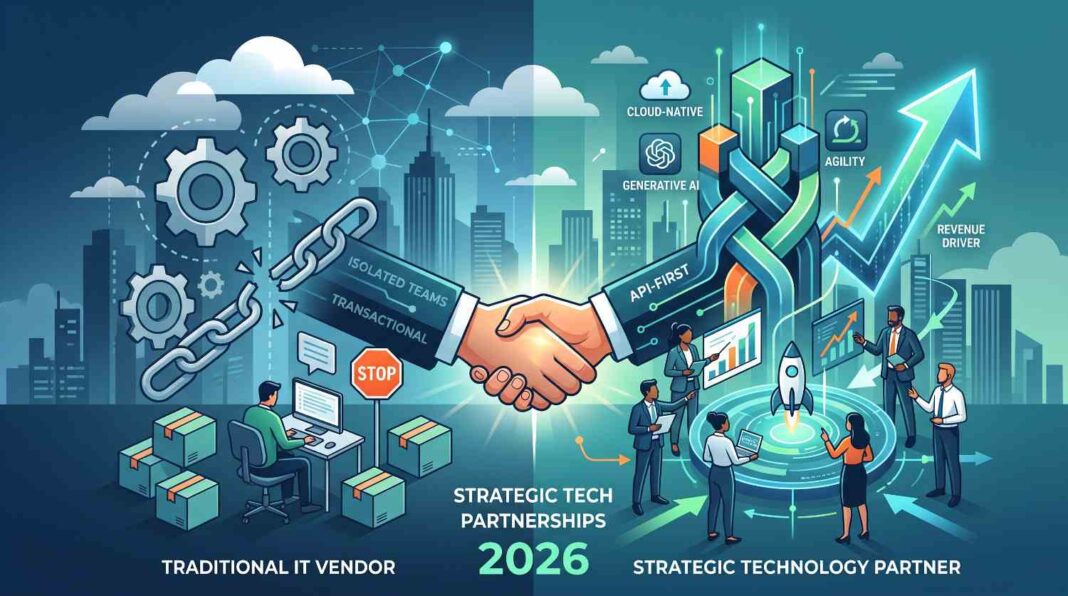
The enterprise tech ecosystem in 2026 no longer rewards isolated, self-contained development teams. Rapid shifts across cloud-native architecture, generative workflows, and API-first business models demand more agility than most internal departments can sustain alone.
Navigating this pace requires moving beyond ordinary outsourcing. High-performing organizations scale through strategic technology partnerships—collaborative alliances that combine specialized technical execution with core commercial goals.
Redefining the Alliance: Vendors vs. True Technology Partners
Traditional vendor relationships focus on transactional code delivery against a static ticket queue. When requirements shift or technical debt builds, the risk sits entirely with the client.
| Traditional IT Vendor | Strategic Technology Partner |
|---|---|
| Focuses purely on task completion and logged billable hours | Aligns software architecture directly with commercial ROI |
| Operates with rigid, ticket-based scopes | Adapts roadmaps dynamically using Agile sprint cycles |
| Keeps client leadership insulated from technical roadblocks | Co-owns technical debt, data security, and scalability risks |
| Hands off source code at milestone sign-off | Builds sustainable architectures meant for long-term ownership |
Treating development as an integrated partnership turns technical infrastructure from an operational cost center into a direct revenue driver.
Core Mechanics Fueling Rapid Business Expansion
Compressed Time-to-Market
Internal hiring cycles for niche engineers frequently stretch across quarters. A mature tech partner brings pre-assembled, synchronized engineering pods to day one of a build. This cuts development lag and lets products hit production well ahead of direct market competitors.
On-Demand Access to High-Scarcity Capabilities
Maintaining full-time internal experts across modern data engineering, distributed microservices, and hardened cloud security strains operating budgets. Collaborative alliances allow companies to inject high-tier engineering specialists into critical sprints precisely when needed, bypassing massive overhead.
Capital Efficiency and Operational Flexibility
Fixed payroll restricts dynamic resource reallocation. Partner-driven engineering models allow leadership to throttle development velocity up or down based on current market demands, preserving working capital during uncertain economic cycles.
Frictionless System and API Integration
Modern businesses rely on interconnected data flows across ERPs, CRMs, and customized customer portals. Partners with deep systems-integration expertise bridge disparate legacy databases with modern SaaS layers, preventing data silos that kill operational productivity.
Operationalizing AI and Infrastructure in 2026
Deploying enterprise AI today requires far more than wrapping public LLM endpoints. It demands proprietary data pipelines, rigorous vector storage, and zero-leakage security boundaries.
-
Predictive Workflow Automation: Building tailored logic that trims administrative overhead without exposing internal trade secrets.
-
Elastic Cloud Workloads: Designing infrastructure that scales dynamically during usage spikes while pruning idle compute nodes to prevent cloud bill shock.
-
Proactive Security Hardening: Embedding continuous vulnerability testing, secrets management, and automated regulatory compliance checks straight into CI/CD pipelines.
Vetting Framework: Selecting an Enterprise-Grade Partner
Selecting the wrong provider drains capital and buries teams under unmaintainable codebases. Evaluate prospective firms using strict operational benchmarks:
-
Production-Grade Delivery Portfolio: Review case studies focusing on uptime, system load handling, and clean documentation—not polished marketing decks.
-
Synchronized Communication Norms: Require shared sprint planning, transparent sprint backlogs, and real-time Git repository visibility to verify momentum.
-
Rigorous IP and Security Safeguards: Establish strict contractual clauses covering source code ownership, NDA terms, and continuous compliance checks (SOC 2, ISO, GDPR) before work starts.
Tracking the Direct ROI of Tech Alliances
Measuring partnership efficacy goes far beyond tracking commit counts or closed support tickets. Leadership must track hard operational indicators:
-
Deployment Frequency: The speed at which clean, stable features reach active users.
-
Mean Time to Recovery (MTTR): How rapidly production incidents are isolated and patched without service disruption.
-
Resource Cost-to-Output Ratio: Development spend measured directly against new customer acquisitions or platform efficiency gains.
Sustainable business scaling in 2026 hinges on architectural leverage. By integrating seasoned technical partners into your core roadmap, your business secures the engineering velocity required to dominate market share while remaining focused on core commercial strategy.