Modern enterprises are adopting generative algorithms and autonomous workflows at a breakneck pace. Yet, buying or building sophisticated models is no longer the true operational bottleneck. The hard reality is that AI transformation is a problem of governance, where technology advances far quicker than internal guardrails, organizational accountability, and regulatory structures can adapt.
Establishing oversight cannot mean suffocating the business with bureaucratic delays. Winning companies treat enterprise governance as an accelerator—giving teams clear boundaries within which they can deploy, iterate, and innovate with confidence.
Introduction
The Enterprise AI Paradox
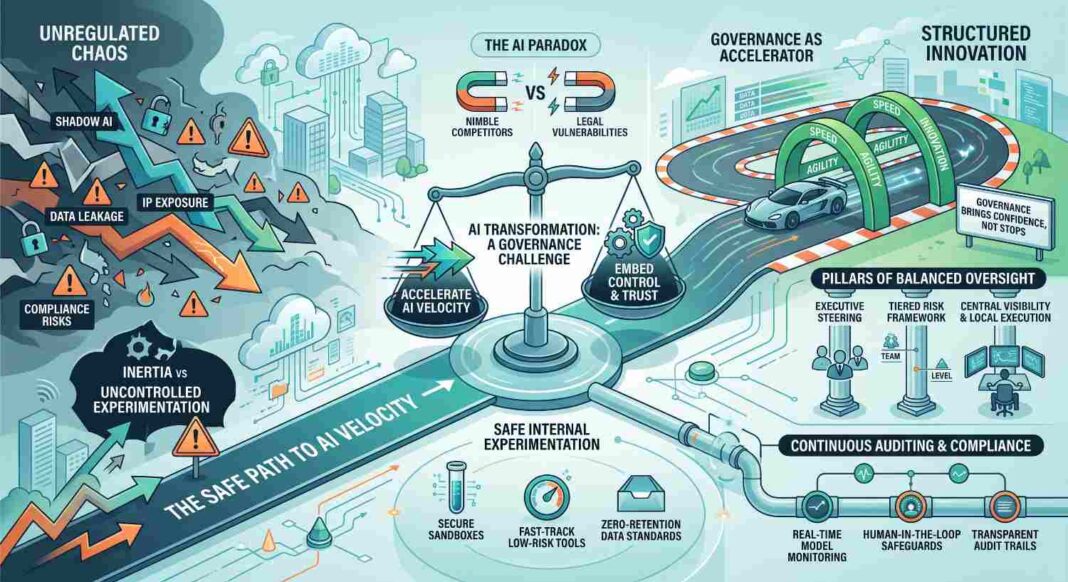
Organizations face a conflicting dynamic: business units that hesitate to adopt AI risk being outpaced by nimble competitors, yet unregulated deployment creates severe technical and legal vulnerabilities. Most executives find themselves caught between total inertia and uncontrolled experimentation.
Balancing Velocity and Control
Sustainable digital scaling requires a shift from reactive prohibition to active enablement. True governance acts like the brakes on a race car—it is not there to stop the vehicle, but to give the driver the ability to travel at top speeds safely.
Risks of Shadow AI
When companies do not offer clear, secure channels for modern tooling, employees inevitably rely on unapproved consumer platforms to finish their daily work.
Unchecked Corporate Data Leakage
Staff paste sensitive spreadsheets, customer communications, and financial summaries directly into public chat interfaces. Without corporate protections, that proprietary data often enters public training sets.
Proprietary Intellectual Property Exposure
Engineers leveraging unsanctioned code assistants risk exposing core application logic, proprietary trade secrets, and internal API credentials to external servers.
Looming Regulatory Compliance Fines
Enforcement bodies worldwide penalize unregulated automated profiling and negligent data mishandling. Shadow AI workflows strip enterprises of the auditable paper trails required during standard legal inquiries.
Pillars of Balanced Oversight
Constructing a durable framework demands structured operating policies rather than ad-hoc memos.
| Governance Pillar | Strategic Purpose | Enterprise Impact |
|---|---|---|
| Clear Executive Ownership | Designates dedicated cross-functional leaders | Eliminates organizational confusion and finger-pointing |
| Tiered Risk Frameworks | Categorizes use cases by exposure level | Prevents low-risk tasks from facing high-risk delays |
| Centralized Visibility | Provides unified telemetry over tool usage | Balances uniform compliance with localized team autonomy |
Defining Clear Executive Ownership
Accountability cannot sit solely with IT or Legal. A unified steering committee—spanning security, legal, product, and engineering—must own AI deployment policies and review cadences.
Tiered Risk Assessment Frameworks
Not every internal application carries the same downside. Drafting a basic meeting summary carries minimal operational risk, whereas deploying automated credit scoring or processing medical records involves high legal exposure. Tiered scoring ensures minor projects move forward without months of compliance reviews.
Centralized Visibility, Local Execution
Corporate leadership needs complete observability over approved tool stacks, while business units retain the flexibility to choose specific workflows that address their daily departmental needs.
Safe Internal Experimentation Zones
To eradicate shadow AI, companies must provide secure, superior alternatives that developers and operators actually want to use.
-
Secure Enterprise Sandboxing Protocols: Isolate experimentation inside private cloud environments, detached from production databases, where developers can stress-test applications without risking operational leaks.
-
Fast-Tracking Approved Low-Risk Tools: Establish expedited paths for tools that do not process customer data, ensuring employees do not bypass IT approval queues out of frustration.
-
Zero-Retention Prompt Data Standards: Enforce vendor enterprise agreements guaranteeing that internal corporate prompts and queries are never retained, logged, or utilized to retrain external base models.
Continuous Monitoring and Compliance
Oversight must run continuously in background environments alongside operational models.
Automated Real-Time Model Auditing
Deploy continuous monitoring pipelines that track model drift, detect hallucinations, and flag latency degradations before faulty outputs impact external customers.
Enforcing Human-in-the-Loop Safeguards
Automate operational mechanics, but mandate certified human sign-off for critical decision points—such as automated hiring selections, payment routing, and legal contracts.
Transparent Diagnostic Audit Trails
Log inputs, system versions, and contextual outputs systematically. Should an algorithm produce an unexpected or biased result, engineering teams must possess the telemetry needed to recreate and resolve the issue.
Culture and Practical Adoption
Policies written in isolation on company intranets rarely translate to daily operational safety.
Upskilling Teams in AI
Train teams across core disciplines: effective prompt formulation, verification of AI responses, and identifying system anomalies. Confident teams rarely resort to unapproved external tools.
Driving Ethical Employee Ownership
Foster a company culture where employees actively evaluate AI tools for safety, report output hallucinations early, and take individual ownership of every piece of generated code or text they release.
Conclusion
People Ask
Innovation Backed by Integrity
Scaling artificial intelligence is ultimately an organizational discipline rather than an infrastructure purchase. Establishing structured risk tiers, building secure deployment sandboxes, and aligning technical leadership enables enterprises to capture the true velocity of AI without putting corporate integrity on the line.
What is the enterprise AI paradox?
The enterprise AI paradox occurs when companies face two conflicting pressures: hesitating to adopt AI risks falling behind agile competitors, but unregulated deployment exposes the business to serious technical and legal liabilities.
Why is AI transformation about governance?
AI transformation is primarily a governance issue because acquiring tools is easy, while establishing the necessary rules, internal accountability, and regulatory guardrails required to safely manage them lags behind.
What is workplace shadow AI?
Shadow AI happens when employees bypass corporate IT restrictions to use unapproved, consumer-grade AI tools for daily tasks, exposing proprietary data, internal code, and credentials to third-party platforms.
How does governance accelerate innovation?
Effective governance establishes clear operational boundaries, pre-approved toolpaths, and safe sandboxes. Rather than blocking projects, it allows teams to deploy and iterate rapidly without risking security or compliance breaches.
What is a tiered risk framework?
A tiered risk framework categorizes AI use cases by their potential operational and legal harm. Low-risk applications gain fast-tracked approval, while high-risk systems undergo thorough security reviews.
Why are enterprise sandboxes necessary?
Sandboxes provide secure, isolated private cloud environments where developers can test models without touching live customer databases, effectively preventing unauthorized data leaks.
What are zero-retention prompt standards?
Zero-retention standards are contractual agreements with AI vendors ensuring that corporate inputs, queries, and internal prompts are never saved, logged, or used to retrain public models.
Why require human-in-the-loop safeguards?
Human-in-the-loop protocols mandate that high-stakes outcomes—such as employment evaluations, financial transactions, and legal commitments—receive verified human review before final execution to prevent algorithmic errors.