Key Takeaways
- FUE removes individual follicular units, while FUT removes a narrow strip of hair-bearing scalp.
- FUE leaves small dot-like scars, and FUT leaves a linear donor scar.
- Neither procedure is automatically better for every patient.
- Donor density, graft needs, hair length, scalp laxity, and future hair loss should guide the decision.
- Natural-looking results rely heavily on hairline design and careful graft placement.
Choosing between FUE and FUT is not simply a matter of selecting the newest or most advertised procedure. Both are established methods for harvesting hair follicles for transplantation, and the better fit depends on your donor hair, the degree of thinning, preferred hairstyle, scalp characteristics, and long-term goals. For patients researching a hair transplant clinic Washington, DC, Millennium Medical – MD Hair Transplant provides information about FUE and FUT hair restoration, individualized treatment planning, and surgical options for people in Washington, DC, Maryland, and Northern Virginia. Its Chevy Chase practice focuses on evaluating each patient’s hair loss pattern and available donor supply before recommending an approach. A transplant can improve coverage in areas affected by certain types of hair loss, but it does not stop all future thinning. That is why the method used to collect grafts matters, but it is only one part of a sound treatment plan. Hairline design, graft placement, realistic density goals, and the protection of donor hair for the future are equally important.
Why The Choice Between FUE And FUT Matters
FUE and FUT differ mainly in how the surgeon obtains donor follicles from the back and sides of the scalp. After harvesting, both procedures involve preparing grafts and placing them into recipient sites in thinning or bald areas. The final appearance is therefore not determined by the harvesting method alone. For example, someone who keeps a very short fade may prioritize avoiding a linear scar, making FUE worth discussing. Someone with advanced hair loss who needs substantial coverage may be a stronger candidate for FUT if scalp laxity and donor characteristics are favorable. A consultation should also identify the cause of hair loss before surgery is considered.
FUE and FUT At A Glance
- Harvesting method:FUE removes follicular units one at a time with small punches. FUT removes a strip of donor scalp, which is then dissected into individual grafts.
- Scarring:FUE can leave scattered circular scars. FUT creates a line-shaped scar that may be concealed by surrounding hair.
- Closure:FUE does not involve a long donor incision. FUT requires the donor area to be closed with stitches or staples.
- Haircut flexibility:FUE may be preferred by people who want shorter donor-area hair. FUT may work well for those who plan to keep more length.
- Graft planning:Either method can support meaningful restoration, but FUT may be considered when a larger graft count is needed.
What Happens During An FUE Hair Transplant?
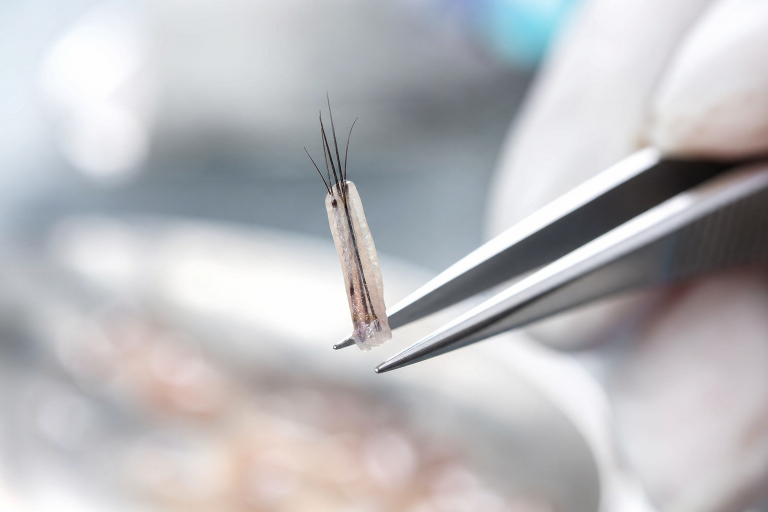
During FUE, the surgeon evaluates the donor area, maps the hairline and treatment zones, and administers local anesthesia. Individual follicular units are carefully extracted, sorted, and protected until they are placed. The surgeon then creates recipient sites at planned angles and directions before inserting the grafts. FUE is not scar-free. The small extraction sites heal as tiny scars, and visibility can vary according to punch size, healing, skin tone, donor density, and how closely the hair is cut. Removing too many follicles from one area can also create a thin or uneven donor appearance, which is why extraction planning is essential.
What Happens During An FUT Hair Transplant?
FUT begins with an assessment of donor density and scalp laxity. A narrow strip of hair-bearing scalp is removed from the donor area, and the incision is closed. Under magnification, the strip is divided into follicular unit grafts. The surgeon then creates recipient sites and places the grafts according to the treatment plan. FUT is a strip-based method, not an outdated procedure. Its primary trade-off is a linear scar and healing around the incision.
Which Method May Fit Different Hair Goals?
FUE May Be Worth Discussing If:
- You prefer short hairstyles and are concerned about a linear scar.
- You want to avoid a strip incision and donor-area closure.
- Your donor area has sufficient density for individual extraction.
- Your treatment area is small to moderate, or your plan calls for a limited session.
FUT May Be Worth Discussing If:
- You may need a larger number of grafts for planned coverage.
- You generally wear enough hair length to cover a donor scar.
- Your scalp has appropriate laxity for strip removal and closure.
- Your surgeon believes strip harvesting better supports your donor-management plan.
Scarring, Healing, And Hair Length
Both approaches create scars because both involve removing tissue from the scalp. FUE scars tend to be small and dispersed, while FUT leaves one linear scar. Neither scar pattern is universally invisible. Healing differs among patients, and scar appearance can be affected by genetics, wound care, hair density, skin characteristics, and haircut length. Redness, scabbing, tenderness, swelling, and temporary shedding can occur after either procedure. Patients should not judge an outcome in the first few weeks. Follow the clinic’s instructions for washing, sleeping, activity limits, medications, and follow-up visits.
How Graft Numbers And Donor Supply Affect The Plan
A graft is not the same as a single hair. One follicular unit may contain one, two, three, or more hairs. Comparing clinics by graft count alone can be misleading because hair caliber, curl pattern, contrast between hair and scalp, and the size of the thinning area all affect visible coverage.
- Single-hair grafts may be used near the front hairline for softness and natural irregularity.
- Multi-hair grafts can add density behind the hairline and in broader thinning zones.
- Donor follicles should be preserved for potential future needs.
- Advanced hair loss requires careful coverage priorities instead of promises of unlimited density.
Clinical discussion recognizes FUE and FUT as established harvesting methods, each with distinct benefits and limitations. Readers interested in the medical literature can review information on follicular unit extraction techniques for additional context.
Why Hairline Design Often Matters More Than The Method
A natural hairline is usually age-appropriate, slightly irregular, and designed with future thinning in mind. The surgeon must consider the graft angle, direction, spacing, and density to ensure the transplanted hair blends with existing hair. Even successful graft growth can look unnatural if the hairline is too low, too straight, or too dense for a patient’s age and projected pattern of loss.
Questions To Ask During A Consultation
- What is causing my hair loss, and is it stable enough for surgery?
- Which method do you recommend, and why does it fit my donor area?
- How many grafts are recommended, and what coverage can I realistically expect?
- Who performs the harvesting, site creation, and graft placement?
- What will my donor area likely look like after healing?
- How could future hair loss change the appearance of my result?
- Are medical treatments or other non-surgical options appropriate?
- What does the quoted fee include, including follow-up care?
Conclusion
FUE and FUT can both support natural-looking hair restoration when the procedure matches the patient’s donor supply, hair loss pattern, hairstyle, and long-term priorities. Look beyond marketing labels and compare scar patterns, graft needs, recovery, hairline planning, surgeon involvement, and future loss. A careful medical consultation is the best way to choose a realistic treatment plan. Understanding the benefits and limitations of each approach can help patients develop expectations based on their individual situation rather than general promises. The best results usually come from a personalized strategy that considers current hair loss, available donor hair, future progression, and overall goals for appearance and confidence.