Introduction
The world of technology and science is filled with terms that inspire curiosity, speculation, and wonder. One such phrase making its way into discussions about artificial intelligence and futuristic communication is “Nexus AlienSync.”
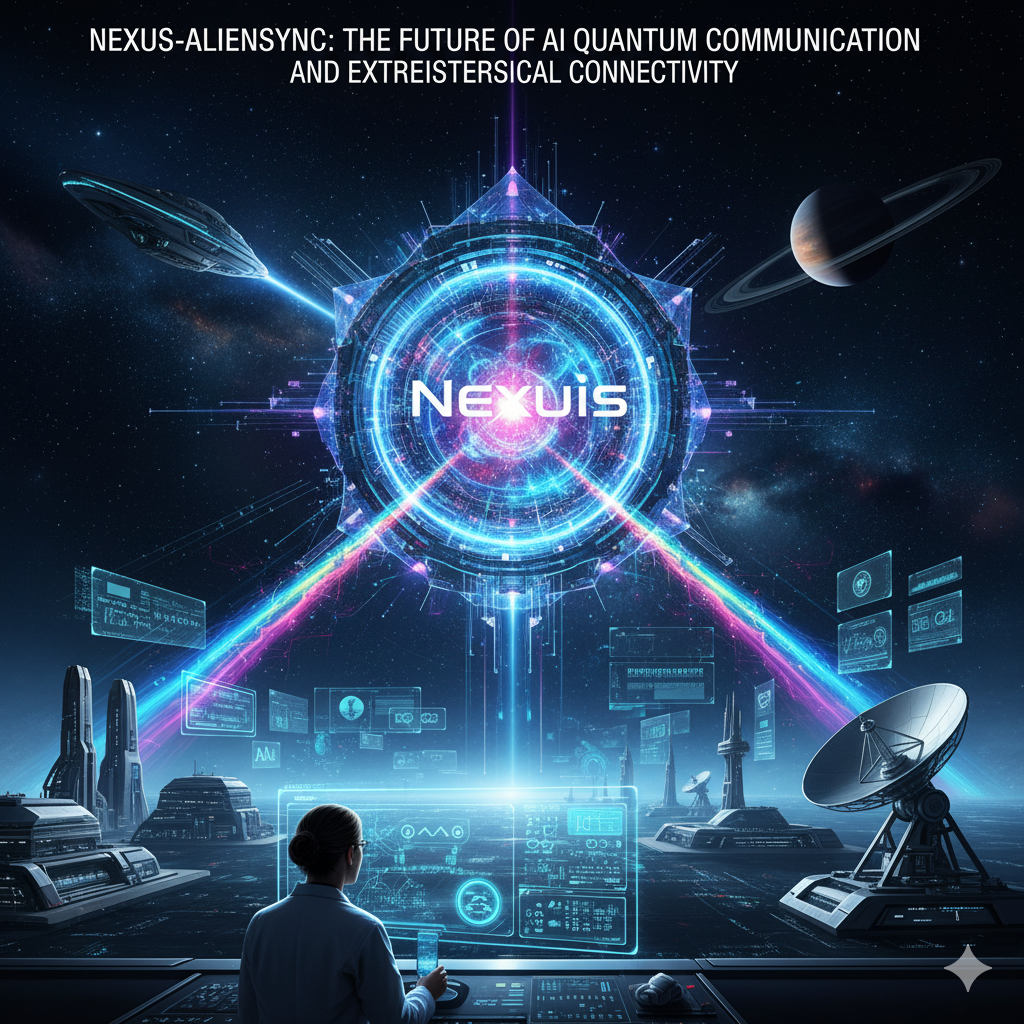
At first glance, the term seems almost too imaginative — something you might expect from a science fiction novel or a space exploration video game. Yet when examined closely, Nexus AlienSync appears to be more than just a catchy phrase. It embodies a range of ideas: advanced AI integration, quantum communication frameworks, and even astro-linguistic approaches to extraterrestrial contact.
Interestingly, there is no single, widely recognized meaning of Nexus AlienSync. Some sources suggest it refers to an AI orchestration platform, while others describe it as a speculative concept connecting human intelligence to alien systems. In another interpretation, it may be linked to advanced research projects, such as supercomputers at universities like Georgia Tech, designed to handle next-generation AI and communication experiments.
This layered meaning is what makes Nexus AlienSync a fascinating topic. It is both a technological framework and a philosophical idea, standing at the intersection of human progress, AI evolution, and our enduring curiosity about life beyond Earth.
The Origins of Nexus AlienSync
Unlike technologies with clear histories — such as the internet or blockchain — Nexus AlienSync does not have a documented inventor, company, or institution that claims ownership. Instead, it seems to be a conceptual phrase that gained visibility in speculative technology articles and futuristic think pieces.
One such mention reportedly appeared in The Numerist, which discussed the possibility of bridging communication between humans and extraterrestrials using advanced AI systems. In this interpretation, Nexus AlienSync is less of a tangible product and more of a vision for future communication systems, capable of handling unknown languages, signals, or thought patterns.
Another possibility is that Nexus AlienSync represents a marketing or research term for emerging AI integration platforms. In an age where companies often coin futuristic names for their platforms, it would not be surprising if this phrase is linked to an AI product designed to handle automation, machine learning orchestration, or even cross-platform synchronization.
Finally, the association with the Nexus supercomputer at Georgia Tech adds another layer of intrigue. This machine is already being used for advanced AI research, quantum computing simulations, and scientific discovery. Pairing it with the phrase “AlienSync” creates the impression of a supercomputer capable of decoding alien logic or managing AI systems that mimic non-human intelligence.
In other words, the origins of Nexus AlienSync are murky — but its significance lies precisely in its multi-interpretive potential.
Nexus AlienSync as an AI Integration Platform
Perhaps the most grounded interpretation of Nexus AlienSync is that it is an AI integration or orchestration platform. Modern businesses and research labs often rely on multiple AI tools, datasets, and machine learning models. Managing them can be chaotic, with each model functioning like an isolated island.
A “Nexus” implies a hub or connection point, while “AlienSync” suggests synchronization with something foreign, unknown, or advanced. Together, the term may represent a platform that enables different AI systems to “speak the same language,” regardless of their source, architecture, or design.
Potential Features of Nexus AlienSync as an AI Platform:
-
Cross-Model Synchronization: Allowing different AI models (vision, language, predictive analytics) to interact seamlessly.
-
Automated Orchestration: Coordinating tasks between multiple AI agents without human micromanagement.
-
Adaptive Interfaces: Translating complex outputs into formats usable by humans or other AI.
-
Alien Logic Simulation: Exploring new reasoning models beyond traditional binary logic, perhaps inspired by quantum principles.
Real-World Applications:
-
Business Automation: Integrating AI-driven tools for supply chain, marketing, and customer management.
-
Healthcare Research: Synchronizing diagnostic AI, genetic data, and patient care systems for improved outcomes.
-
Space Exploration: Orchestrating AI systems that analyze cosmic signals, planetary data, and robotic exploration tasks.
In this sense, Nexus AlienSync could be the missing link that transforms today’s fragmented AI environment into a unified digital ecosystem.
Quantum Communication and Nexus AlienSync
Quantum communication has been a buzzword in recent years, promising unbreakable encryption and faster-than-light information transfer — at least in theory. If Nexus AlienSync is tied to this field, it represents a paradigm shift in data exchange and AI synchronization.
Key Principles of Quantum Communication:
-
Entanglement: Two particles remain linked regardless of distance, enabling instant correlation.
-
Qubits: Unlike classical bits, qubits can hold multiple states simultaneously, enhancing computation.
-
Non-Locality: Information might not be bound by traditional spatial limits.
Nexus AlienSync could theoretically act as a quantum communication hub, transmitting AI data instantly across vast distances.
Speculative Applications:
-
Interstellar Messaging: Sending messages to distant planets or star systems without delay.
-
Global AI Synchronization: Linking AI systems worldwide into one cohesive “supermind.”
-
Unbreakable Security: Using quantum encryption to safeguard sensitive data in finance, defense, and healthcare.
If successful, this would not only accelerate AI development but also open entirely new frontiers in human communication and space exploration.
Speculative Extraterrestrial Connectivity
One of the more imaginative meanings of Nexus AlienSync relates to contact with extraterrestrial intelligence. The term “AlienSync” almost begs to be read in this way, as if it implies syncing human intelligence with alien systems.
Scientists have long speculated about how to communicate with extraterrestrials. Would they use mathematics? Radio signals? Symbols? Or something completely beyond human comprehension?
Astro-Linguistics and Alien Signals
Astro-linguistics is the study of how humans might communicate with non-human intelligence. Nexus AlienSync could serve as a translator or decoder, capable of analyzing unknown signals and extracting patterns that resemble communication.
For instance, if humanity receives a mysterious radio burst from deep space, Nexus AlienSync could use advanced AI, quantum algorithms, and probabilistic reasoning to determine whether it contains language-like structures, instructions, or even consciousness-encoded data.
Such capabilities would make it one of the most transformative technologies in human history — bridging the gap between civilizations across the stars.
Technical Architecture and Features
Although speculative, one can imagine the technical backbone of Nexus AlienSync.
Possible Components:
-
Supercomputing Core: Like the Nexus supercomputer, capable of handling massive datasets and complex AI simulations.
-
Quantum Nodes: Dedicated units for processing quantum communication and entanglement protocols.
-
AI Integration Layer: A middleware system that allows multiple AI models to interact and share knowledge.
-
Neural-Decoding Engine: A subsystem that attempts to decode alien or unknown communication structures.
-
Cybersecurity Module: Protecting against hacking, data corruption, or unintended AI consequences.
Such an architecture would blur the line between computer science, astrophysics, and philosophy, creating a platform that is both practical and speculative.
Philosophical and Ethical Considerations
Beyond technology, Nexus AlienSync raises profound ethical and philosophical questions.
-
What does it mean to synchronize with alien intelligence? Would humanity risk losing its identity in the process?
-
Could AI act as a mediator between species? Would it truly represent human values, or evolve into something independent?
-
Should we even attempt alien synchronization? Some argue it could expose us to dangers we don’t yet understand.
There are also questions of consciousness expansion. If Nexus AlienSync connects humans, AI, and alien logic, could it lead to collective consciousness — a “galactic mind”? Or would it fracture society into those who embrace the sync and those who resist it?
These dilemmas suggest that Nexus AlienSync is not just a technological challenge but a civilizational decision point.
Challenges and Limitations
No futuristic concept is without obstacles. Nexus AlienSync faces enormous hurdles:
-
Technological Gaps: Quantum computing and communication are still in their infancy.
-
Biological Barriers: Human cognition may not be equipped to process alien logic.
-
Security Risks: A network this powerful could become a prime target for misuse.
-
Interpretive Limits: Even with AI, we may never fully grasp alien consciousness if it exists.
These challenges highlight why Nexus AlienSync, while inspiring, remains speculative.
Future Prospects and Speculative Scenarios
Looking ahead, Nexus AlienSync could evolve in several directions:
-
Short-Term (5–10 years): AI integration platforms emerge, offering seamless orchestration of business and research systems.
-
Medium-Term (10–20 years): Quantum communication nodes become practical, enabling global AI synchronization.
-
Long-Term (50+ years): Humanity uses Nexus AlienSync-like systems to decode alien messages or even establish interstellar communication.
Speculative Scenario:
In 2085, a team of researchers using Nexus AlienSync receives a structured signal from Proxima Centauri. The system decodes it into a mathematical sequence that suggests collaborative problem-solving. This becomes the first true instance of alien-human communication, mediated by AI.
Conclusion
Nexus AlienSync is not just a phrase. It is a symbol of humanity’s ambition — to integrate advanced AI, explore quantum communication, and reach beyond the stars in search of connection.
Whether it becomes a real product, a supercomputer project, or remains a speculative idea, it forces us to ask critical questions about technology, identity, and the universe.
In its essence, Nexus AlienSync reflects humanity’s drive to connect — with machines, with each other, and perhaps, one day, with alien civilizations.