Neuroscience News Today: Latest Brain Research 2026

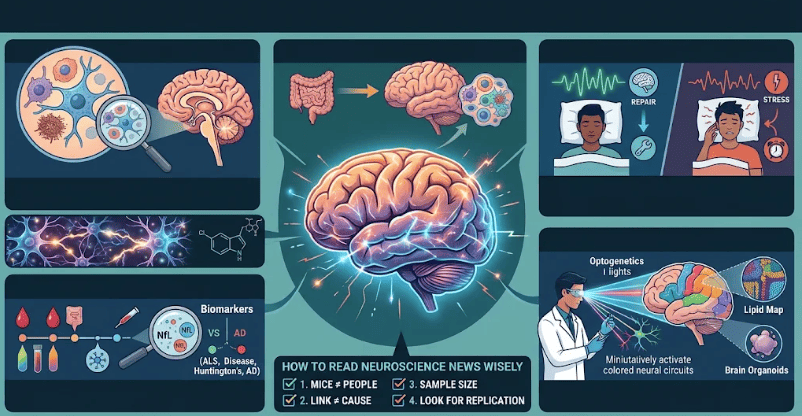
If you want the neuroscience news today in one place, you are in the right spot. Brain science is moving fast this month. New studies are shedding light on how Alzheimer’s disease may begin, why a simple cup of coffee might matter for your memory, how psychedelics reshape neural connections, and how a Nobel Prize-winning light technique is changing the way scientists study the brain.
This guide pulls together the latest neuroscience news and explains each finding in plain language. We also tell you what is solid evidence and what is still early, because in brain research the difference matters a lot.
Neuroscience News Today: Quick Summary
- Alzheimer’s research: New lab work suggests early signs of the disease may appear outside the brain.
- Dementia risk: A very long study links moderate coffee drinking with lower dementia risk.
- Sleep and the brain: Common sleep disorders are tied to structural changes in brain areas that handle attention and emotion.
- Psychedelics: Psilocybin appears to create and strengthen new neural connections.
- Early detection: Blood tests are getting better at spotting ALS, Huntington’s disease and Alzheimer’s risk earlier.
- Big event: The Society for Neuroscience annual meeting opens in Washington, DC on November 14.
1. Alzheimer’s May Start Outside the Brain
One of the most talked-about brain research news stories this week comes from experiments using tiny laboratory systems grown from human cells. Researchers found that gene mutations linked to inherited Alzheimer’s can cause problems in cells outside the brain, which suggests the disease may leave early traces elsewhere in the body.
Why it matters: if the first warning signs can be found outside the brain, doctors may one day detect Alzheimer’s much sooner and with less invasive tests. Remember that this is laboratory work, so it is a lead for future studies and not yet a diagnostic tool.
A related line of work looks at blood-based testing. A large international study reported that a simple blood test could help predict Alzheimer’s-related cognitive decline up to ten years before symptoms show up. Earlier detection is a major goal of Alzheimer’s research, because treatments tend to work best before serious damage is done. To learn which symptoms to watch for, read our guide on Alzheimer’s early warning signs.
2. Coffee and Dementia Risk
A study that followed people for as long as 43 years found that drinking two to three cups of caffeinated coffee a day was linked to a lower risk of dementia and better thinking skills. The key word is linked. This type of study shows an association and cannot prove that coffee itself protects the brain. Diet, income, sleep and exercise can all play a part.
The takeaway for readers: moderate coffee appears safe for most healthy adults and may be part of a brain-friendly lifestyle, but it is not a substitute for exercise, good sleep and regular health checks.
3. Sleep Disorders Leave a Mark on the Brain
Scientists report that common sleep disorders are associated with structural differences in brain regions that control attention, decision-making and emotions. This may help explain why poor sleep makes it harder to focus, stay calm and make good choices.
Another new study connects Alzheimer’s-related protein buildup with disrupted brain waves during deep sleep, and with fading memory. Put together, the message is consistent: sleep is not just rest, it is active maintenance for the brain. If you struggle with sleep, our article on how sleep affects your brain explains simple habits that can help.
4. Psilocybin Rewires Brain Connections
Researchers found that psilocybin, the active compound in magic mushrooms, rapidly encourages the brain to form new connections between neurons and strengthens them. The drug also seemed to behave differently in healthy brains compared with brains under stress or disease conditions.
This is an important piece of neuroscience research for mental health, because it may help explain why psychedelic-assisted therapy is being studied for depression and PTSD. It is still an active research area, and these substances should only be used in approved clinical settings.
5. Lifestyle Studies Making Headlines
Several studies this month link everyday habits with brain health:
- Ultra-processed food: A small study of children aged 7 to 10 found that eating more ultra-processed food was linked with a brain response that may encourage weight gain.
- Body weight: A 24-year study of more than 8,200 adults suggests excess weight may speed up brain aging, with faster declines in memory and concentration.
- Artificial sweeteners: A study of nearly 13,000 adults linked high intake of certain sugar substitutes with faster decline in memory and thinking skills. Larger and longer trials are needed to confirm cause and effect.
- Exercise and Parkinson’s: A seven-year study found that people with Parkinson’s who were more physically active had slower declines in memory, thinking and movement.
- Fish oil: A two-year study found no brain benefit from fish oil supplements, a useful reminder that popular supplements do not always deliver.
6. Earlier Diagnosis: Blood Tests and Biomarkers
A strong theme in the latest neuroscience news is catching disease sooner:
- ALS: A panel of 10 blood proteins separated people with ALS from healthy individuals with nearly 98 percent accuracy, which could support a future blood test.
- Huntington’s disease: Researchers studying 296 people with Huntington’s mutations found raised levels of a nerve-damage marker called NfL before symptoms or visible brain shrinkage appeared.
- Alzheimer’s disease: Blood-based risk tests continue to improve, as covered above.
Faster, simpler tests could help patients start treatment earlier and help researchers recruit the right people for clinical trials.
7. New Treatments and Drug Targets
- Alexander disease: The FDA has approved the first drug that directly targets this rare and devastating brain disease, a milestone after decades of research.
- Alzheimer’s drugs in development: Scientists reported that a drug first built for spinal cord injury may reduce DNA damage and brain inflammation, and another study suggests low-dose rapamycin, an anti-aging drug, may protect people who carry high genetic risk.
- Brain inflammation: Blocking a receptor called P2X7 reduced inflammation in human brain tissue, pointing to a possible strategy for Alzheimer’s and Parkinson’s disease.
- GLP-1 drugs: A new review of evidence on GLP-1 medicines suggests possible cognitive benefits, especially in obesity and type 2 diabetes, but the clinical evidence is still mixed.
Most of these results come from early-stage studies or animal models, so treat them as promising directions, not proven cures.
8. Neuroscience Breakthroughs in Technology
The 2026 Nobel Prize recognized the discovery that began with tiny algae and led to a method for switching brain cells on and off using light. This technique, called optogenetics, has become a core tool in labs worldwide.
Other technology stories to watch:
- Brain organoids: Scientists compared human, chimpanzee and gorilla brain organoids and found nearly 600 genetic switches that are more active in human neural stem cells, offering clues about what makes the human brain unique.
- Brain mapping: A new 3D map of brain fats (lipids) revealed 539 distinct regions, adding a new layer to brain organization.
- Brain-computer interfaces: Devices that read and respond to brain signals keep improving. Learn the basics in our guide to brain-computer interfaces explained.
What to Watch Next
The Society for Neuroscience annual meeting, Neuroscience 2026, runs November 14 to 18 in Washington, DC. It is one of the biggest gatherings in the field, so expect a new wave of research announcements next week.
How to Read Neuroscience News Wisely
Headlines can make early findings sound like cures. Keep these checks in mind:
- Mice are not people. Many breakthroughs are first shown in animals.
- Association is not causation. A link between coffee, sweeteners or weight and brain health does not prove one causes the other.
- Sample size matters. A study of 46 children is a signal, not a verdict.
- Look for replication. Results confirmed by other teams are far more reliable.
- Talk to a professional. For memory, mood or sleep concerns, see a qualified doctor rather than relying on headlines.
Frequently Asked Questions
What is neuroscience?
Neuroscience is the scientific study of the brain, spinal cord and nerves, and how they shape thinking, feeling, movement and behavior.
Where can I find neuroscience news today?
University press offices, journals such as Nature Neuroscience, and science news sites publish new findings daily. This page is updated to highlight the most important stories in simple language.
What are the biggest neuroscience breakthroughs this year?
Highlights include the Nobel Prize for light-based control of brain cells, better blood tests for early diagnosis, new drug targets for Alzheimer’s and Parkinson’s, and detailed brain maps and organoid studies.
Can coffee really lower dementia risk?
A long-term study found a link between two to three cups a day and lower dementia risk, but this does not prove coffee is the cause.
Is Alzheimer’s disease preventable?
There is no guaranteed way to prevent it, but research supports exercise, quality sleep, healthy weight, blood pressure control and staying mentally and socially active.
Conclusion
The neuroscience news today shows a field moving toward earlier detection, smarter treatments and a deeper understanding of how everyday habits shape the brain. Bookmark this page and check back for updates, especially after the Neuroscience 2026 meeting. Keep a healthy skepticism, enjoy the discoveries, and use the science to look after your own brain.