Biometric Attendance Machines in Pakistan: Price & Guide

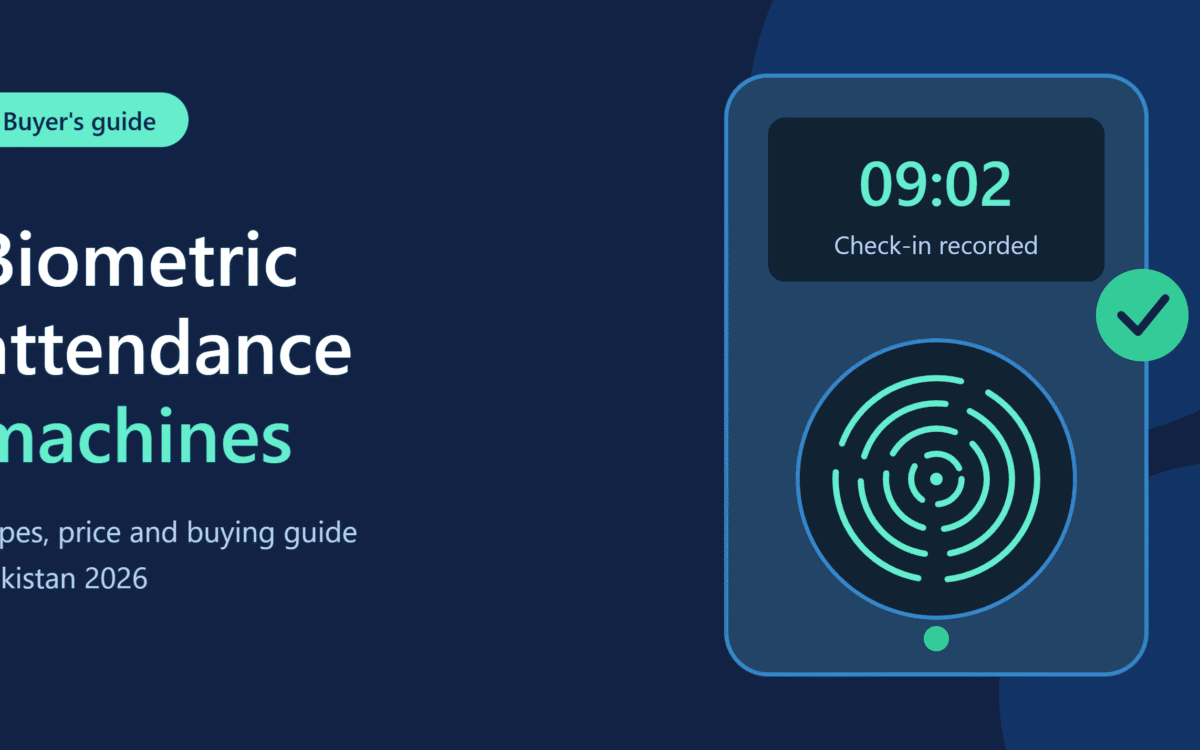
Paper registers and punch cards still cause the same headaches in many Pakistani offices: wrong payroll, proxy attendance and hours of manual checking at month end. Biometric attendance machines solve this by recording an employee’s identity through a fingerprint, face or palm, then logging the exact time automatically.
This guide explains how these devices work, which type suits your business, what they cost in Pakistan and what to check before you buy.
What Is a Biometric Attendance Machine?
A biometric attendance machine is a device that identifies each employee by a unique body feature and records their check-in and check-out time. The data is stored on the device and sent to attendance software on your computer over LAN, USB or Wi-Fi. HR can then generate daily, monthly and overtime reports without typing a single entry.
Unlike an ID card, a fingerprint or face cannot be lent to a colleague. That is why a biometric attendance system is the standard fix for buddy punching and time theft.
How Does a Biometric Attendance System Work?
- Enrollment: The employee registers a fingerprint, face or palm once. The machine saves a template, not a photo or image.
- Verification: On every punch, the device compares the live scan against saved templates. Good terminals verify in under one second.
- Recording: The device stores the time, date and user ID in its memory.
- Reporting: The attendance software collects the logs and turns them into sheets for late arrivals, absences, shifts and overtime.
Most modern machines keep working during a power cut because of a built-in battery. Check this before buying if load shedding affects your area.
Types of Biometric Attendance Machines
| Type | Best for | Main advantage | Limitation |
|---|---|---|---|
| Fingerprint machine | Small and medium offices, shops, schools | Lowest cost, simple to use | Worn, dry or dirty fingers can fail |
| Face recognition machine | Offices, hospitals, high-traffic entrances | Touch-free and fast | Costs more; needs decent lighting |
| Palm recognition machine | Offices wanting extra accuracy | Works when fingerprints are worn | Fewer models available |
| Face + fingerprint combo | Mixed workforces | Two methods in one device | Higher price |
| RFID card + fingerprint | Factories, warehouses | Backup when a finger fails | Cards can be lost |
If you want to see the low-cost option in detail, our guide to fingerprint attendance machines covers sensors and capacity. For touch-free entry, read about face recognition attendance machines.
Biometric Attendance Machine Price in Pakistan
Prices depend on the verification method, user capacity, screen, connectivity and brand. Based on current market listings in Pakistan, you can expect roughly these ranges:
- Entry-level fingerprint machines: about Rs 11,000 to Rs 18,000
- Mid-range fingerprint models with larger capacity: about Rs 16,000 to Rs 35,000
- Palm or advanced network models: about Rs 30,000 and above
- Face and fingerprint terminals: about Rs 55,000 to Rs 85,000 or more
These are indicative figures. Dollar rates, stock and dealer margins change prices often, so always ask for a current quotation and confirm warranty terms in writing.
Popular Brands Available in Pakistan
- ZKTeco: The most widely sold brand, with fingerprint, face and palm models for almost every budget. Spare parts and resellers are easy to find.
- Hikvision: A good pick if you already run Hikvision CCTV, since attendance and security can work together.
- BlackCopper: A budget-friendly option with the basics covered, such as a few thousand users, battery backup and TCP/IP.
Brand matters less than local support. A reliable dealer who answers calls and honours warranty is worth more than a slightly cheaper box.
Key Features to Check Before Buying
User and record capacity. Machines are rated for a set number of fingerprints, faces and log records. A device with 1,000 fingerprint slots suits a 300-person company with room to grow. Buy for next year’s headcount, not today’s.
Verification speed. Look for 1:N matching in under a second so staff do not queue at 9 am.
Connectivity. TCP/IP (LAN) is the most stable. Wi-Fi is handy where cabling is hard. USB is a useful backup for exporting data.
Battery backup. An internal battery keeps punches safe during outages.
Software compatibility. Confirm the machine syncs with your payroll or HR software. Ask whether the software needs a monthly subscription.
Sensor quality. If your staff do manual work, choose a sensor that reads dry, wet or rough fingers, or choose face recognition instead.
Access control. Some terminals can also lock and unlock doors, so one device handles attendance and entry. Learn more about biometric access control systems.
Fingerprint or Face Recognition: Which Is Better?
Choose fingerprint if your budget is tight, your staff work in a clean office environment and you want a simple, proven system.
Choose face recognition if you want touch-free punching, have heavy foot traffic or work in a hygiene-sensitive place such as a clinic. Look for anti-photo detection so nobody can punch in with a picture on a phone.
For factories and workshops where hands get dirty, face recognition or a card-plus-fingerprint device is usually the safer choice.
Benefits of Biometric Attendance Machines
- Accurate records: No manual entry, no guesswork.
- No buddy punching: The employee has to be there in person.
- Faster payroll: Reports export straight to Excel or payroll software.
- Less admin work: HR spends hours less on attendance every month.
- Fairer workplace: Everyone is measured by the same system.
Common Mistakes to Avoid
- Buying on price alone. The cheapest unit often has weak software and no warranty support.
- Choosing too small a capacity. You will need to replace it when the team grows.
- Placing the device badly. Direct sunlight can confuse sensors, and a face terminal far from the door creates queues.
- Ignoring data privacy. Tell employees how their biometric data is stored and who can access it.
- Skipping a demo. Ask the seller to show you how the data moves into the report before you pay.
Frequently Asked Questions
How much does a biometric attendance machine cost in Pakistan?
Simple fingerprint models start at around Rs 11,000, while face recognition models usually cost from about Rs 55,000 upward, depending on brand and capacity.
Which biometric attendance machine is best for a small office?
A fingerprint machine with battery backup and TCP/IP, with capacity for at least 500 users, is usually enough and the most economical choice.
Can biometric attendance machines work without internet?
Yes. Most store logs on the device and transfer them over LAN or USB. Internet is only needed for cloud software.
Do biometric machines store my actual fingerprint?
Most store an encrypted mathematical template rather than a full image, which cannot be rebuilt into a fingerprint photo.
What happens during a power cut?
Machines with a built-in battery keep recording for some hours. Models without one stop working.
Is face recognition more accurate than fingerprint?
Neither is always better. Face recognition is faster and touch-free, while fingerprint is cheaper and very reliable in normal office conditions.
Final Thoughts
The right biometric attendance machine depends on your team size, workplace and budget. Match capacity to your headcount, pick the verification method that suits your staff, check software compatibility and insist on local after-sales support.