How Far Is 100 Ft? Meters, Steps and Real Examples

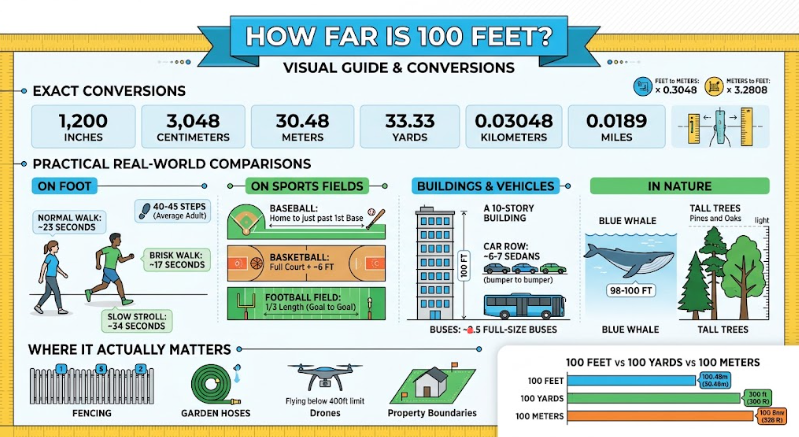
How far is 100 ft? One hundred feet equals 30.48 meters, 33.33 yards, or 1,200 inches. On foot, it is about 40 to 45 steps, and a relaxed walker covers it in roughly 20 to 25 seconds. Vertically, it is about the height of a 9 or 10-story building.
That is the short answer. But a number on its own rarely helps. If you are marking out a fence line, buying a hose, checking a property setback or just curious, you want to see the distance in your head. This guide gives you the exact conversions first, then walks you through practical ways to picture, pace and measure 100 feet.
Quick Answer: 100 Feet at a Glance
| Unit | 100 Feet Equals |
|---|---|
| Inches | 1,200 in |
| Centimeters | 3,048 cm |
| Millimeters | 30,480 mm |
| Meters | 30.48 m |
| Yards | 33.33 yd |
| Kilometers | 0.03048 km |
| Miles | 0.0189 mi |
The formula: multiply feet by 0.3048 to get meters. So 100 × 0.3048 = 30.48 m. To go the other way, multiply meters by 3.2808.
How Long Does It Take to Walk 100 Feet?
Distance feels very different depending on how fast you move. Here is how long 100 feet takes at common speeds:
| Pace | Speed | Time to cover 100 ft |
|---|---|---|
| Slow stroll | 2 mph | about 34 seconds |
| Normal walk | 3 mph | about 23 seconds |
| Brisk walk | 4 mph | about 17 seconds |
| Easy jog | 6 mph | about 11 seconds |
For comparison, a world-class sprinter running at record pace covers 100 feet in under 3 seconds. So 100 feet is a short walk, but a surprisingly long sprint if you are carrying something heavy or pulling a hose behind you.
How many steps is 100 feet?
An average adult step is about 2.2 to 2.5 feet, so 100 feet is roughly 40 to 45 steps. If you are shorter, expect the higher number. If you are tall or walking briskly, expect closer to 40.
What Does 100 Feet Look Like? Real-World Comparisons
Most people cannot judge 100 feet by eye. Anchor it to something you already know.
On sports fields and courts
- Baseball diamond: The bases are 90 feet apart. So 100 feet is just a little farther than the run from home plate to first base.
- Basketball court: An NBA court is 94 feet long. Stand on one baseline, look at the other, and add about six feet. That is your 100.
- Football field: The playing field between the goal lines is 300 feet (100 yards), so 100 feet is exactly one-third of the field. Counting both end zones, the full field is 360 feet.
- Bowling lane: From the foul line to the head pin is 60 feet. Add another 40 feet and you have 100.
- Olympic swimming pool: A 50-meter pool is about 164 feet long, so 100 feet is a little over 60% of one length.
- Cricket pitch: A pitch is 22 yards, or 66 feet, from stump to stump. One and a half pitches gives you about 99 feet, which is nearly 100.
In buildings and vehicles
- A 10-story building: Floors are usually 10 to 12 feet apart, so 100 feet is roughly an 8 to 10-story building.
- School buses: A full-size bus is about 35 to 45 feet, so 100 feet is two and a half buses bumper to bumper.
- Cars in a row: A typical sedan is about 15 feet long, so 100 feet fits roughly 6 to 7 cars bumper to bumper. That is a handy check when you are measuring road frontage or a driveway.
- Inside a room: A typical bedroom is only 10 to 12 feet across, so 100 feet is the length of about 8 to 10 bedrooms in a straight line. Indoors you will only find it in large halls, warehouses, gyms and airport terminals.
In nature
- Tall trees: Mature cottonwoods, oaks and many pines can reach around 100 feet.
- Blue whale: The largest animals ever recorded reach about 98 to 100 feet, which is why the whale is the classic answer to “what is 100 feet long?”
How Tall Is 100 Feet?
Height feels more dramatic than distance. A 100-foot drop is about 30 meters. An object falling that far, ignoring air resistance, hits the ground in about 2.5 seconds. That is one reason 100 feet is such an important number in rescue work, tree trimming and construction safety: it is high enough to be serious, yet low enough that a standard 100-foot rope or ladder can reach it.
If you are looking up at something 100 feet tall, picture three Olympic 10-meter diving platforms stacked on top of each other. That is almost exactly 100 feet.
100 Feet vs 100 Yards vs 100 Meters
This is the most common mix-up, and it can be expensive when you are ordering materials. Here is the difference:
| Measurement | In feet | In meters |
|---|---|---|
| 100 feet | 100 ft | 30.48 m |
| 100 yards | 300 ft | 91.44 m |
| 100 meters | 328.08 ft | 100 m |
So 100 yards is three times longer than 100 feet, and 100 meters is a little over three times longer too. If a supplier quotes a price per foot, double-check whether your plan is in feet, yards or meters before you place the order.
Where Does 100 Feet Actually Matter?
Knowing the number is useful, but knowing where it shows up is better. Here are the everyday situations where 100 feet comes up.
Fencing. A 100-foot fence line needs about 13 panels if each panel is 8 feet wide, or about 17 panels if each is 6 feet wide. Always round up and add a spare.
Garden hoses and extension cords. A 100-foot hose is the longest common length for home use. Water pressure noticeably drops over that run, so a wider hose helps if you are watering at the far end of a yard.
LED strip lights. Strip lights are commonly sold in reels of about 16.4 feet (5 meters). To cover 100 feet you need about six reels.
Network cables. An Ethernet cable can run up to 100 meters (328 feet) before the signal weakens, so a 100-foot cable is well within the limit for home and office use.
Property and zoning. Lot frontage, setbacks and buffer zones are often specified in feet. A 100-foot lot depth gives you a decent backyard, while a 100-foot setback is a large gap in a typical neighborhood.
Drones. Rules for hobby and commercial drone flights are set in feet. 100 feet is far below the common 400-foot altitude ceiling, but high enough that a drone is already hard to judge by eye.
How to Measure 100 Feet Without a Tape Measure
You do not always have a tape in your pocket. These methods get you close:
- Pace it out. Walk 10 normal steps, measure that distance once, and divide by 10 to find your personal step length. Then divide 100 by that number. For most adults the answer is 40 to 45 steps.
- Use a known object. Line up reference objects of known length, such as 10 kayaks, 13 fence panels or 11 car parking stalls.
- Use your phone. Many phones have a built-in measuring app that uses the camera. A map app with a distance-measure option also works well outdoors.
- Use a measuring wheel or laser. For anything that matters, such as property lines or construction, a measuring wheel or a laser distance meter is quicker and far more accurate than guessing.
For legal boundaries and building work, always confirm with a proper survey or a calibrated tool rather than pacing.
Frequently Asked Questions
How far is 100 ft in meters?
100 feet is exactly 30.48 meters.
How far is 100 ft in kilometers and miles?
100 feet is 0.03048 kilometers, or about 0.0189 miles. That is less than 2% of a mile.
How many cars equal 100 feet?
About 6 to 7 average sedans parked end to end.
How far is 100 ft in yards?
100 feet equals 33.33 yards, or one-third of a 100-yard football field.
How many steps is 100 feet?
About 40 to 45 steps for an average adult.
How long does it take to walk 100 feet?
Around 23 seconds at a normal walking pace of 3 mph. A brisk walk takes about 17 seconds.
Is 100 feet bigger than a football field?
No. A football field is 300 feet between the goal lines, so 100 feet is only one-third of it.
How tall is a 100-foot building?
Roughly 8 to 10 stories, depending on the ceiling height of each floor.
Is 100 feet the same as 100 meters?
No. 100 meters is about 328 feet, so it is more than three times longer than 100 feet.
How far can you see 100 feet away?
Very easily. You can recognize a person’s face and read large signs at that range, which is why 100 feet is often used as a short-range reference in safety and design standards.
Final Thoughts
So, how far is 100 ft? It is 30.48 meters, about 33 yards, roughly 40 to 45 steps, and a walk of under half a minute. Picture it as the distance from home plate to just past first base, a bit longer than a basketball court, or a one-third slice of a football field.
Once you attach 100 feet to two or three of those pictures, you will be able to estimate it in seconds. Bookmark this page for the conversion tables, and use the walking-time chart whenever you need to plan a route or a layout.