How Does the English Football Pyramid Work?

The English football pyramid links more than 7,000 men’s teams in one giant ladder. This guide answers the most common questions about it, one by one, so you can find exactly what you need.
What Is the English Football Pyramid?
The English football pyramid is the system of connected leagues that links every men’s club in England through promotion and relegation. It is also called the English football league system.
The best clubs in each division move up a level. The worst move down. Because of this, even a small local club can, in theory, reach the Premier League. Estimates put the total at more than 7,000 teams from nearly 5,300 clubs.
How Many Levels Are in the English Football Pyramid?
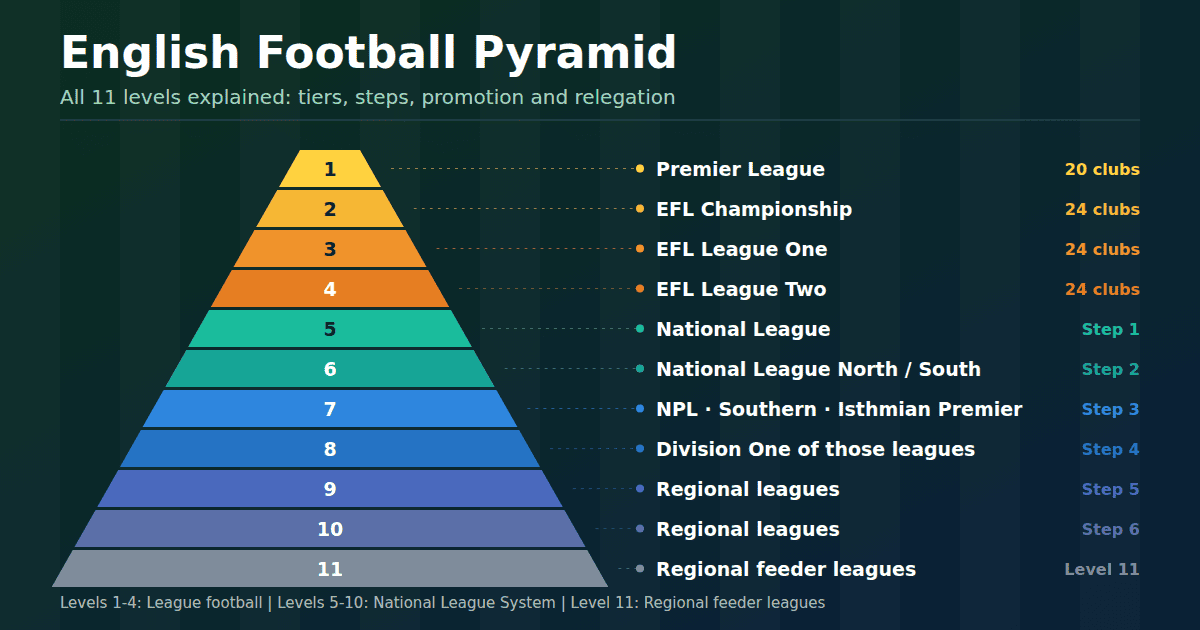
The official structure has 11 levels, and local leagues continue below that. Levels 1 to 4 are professional, Level 5 onwards is non-league, and the number of leagues grows with each step down.
The top five levels have one nationwide division each. From Level 6 downward, leagues split by region to cut travel and keep fixtures local.
What Are the English Football Tiers in Order?
The tiers run from the Premier League at Level 1 down to regional and county leagues at Level 11.
| Level | Competition | Clubs | Run by |
|---|---|---|---|
| 1 | Premier League | 20 | Premier League |
| 2 | EFL Championship | 24 | EFL |
| 3 | EFL League One | 24 | EFL |
| 4 | EFL League Two | 24 | EFL |
| 5 (Step 1) | National League | 24 | The FA |
| 6 (Step 2) | National League North and South | 24 each | The FA |
| 7 (Step 3) | Northern Premier, Southern, Isthmian Premier divisions | 22 each | The FA |
| 8 (Step 4) | Division One groups of those leagues | 22 each | The FA |
| 9-10 (Steps 5-6) | Regional leagues | Varies | The FA |
| 11 | Regional feeder leagues | Varies | County FAs |
Who Runs the English Football Pyramid?
Three groups run it: the Premier League, the English Football League (EFL) and the FA.
- The Premier League runs Level 1 by itself.
- The EFL runs Levels 2, 3 and 4.
- The FA oversees Levels 5 to 10, known as the National League System, while county FAs handle many leagues below that.
What Is the Difference Between League and Non-League Football?
League football means the top four levels. Non-league football means everything below League Two.
The term dates back to the days when “the League” meant only the Football League. It confuses people, because non-league clubs still play in leagues. They are simply outside the EFL.
Levels 1 to 4 hold 92 clubs, and all are full-time professional. Non-league clubs are a mix of full-time, semi-professional and amateur sides, depending on the level.
How Does Promotion and Relegation Work?
Clubs that finish at the top of a division move up, and clubs at the bottom move down. The numbers differ by level:
- Premier League: bottom three are relegated.
- Championship: top two promoted automatically, plus one through the play-offs. Bottom three relegated.
- League One: top two promoted, plus one through play-offs. Bottom four relegated.
- League Two: top three promoted, plus one through play-offs. Bottom two relegated.
- National League: the champions go up, plus the play-off winner. Bottom four go down.
From the 2026-27 season, the Championship play-offs expand from four teams to six after a vote by EFL clubs.
Promotion is not only about results. Higher leagues set ground and financial standards, so a club can finish first and still be refused if it does not meet them.
What Are “Steps” in Non-League Football?
Steps are the FA’s way of numbering Levels 5 to 10 of the pyramid. Step 1 is Level 5 (the National League), Step 2 is Level 6, and so on down to Step 6 at Level 10.
Level 11 was once called Step 7. Since 2020 it has been known as the Regional Feeder League level.
What Is the Lowest League in English Football?
There is no single official bottom. The formal structure is defined to Level 11. Below that, local leagues exist, but they change often and are not officially ranked. In dense areas, there are leagues more than twenty levels below the Premier League.
Which Cups Does Each Level Play In?
Your level decides which cups you enter.
- FA Cup: open to clubs from Levels 1 to 9. Levels 1 to 4 enter the main competition, and lower clubs start in qualifying rounds.
- EFL Cup: Levels 1 to 4.
- FA Trophy: Levels 5 to 8.
- FA Vase: Levels 9 and 10.
This mix is why the FA Cup produces shocks. In January 2026, non-league Macclesfield beat holders Crystal Palace 2-1.
Is Sunday League Football Part of the Pyramid?
No. Sunday league football is a separate world with no promotion or relegation into the pyramid. Some Sunday clubs do join pyramid leagues when they want to climb higher.
Is There a Women’s Football Pyramid in England?
Yes, the women’s game has its own separate pyramid. The Women’s Super League (WSL) is at the top, then the Women’s Championship, then the Women’s National League tiers.
Promotion works differently. Clubs must also meet licensing standards on facilities, finances and safeguarding, so finishing first is not always enough.
Can a Non-League Club Reach the Premier League?
Yes, in theory. Nothing stops a club from climbing one level at a time. In practice it is very hard, because each step demands better facilities, bigger crowds and more money.
Players do make the jump. Jamie Vardy and Ian Wright both played non-league football before reaching the Premier League.
When Did the English Football Pyramid Begin?
It began with the first Football League in 1888. Aston Villa director William McGregor created the league, which had twelve founding clubs: six from Lancashire and six from the Midlands. The Premier League split off in 1992, which created today’s top-flight and EFL structure.
Why Does the English Football Pyramid Matter?
It gives every club a path to the top and keeps football open and unpredictable. Matches in every division count for something, because every result affects promotion or relegation somewhere on the ladder.
To go deeper, read our guides on [Premier League promotion and relegation], the [EFL Championship explained] and [how the FA Cup works].