What Is SEO by HighSoftware99? How to Get Real Google Visibility in 2026

If you searched for SEO by HighSoftware99, you probably noticed that every article says something slightly different. Some describe it as a service. Others call it a framework. A few connect it with “SEO instant appear HighSoftware99” and promise quick Google visibility.
Here is the honest picture. The phrase appears across many blogs, and most of them describe the same basic ideas: technical SEO, structured content, semantic relevance and ethical link building. There is no public proof that it is a proprietary ranking system, and nothing in Google’s documentation mentions it. So the smartest way to treat SEO by HighSoftware99 is as a label for common SEO fundamentals, not as a secret tool.
That is not a bad thing. Fundamentals are what actually move rankings. The problem starts only when the label is sold as a shortcut.
Why Is Everyone Searching for “Instant Appear” SEO?
The word “instant” is the reason this keyword spreads. A new site owner publishes a page, searches for it, and sees nothing. Naturally they look for a fast fix. “SEO instant appear HighSoftware99” sounds like that fix.
But “appear” can mean five different things in search:
| Stage | What it means | Can it be fast? |
|---|---|---|
| Crawled | Googlebot found and fetched your page | Yes, often within days |
| Indexed | Google stored your page in its database | Often, not guaranteed |
| Brand search visibility | Your page shows when someone searches your exact name | Fairly quick |
| Autocomplete | Your phrase appears as a typed suggestion | No, depends on real search demand |
| Page-one ranking | You beat competitors for a real keyword | No, takes time and authority |
When a provider says “instant appear,” always ask which of these five stages they mean. Most of the time, only the first two are realistic.
Is SEO by HighSoftware99 Legit?
This is the most searched question, and the answer needs care. After reviewing the pages ranking for this phrase, one pattern is clear: many articles repeat each other, use vague claims, and give no case studies, client names or verifiable results.
That does not prove fraud. It does mean you should verify before you trust or pay anyone. Use this checklist:
- Ask for proof: real before-and-after Google Search Console screenshots, not just rank-checker images.
- Check the promise: walk away from anyone guaranteeing page-one rankings or “instant” results.
- Ask what they will change: content, code, links, or your Google Business Profile.
- Demand a clear method: you should be able to understand the work in plain words.
- Check Google’s rules: the service should follow Google Search Essentials and avoid link schemes and spam tactics.
If you want a calmer way to think about this, read our guide on how to build a technical SEO checklist for a new website before spending money on any service.
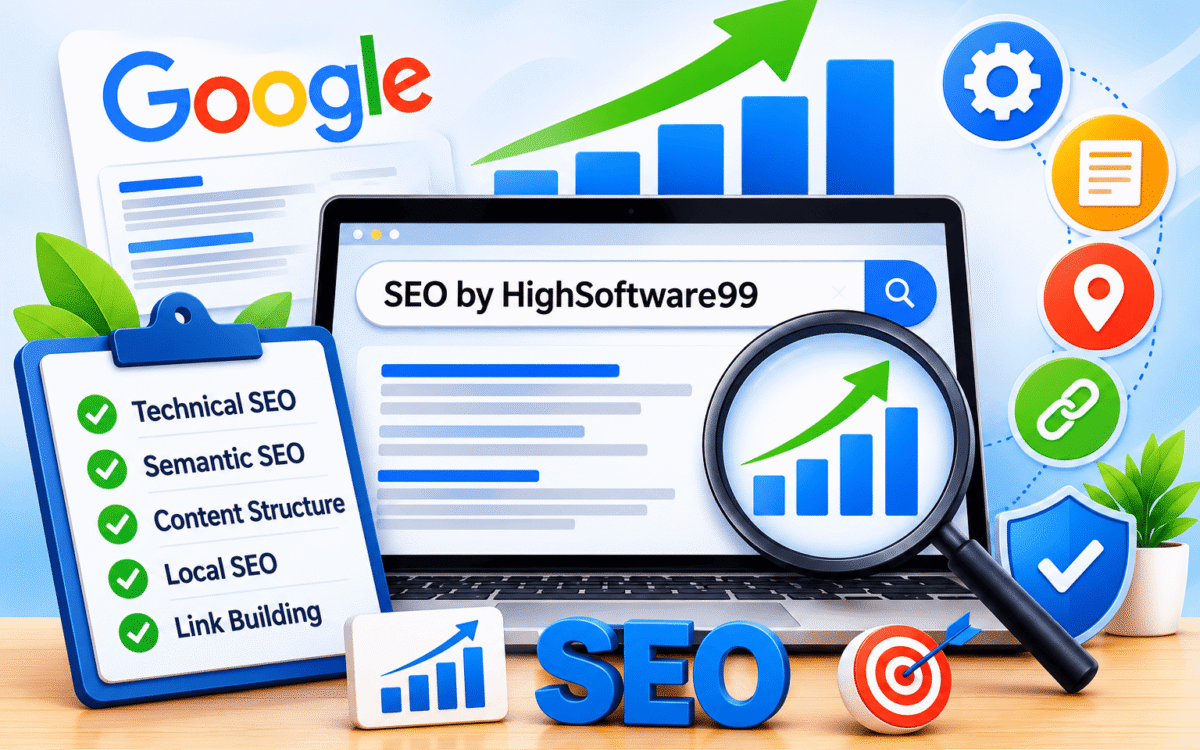
What the Phrase Usually Claims to Cover
Across the pages discussing SEO by HighSoftware99, the same service areas keep appearing. Here is what each one really involves and whether it is worth your time.
1. Technical SEO
This is the base layer. It includes a clean URL structure, an XML sitemap, correct canonical tags, working internal links, mobile friendliness and fast loading. Google’s Core Web Vitals give clear targets: Largest Contentful Paint under 2.5 seconds, Interaction to Next Paint under 200 milliseconds, and Cumulative Layout Shift under 0.1.
2. Semantic SEO
Semantic SEO means covering a topic fully instead of repeating one keyword. For this topic, that means explaining indexing, Autocomplete, search intent, internal linking and measurement together. Search engines and AI answer systems both prefer pages that connect related ideas clearly.
3. Content Structure
Short paragraphs, descriptive headings, direct answers under question headings, and tables help readers scan. They also make your content easier for Google to quote in featured snippets and AI-generated answers.
4. Local SEO
Some descriptions include local work such as Google Business Profile setup, location pages, reviews and citations. This is valuable for shops and service businesses, and it is a normal part of any good SEO plan.
5. Link Building
The safer versions of this claim talk about earning links through useful content. That is correct. Paid link packages and mass directory submissions are the opposite and can hurt you.
Indexing vs Ranking: The Difference That Saves You Money
Most confusion around SEO by HighSoftware99 comes from mixing up two different things.
Indexing means Google has discovered your page and stored it. Ranking means Google has decided where your page belongs for a specific search. A page can be indexed on day two and still sit on page eight for months.
Google itself says it cannot be paid to crawl more often or rank a site higher, and it does not promise that every page will be indexed. So any service that says it controls organic rankings is promising something it cannot deliver.
Does Autocomplete SEO Actually Work?
Some sellers link “instant appear” with Google Autocomplete. Autocomplete suggestions are generated from real search behavior, language, location and freshness, and they are filtered by Google’s policies. You cannot switch them on with a button.
What you can do honestly is build real brand demand: publish useful content, get mentioned on relevant sites, and encourage genuine searches for your name. Over time, that is the only dependable path to appearing in suggestions. A single screenshot proves very little because suggestions differ by device, country and time.
How to Get Your Page Discovered Faster (Safe Method)
You cannot force Google, but you can remove every obstacle in the way. Follow these steps in order:
- Publish on a clean canonical URL. Avoid duplicate versions of the same page.
- Add the page to your XML sitemap and submit the sitemap in Google Search Console.
- Use the URL Inspection tool in Search Console and request indexing for the new page.
- Link to it from at least three relevant pages on your own site. Our walkthrough on internal linking for faster indexing shows exactly how.
- Make sure nothing blocks it. Check robots.txt and any noindex tags.
- Share it from real profiles so people can find and visit it.
- Recheck after a few days in the Page indexing report.
A Realistic 30-Day Plan
This plan suits low-to-medium competition keywords. Harder keywords need longer.
Week 1: Foundation. Fix crawl errors, confirm indexing, rewrite your title and meta description, and improve mobile speed.
Week 2: Depth. Study the top results for your keyword, find the subtopics they miss, and add them. Include a short FAQ with direct answers.
Week 3: Connections. Add internal links from older related posts. Add author details and an update date to build trust.
Week 4: Authority and review. Earn a few relevant links by sharing useful resources, then review impressions, clicks and average position in Search Console.
Expect discovery first. Ranking movement follows only if your page answers the search better than what already ranks.
How to Measure Results the Right Way
Do not judge any service by a single screenshot. Track these instead:
- Indexed pages in Google Search Console
- Impressions and clicks for your target keyword
- Average position and click-through rate
- Queries that bring visitors, including long-tail variations
- Conversions, such as calls, leads or sales, because traffic without action has little value
If you are new to reporting, see our guide to reading Google Search Console reports for a simple starting point.
Red Flags to Avoid
- Guaranteed rankings or “first page in 24 hours”
- No explanation of the method
- Claims of a special relationship with Google
- Pricing based on mass links or directory blasts
- Reports with no Search Console data
- Pressure to pay before any audit
Is It Worth Using Fast-Visibility Services?
It depends on what is actually being offered. A technical cleanup, a better site structure and clearer content can improve how quickly Google understands your pages. That has real value. A promise of instant top rankings does not. Judge the service by what it will change on your site, how it will be measured, and whether the work would still make sense if rankings never moved.
Frequently Asked Questions
What does SEO by HighSoftware99 mean?
It is a search phrase used online to describe a structured SEO approach built on technical health, content quality and early visibility. It is not an official Google term or a confirmed proprietary system.
Is SEO by HighSoftware99 legit?
There is not enough verifiable public evidence to call it a proven service. The ideas it is linked with are standard SEO practice, but you should demand real case data before paying anyone.
Can SEO make a website appear on Google instantly?
SEO can help a page get discovered and indexed faster through Search Console, sitemaps and internal links. Ranking instantly for a competitive keyword is not realistic.
What is the difference between indexing and ranking?
Indexing means Google has stored your page. Ranking means Google has chosen where to show it for a search. Indexing can be quick, while ranking depends on quality, competition and authority.
How long does SEO take to work?
Most sites see early movement in a few weeks and stronger results over three to six months. Competitive keywords usually take longer.
Does Google Autocomplete SEO work?
Not as a quick trick. Suggestions depend on real search demand and Google’s filters, so building genuine brand awareness is the only reliable method.
Final Thoughts
SEO by HighSoftware99 is best understood as a popular search phrase wrapped around ordinary, useful SEO fundamentals. Fast visibility is possible only in the early stages: crawling and indexing. Page-one rankings still need strong content, a technical foundation, internal links and earned authority.
Define what “appear” means, measure with real data, avoid shortcuts and build pages that deserve to be found. That approach works whichever label you put on it.