How to Read the News Critically: Polls, Official Statements and Media Literacy

We are surrounded by information, and most of it arrives in fragments: a headline, a chart, a quote clipped from a longer speech. Reading the news well has become a skill in its own right. It is not about distrusting everything, which is as unhelpful as believing everything. It is about asking a few steady questions so that you can tell solid reporting from noise.
This guide offers a practical toolkit for three common situations: reading an opinion poll, interpreting an official statement and judging the reliability of a source.
Start with the basics: who is speaking and why
Before evaluating any claim, ask who is making it. Is it a news organization with a record of corrections, a government office, a company, an advocacy group or an anonymous account? Each can be useful, but each has different incentives.
Then ask what is being offered: a report of facts, an analysis, an opinion or an advertisement. Mixing these categories is a common source of confusion. A column that argues for a position is not a news report, even if it uses factual language.
Check the date too. Old stories are often shared again as if they were new, and context changes quickly.
How to read an opinion poll
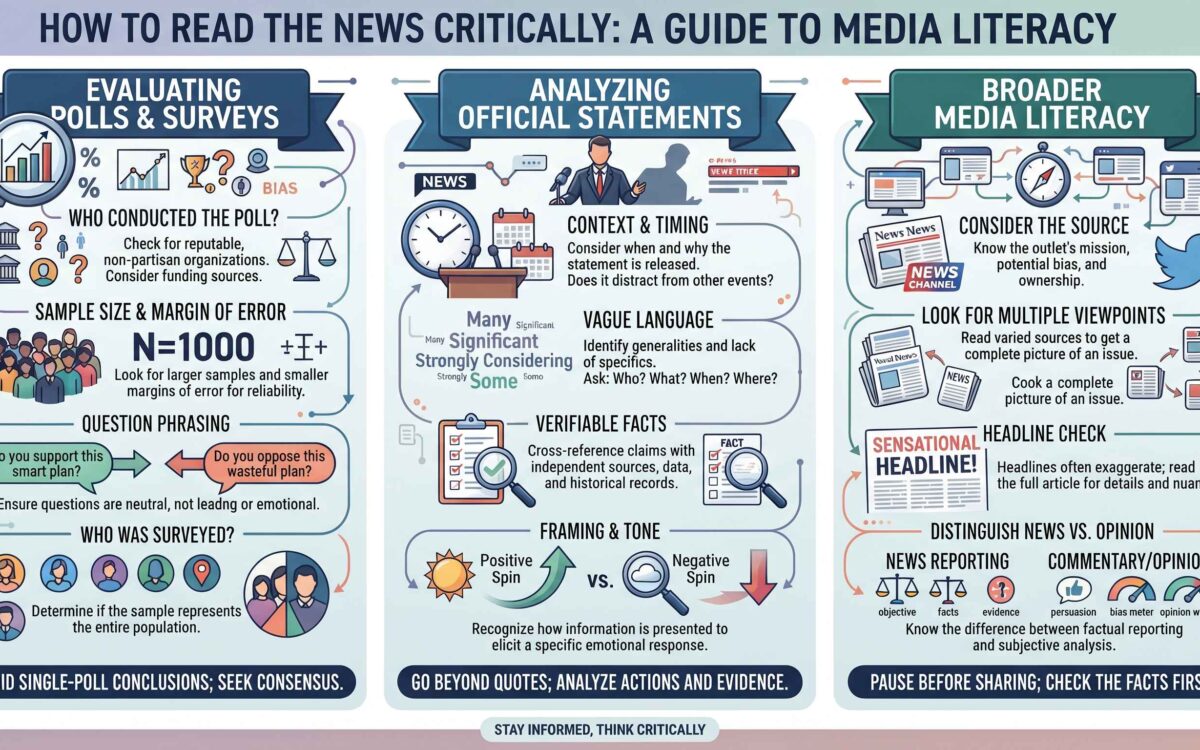
Polls are snapshots, not predictions. A good poll can tell you roughly what a population thinks at a given moment, but only if it was done carefully.
Look for the following details. The sample size and how people were selected matter, because a poll that reaches only volunteers or one narrow group does not represent everyone. The margin of error tells you how much the result might differ from the real value. If one candidate leads by two points and the margin of error is three points, the race is effectively too close to call. The wording of questions can push answers in a direction, and the order of questions can also influence responses. The dates matter, since opinions change after major events. And the organization that paid for or conducted the survey should be clear.
Beware of headlines that treat small changes as dramatic shifts. A move of one point within the margin of error is likely noise. This guide explains how to read an opinion poll and understand the margin of error (in Spanish) with clear examples.
How to read an official statement or press conference
Official communications are an important source, but they are also written to present a message. Reading them well means noticing what they say and what they leave out.
Ask what exactly is being announced, and whether it is a decision, a plan or only an intention. Look for specific figures, dates and responsible parties. Vague phrases such as “significant progress” or “measures will be evaluated” often mean there is little concrete to report. Notice which questions were answered in a press conference and which were avoided. Compare the statement with independent reporting and with the underlying documents when available.
When a statement is about a controversy, check whether those affected had a chance to respond. A story with only one side is incomplete, whichever side it is. For practical advice, read this article on how to read an official statement and a press conference with a critical eye (in Spanish).
Spotting weak or misleading content
Several warning signs appear again and again. Emotional language designed to make you angry or afraid. No named sources, or sources that cannot be verified. Statistics with no context, such as a percentage without the total number behind it. Charts with truncated axes that exaggerate small differences. Photos or videos reused from other events. And pressure to share immediately.
A simple habit helps: pause before sharing. Take thirty seconds to check who published it, search whether other reliable outlets report the same thing and look at the original source of any quoted figure.
Check a claim in three quick steps
First, find the original. Search for the document, study or full video behind the claim, rather than relying on a summary. Second, look for corroboration. If something important is true, more than one independent source usually reports it. Third, check the context. Ask what comes before and after the quote, and what the data look like over a longer period.
Fact-checking organizations and the corrections pages of established media outlets are helpful tools, but they work best when combined with your own questions.
Why media literacy matters for everyone
A community that can evaluate information is harder to manipulate and better able to debate real problems. Schools can play a role by teaching students how media works, how to cite sources and how to question what they see. This opinion piece on media education in schools (in Spanish) discusses why this training deserves a place in the curriculum.
Media literacy is not only for students. Adults who share news with family groups and social networks influence what others see. Setting a good example, by checking before sharing and correcting mistakes openly, has real value.
Build a healthier information diet
More news is not always better. Choose a few reliable sources with different perspectives and read them with attention, instead of scrolling through endless feeds. Set specific times to catch up rather than checking constantly. Favor in-depth reporting for important topics and treat breaking news with extra caution, since early reports are often incomplete or later corrected.
Be aware of your own biases, too. We tend to believe information that agrees with what we already think and to scrutinize information that does not. A useful exercise is to apply the same standards to claims you like and claims you dislike.
A short checklist
Before you trust or share a story, ask: Who published this, and what is their record? What exactly is the evidence? Is it fact, analysis or opinion? Are other reliable sources reporting it? Is the date current? Does it feel designed to trigger an emotional reaction?
No one gets every judgment right, and good outlets make mistakes as well. What matters is the habit of questioning calmly, correcting yourself when needed and giving more weight to evidence than to volume.
For more explanations on current affairs and how information works, visit Al Heraldo.