How to Spot a Link Farm: A Practical Guide for 2026

Links from other websites can help people discover a business, but not every link is a sign of genuine interest or credibility. For companies reviewing their SEO or considering a link-building offer, knowing how to spot a link farm can help avoid tactics that put a site’s reputation and search visibility at risk. The key is to look at the purpose and quality of a linking site, not just the number of links it can provide.
What Is a Link Farm?
A link farm is a website, or a group of websites, created mainly to publish links and manipulate search rankings. Its pages may contain long lists of unrelated links, thin articles written around keywords, or posts that exist primarily to point readers to other sites. Some networks link to one another to make those links appear more influential.
That does not mean every directory, guest article, or page with several links is a link farm. Legitimate industry directories help people find relevant providers. Editorial articles may cite useful sources, and businesses can earn links by publishing research or resources others genuinely want to reference. Context and intent matter.
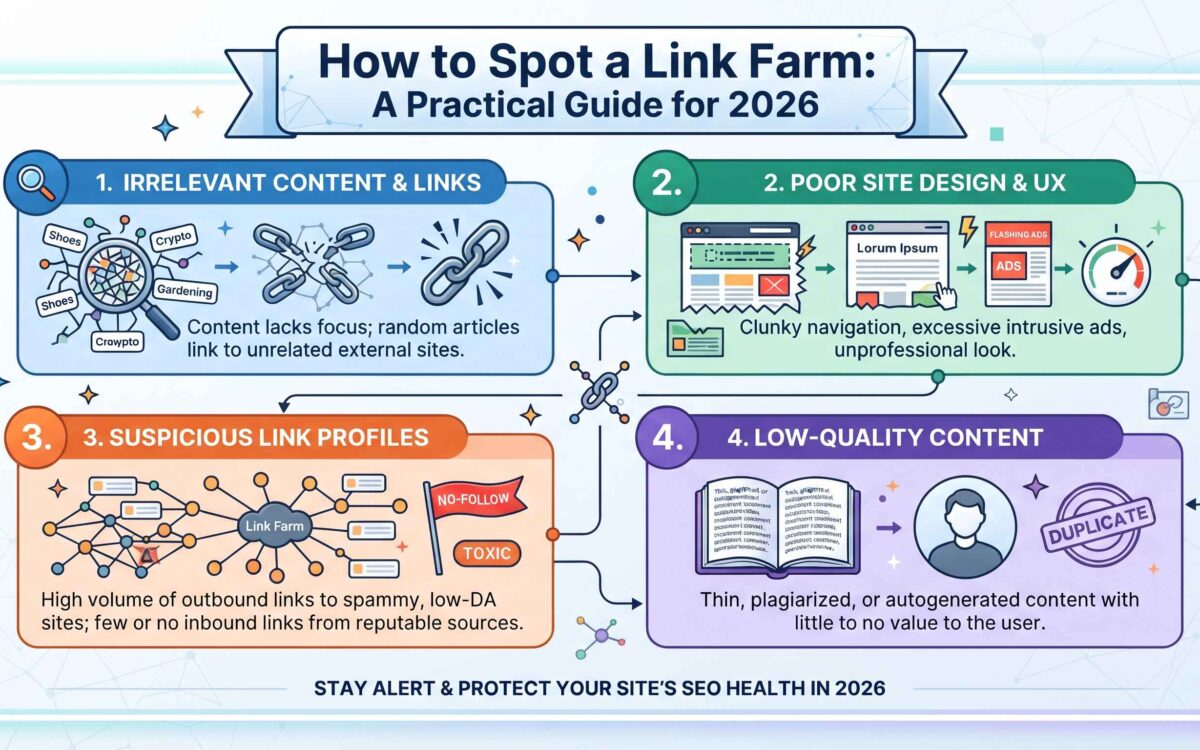
How to Spot a Link Farm
No single sign proves that a website is part of a link farm. Use several checks together, and be cautious if a site looks unnatural across its content, audience, and linking patterns.
Check whether the topics make sense
Look at the site’s recent articles and ask whether they serve a recognizable audience. A publication about home improvement might reasonably cover contractors, materials, and renovation costs. If the same site jumps between unrelated topics with no clear editorial purpose, that may suggest it publishes for link placement rather than readers.
Also inspect the page where your link would appear. Does the surrounding article explain the subject and offer useful information, or does it seem to exist only to accommodate a link? A coherent topic match is more meaningful than a broad claim that a site covers “everything.”
Look beyond polished design
A professional-looking template does not guarantee a trustworthy publication. Review several pages for original reporting, clear explanations, and evidence of editing. Thin, repetitive articles, awkward keyword use, copied passages, and generic text that could fit any business are reasons to investigate further.
Check whether the site publishes consistently and whether its articles appear to have an editorial standard. A large archive is not automatically a positive sign if most pages are shallow or appear to have been produced in bulk.
Review outbound links and link patterns
Look at a few links on the site. Do they lead to relevant, credible resources, or do they point to unrelated commercial pages? Repeated exact-match anchor text, many paid-looking placements, and links clustered in footers or author profiles can be warning signs. Consider whether the link would still make sense to a reader if search engines did not exist.
Tools that estimate traffic or inspect backlinks can add useful context, but their numbers are estimates, not a verdict. A low estimate alone does not establish that a site is manipulative, and a large audience figure does not prove that its links are editorially earned. For a more detailed set of checks, see this guide on spotting link farms in 2026.
Ask Questions Before Accepting a Link Offer
Before paying for a placement or commissioning link-building work, ask who chooses the topic, how the site selects contributors, and whether links are disclosed or marked appropriately. Request examples of published work and review the actual pages rather than relying on a sales sheet. Be wary of guaranteed rankings, promises of a specific number of powerful links, or packages that provide little information about where links will appear.
If you hire a freelancer to create content or support marketing, assess the proposed work as carefully as you would assess a publisher. A marketplace such as Osdire lets buyers compare service offers across categories, including writing and marketing; its guide to getting more orders online discusses what makes an offer clear. When comparing any service, define the deliverables, ask how placements will be selected, and agree on what evidence of completion you expect. Clear pricing and a defined approval process make it easier to evaluate the work without treating link volume as the goal.
What to Do If You Find Suspicious Links
Start by documenting the URLs, the pages they point to, and how you discovered them. Check whether your business or an agency working on its behalf arranged the links. If a supplier created them, ask for a clear account of the work and request that manipulative placements be removed or corrected where possible.
A handful of unexpected links does not necessarily require drastic action. Avoid making rushed changes based on a single tool report. Review the broader pattern, your own link-building history, and current search-engine guidance. If a serious or extensive issue appears to have resulted from past work, consider getting advice from an experienced SEO professional before deciding on next steps.
Choose Relevance Over Volume
Sustainable link-building starts with work that gives another publisher a reason to cite your business: useful research, clear resources, expert commentary, or genuinely helpful products and services. When evaluating an opportunity, prioritize topic relevance, editorial quality, audience value, and transparent terms. Those checks help distinguish a meaningful mention from a link created mainly to influence rankings—and support a more durable search strategy.