Prokaryotic Cell: Structure, Functions, Examples & Diagram

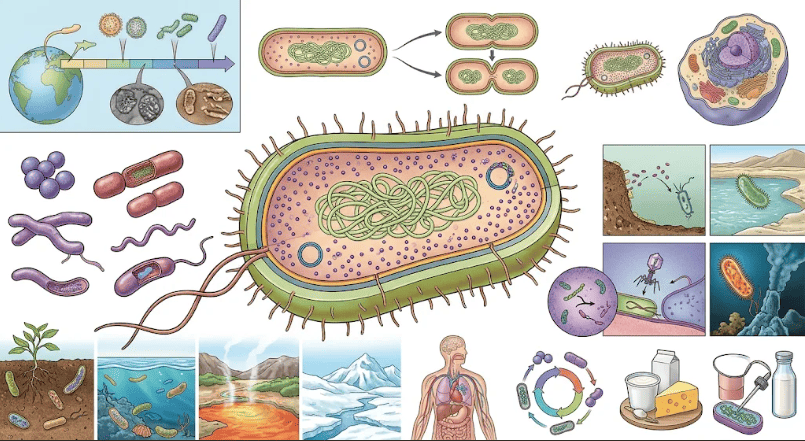
A prokaryotic cell is the simplest and oldest type of cell known to science. It is a single-celled organism that has no true nucleus and no membrane-bound organelles. Its DNA floats in the cytoplasm, and every chemical reaction the cell needs takes place in the same open space. Even with this simple design, prokaryotic cells are among the most successful life forms on Earth. They live in soil, oceans, hot springs, glaciers and inside the human body.
In this guide you will learn the prokaryotic cell definition, its structure with a clear parts table, its main characteristics, real examples, and how it compares with a eukaryotic cell.
Table of Contents
- What is a prokaryotic cell?
- Prokaryotic cell structure
- Prokaryotic cell diagram: how to read it
- Characteristics of prokaryotic cells
- Types and examples of prokaryotic cells
- Prokaryotic vs eukaryotic cells
- How prokaryotic cells reproduce
- Why prokaryotic cells matter
- Frequently asked questions
What Is a Prokaryotic Cell?
The word prokaryote comes from Greek and roughly means “before the nucleus”. That name fits well, because these cells appeared on Earth billions of years before cells with nuclei evolved. The fossil record shows prokaryotes were already living around 3.5 billion years ago.
A prokaryotic cell is defined by three things:
- It has no nucleus. The genetic material sits in a region called the nucleoid.
- It has no membrane-bound organelles such as mitochondria, the Golgi apparatus or the endoplasmic reticulum.
- It is unicellular. Each cell is a complete living organism, although many can gather into colonies or biofilms.
Scientists place all prokaryotes into two domains of life: Bacteria and Archaea. The third domain, Eukarya, includes animals, plants, fungi and protists, and is built from eukaryotic cells.
Prokaryotic Cell Structure
The structure of a prokaryotic cell is compact and efficient. Some parts are found in almost every prokaryote, while others appear only in certain groups. The table below gives a quick overview, and the sections after it explain each part.
| Part | Where it is found | Main job |
|---|---|---|
| Nucleoid | Inside the cytoplasm | Holds the main chromosome (DNA) |
| Plasmid | Inside the cytoplasm | Carries extra genes, such as antibiotic resistance |
| Ribosomes | Cytoplasm | Build proteins |
| Cytoplasm | Inside the membrane | Gel-like fluid where reactions happen |
| Cell membrane | Under the cell wall | Controls what enters and leaves |
| Cell wall | Outside the membrane | Gives shape and protection |
| Capsule | Outside the wall (some species) | Protects against drying out and immune attack |
| Pili (fimbriae) | Surface | Attachment and DNA transfer |
| Flagella | Surface (some species) | Swimming movement |
Nucleoid
The nucleoid is an irregular region in the cytoplasm where the cell’s chromosome is packed. There is no membrane around it, which is the key difference from a eukaryotic nucleus. In most bacteria the chromosome is a single circular DNA molecule, although a few species, such as the Lyme disease bacterium Borrelia burgdorferi, have a linear chromosome.
Plasmids
Plasmids are small, circular DNA molecules that exist separately from the main chromosome. They are not essential for basic survival, but they can give a cell a big advantage, for example resistance to an antibiotic or the ability to break down an unusual food source. Cells can also pass plasmids to each other, which is one reason resistance spreads so quickly among bacteria.
Ribosomes
Every prokaryotic cell contains many ribosomes, the tiny machines that read genetic instructions and assemble proteins. Prokaryotic ribosomes are the 70S type, made of a 50S and a 30S subunit. They are smaller than the 80S ribosomes of eukaryotic cytoplasm. This difference is important in medicine, because several antibiotics target 70S ribosomes without harming human cells.
Cytoplasm
The cytoplasm is the watery, gel-like interior that holds enzymes, salts, nutrients, RNA and proteins. Since there are no organelles to divide the work, processes such as glycolysis and protein synthesis happen directly in the cytoplasm.
Cell Membrane
The cell membrane (plasma membrane) is a thin double layer of lipids with embedded proteins. It decides which substances can enter or leave. Because prokaryotes have no mitochondria or chloroplasts, this membrane also hosts energy-producing steps such as the electron transport chain, and in photosynthetic bacteria, the light reactions.
Cell Wall
Most prokaryotes are wrapped in a rigid cell wall. In bacteria it is built mainly from peptidoglycan, a mesh of sugars and short peptides. The thickness of this layer is the basis of the Gram stain:
- Gram-positive bacteria have a thick peptidoglycan wall and stain purple.
- Gram-negative bacteria have a thin peptidoglycan layer plus an extra outer membrane and stain pink.
Archaea also have cell walls, but theirs do not contain true peptidoglycan. A few prokaryotes, such as Mycoplasma, have no cell wall at all and depend on their membrane for support.
Capsule and Slime Layer
Some bacteria produce a sticky outer coat called a capsule. It helps the cell stick to surfaces, resist drying and, in disease-causing species, hide from the immune system.
Pili and Flagella
Pili (also called fimbriae) are thin hair-like projections used to attach to surfaces. A special type, the sex pilus, helps one bacterium pass DNA to another. Flagella are long, whip-like filaments that spin like a propeller and push the cell toward food or away from danger.
Prokaryotic Cell Diagram: How to Read It
A typical prokaryotic cell diagram shows an oval or rod-shaped cell. To read it quickly, work from the outside in:
- Outer layers: capsule, then cell wall, then cell membrane.
- Surface extras: flagella and pili sticking out.
- Inside: a tangled nucleoid, small circular plasmids and many dots for ribosomes, all floating in the cytoplasm.
If you are making your own labeled diagram for an exam, remember there should be no nucleus and no mitochondria drawn anywhere.
Characteristics of Prokaryotic Cells
These are the features you should remember:
- No true nucleus. DNA lies in the nucleoid.
- No membrane-bound organelles. Some bacteria do contain protein-walled compartments, but these are not true membrane organelles.
- Small size. Most are only about 1 to 10 micrometres long, though a few giants exist.
- Simple, usually circular DNA. One main chromosome plus optional plasmids.
- 70S ribosomes. Smaller than eukaryotic ones.
- Cell wall in most species. Different in bacteria and archaea.
- Fast reproduction. Many divide by binary fission, and some, like E. coli, can double in roughly 20 minutes under ideal conditions.
- Great metabolic variety. Some make food using sunlight, others use chemicals such as sulfur or iron, and others feed on dead matter.
- Wide habitat range. From polar soil to boiling vents.
Types and Examples of Prokaryotic Cells
Bacteria
Bacteria are the most familiar prokaryotes. They come in several shapes:
- Cocci (spherical), for example Streptococcus
- Bacilli (rod-shaped), for example Lactobacillus and E. coli
- Spirilla (spiral), for example Helicobacter pylori
- Vibrios (comma-shaped), for example Vibrio cholerae
Cyanobacteria, formerly called blue-green algae, are photosynthetic bacteria that helped fill Earth’s early atmosphere with oxygen.
Archaea
Archaea look similar to bacteria under a microscope but differ in their membrane lipids, genes and cell wall chemistry. Well-known groups include:
- Methanogens, which produce methane in oxygen-free places such as wetlands and animal guts
- Halophiles, which thrive in extremely salty water
- Thermophiles, which live in hot springs and deep-sea vents
Archaea were once thought to live only in extreme places, but they are now known to exist in oceans, soils and even the human gut.
Prokaryotic vs Eukaryotic Cells
The split between prokaryotic and eukaryotic cells is one of the biggest dividing lines in biology.
| Feature | Prokaryotic cell | Eukaryotic cell |
|---|---|---|
| Nucleus | Absent (nucleoid region) | Present, enclosed by a membrane |
| Membrane-bound organelles | Absent | Present |
| Typical size | About 1 to 10 µm | About 10 to 100 µm |
| DNA | Usually one circular chromosome plus plasmids | Several linear chromosomes |
| Ribosomes | 70S | 80S in cytoplasm |
| Organisms | Bacteria and archaea | Animals, plants, fungi, protists |
| Cell division | Binary fission | Mitosis and meiosis |
| Complexity | Simple, single-celled | Often complex, often multicellular |
One famous idea, the endosymbiotic theory, explains how the two types are connected. It proposes that mitochondria and chloroplasts began as free-living prokaryotes that were taken inside larger cells and stayed there. Evidence includes their own circular DNA and their bacteria-like ribosomes.
For a deeper look at the other side of this comparison, read our guide on the eukaryotic cell and its organelles.
How Prokaryotic Cells Reproduce
Prokaryotes reproduce asexually, mostly through binary fission. The cell copies its DNA, grows longer, and then the membrane and wall pinch inward to split it into two identical daughter cells. Because there is no mitosis, the process is quick.
Even without sexual reproduction, prokaryotes can still swap genes. This is called horizontal gene transfer and happens in three main ways:
- Transformation: a cell picks up free DNA from its surroundings.
- Transduction: a virus carries DNA from one cell to another.
- Conjugation: two cells connect through a pilus and pass a plasmid across.
This gene sharing, along with fast growth, helps populations adapt rapidly, including by developing antibiotic resistance.
To see how these cells fit into the wider picture of life, you can also explore our overview of bacteria and their role in nature.
Why Prokaryotic Cells Matter
Prokaryotic cells affect almost every part of life on the planet:
- Nutrient cycles. They recycle carbon, nitrogen, sulfur and phosphorus through soil and water.
- Human health. Gut bacteria help digest food and train the immune system, while a smaller group of species cause diseases such as cholera and tuberculosis.
- Agriculture. Nitrogen-fixing bacteria help crops get usable nitrogen.
- Food and industry. Bacteria are used to make yogurt, cheese, vinegar, medicines and biofuels.
- Biotechnology. Bacterial enzymes and plasmids are basic tools in genetic engineering and CRISPR research.
- Science of early life. Studying them helps us understand how life began and evolved.
Students who want to understand how all these cell parts fit together can continue with our simple explanation of cell organelles and their functions.
Frequently Asked Questions
What is a prokaryotic cell in simple words?
It is a very small, single-celled organism with no nucleus and no membrane-bound organelles. Bacteria and archaea are the two groups made of prokaryotic cells.
Do prokaryotic cells have a nucleus?
No. Their DNA is located in the nucleoid, a region of the cytoplasm that has no surrounding membrane.
Do prokaryotes have mitochondria?
No. They produce energy using their cell membrane and cytoplasm instead.
Do prokaryotic cells have ribosomes?
Yes. They have 70S ribosomes, which are smaller than the 80S ribosomes in the cytoplasm of eukaryotic cells.
Do all prokaryotic cells have a cell wall?
Most do, but not all. Mycoplasma bacteria, for example, have no cell wall.
What are three examples of prokaryotic cells?
Escherichia coli, Staphylococcus aureus and methane-producing archaea (methanogens) are common examples.
Which structures do prokaryotic and eukaryotic cells share?
Both have a cell membrane, cytoplasm, ribosomes and DNA.
How do prokaryotic cells reproduce?
Mainly by binary fission, a form of asexual reproduction in which one cell splits into two identical cells.
Conclusion
The prokaryotic cell is proof that simple does not mean weak. With only a membrane, a wall, a ribosome-filled cytoplasm and a loose strand of DNA, these cells have survived for billions of years and now shape the air, soil, oceans and our own bodies. Remember the three core points: no nucleus, no membrane-bound organelles, and a very wide range of examples across bacteria and archaea. Once you understand how a prokaryotic cell works, the rest of cell biology becomes much easier to follow.