Strategic Foundations: Building a High-Impact Plan from Scratch


In today’s ever-evolving digital landscape, knowing which marketing efforts truly drive results can feel like searching for a needle in a haystack. This is especially true for businesses in niche industries. Many organizations, almost half, are currently operating without a clearly defined digital marketing strategy. In October 2026, relying on scattered tactics is a recipe for missed opportunities.
A robust digital marketing strategy is no longer optional; it’s essential for survival and growth. With customer journeys becoming increasingly complex, new privacy laws, and the rapid rise of AI, a cohesive plan is critical. This extensive guide provides the framework you need to succeed.
We will explore how to build a powerful strategy from the ground up. We’ll show you how to set clear goals, define your target audience, and select the most effective channels. Whether you’re in a specialized sector like jewelry industry digital marketing or another unique market, our insights offer actionable steps. We will also cover smart budget allocation, essential metrics, emerging trends for 2026, and common mistakes to avoid. By the end, you will be equipped to create a data-driven, omnichannel strategy that truly delivers.
Building a successful digital marketing strategy, especially within a niche industry, begins with a solid foundation. Without a clear strategic blueprint, even the most innovative tactics can fall flat. Our approach emphasizes a structured, analytical process that aligns every marketing effort with overarching business objectives. It’s about moving beyond simply “doing” digital marketing to strategically “achieving” digital marketing goals.
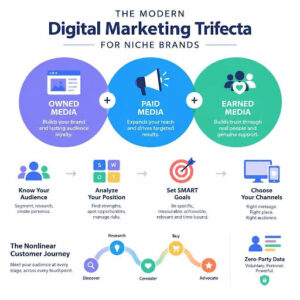
First, we must deeply understand our audience through meticulous audience segmentation and the creation of detailed buyer personas. Segmentation involves dividing our broader market into distinct groups based on shared characteristics like demographics, psychographics, behaviors, and needs. For niche markets, this segmentation becomes even more granular, allowing us to pinpoint specific sub-segments with unique pain points and aspirations. Once segments are identified, we develop buyer personas fictional, generalized representations of our ideal customers. These personas go beyond basic demographics to include motivations, goals, challenges, and even preferred communication channels. Understanding these nuances is paramount, as it informs every subsequent strategic decision, from content creation to channel selection.
Next, we conduct a thorough SWOT analysis (Strengths, Weaknesses, Opportunities, Threats). This internal and external audit helps us understand our competitive landscape, identify our unique selling propositions, and anticipate potential challenges. For niche players, this might mean recognizing a specific market gap we can fill or a unique expertise we possess that competitors lack.
Finally, we define SMART goals: Specific, Measurable, Achievable, Relevant, and Time-bound. Vague objectives like “increase brand awareness” are replaced with concrete targets such as “increase organic search traffic by 20% for high-intent keywords within the next six months.” These goals provide the necessary direction and a benchmark for measuring success.
To effectively reach our audience, we must also understand the different types of media channels available. In 2026, a balanced approach often incorporates a mix of owned, paid, and earned media.
Media Type Definition Advantages for Niche Industries Examples Owned Media Channels controlled directly by your brand. Full control over content and message; builds long-term assets and audience loyalty. Website, blog, email list, proprietary community platform. Paid Media Advertising space purchased on third-party channels. Immediate reach, precise targeting, scalability, and performance tracking. Search ads (PPC), social media ads, display ads, sponsored content. Earned Media Publicity or exposure gained through promotional efforts other than paid advertising. High credibility and trust, organic reach, word-of-mouth marketing. PR mentions, social media shares, customer reviews, influencer endorsements.
Aligning Digital Marketing Strategies with the Nonlinear Customer Journey
The traditional linear marketing funnel is largely obsolete in 2026. Today’s customer journey is a complex, often unpredictable path involving numerous touchpoints across various platforms and devices. For niche industries, where customers might require more education or have highly specific needs, understanding and mapping this nonlinear journey is critical. We must anticipate where our customers are, what they are thinking, and how they prefer to interact at every stage.
A key element in navigating this complexity is the collection and utilization of zero-party data. Unlike first-party data, which is collected from customer interactions, zero-party data is information that customers voluntarily and proactively share with a brand. This includes preference center selections, purchase intentions, personal context, and how they want the brand to recognize them. With tightening privacy laws, zero-party data becomes an ethical and effective foundation for personalization, allowing us to tailor experiences without relying on invasive tracking.
We also focus on identifying and optimizing for micro-moments those instances when people reflexively turn to a device to act on a need to know, go, do, or buy. For a niche business, these moments might be highly specific, such as a potential customer searching for “ethical sourcing for rare gemstones” or “specialized software for small architectural firms.” By understanding these micro-moments, we can ensure our content and ads are present and helpful precisely when intent is highest.
Intent discovery goes hand-in-hand with micro-moments. We analyze search queries, website behavior, and social listening data to uncover the underlying intent behind customer actions. Is someone looking for information, comparison, or ready to purchase? Our strategy must align content and calls to action with these varying intents. Finally, leveraging behavioral triggers allows us to automate personalized responses. For instance, if a customer browses a specific product category on our website but doesn’t convert, an automated email sequence or a retargeting ad can be triggered, offering relevant information or a special incentive. This proactive, context-aware engagement is vital for guiding customers through their unique journeys.
Resource Governance and Balanced Budget Allocation
Effective digital marketing in niche markets requires not only a smart strategy but also intelligent allocation of resources. This includes financial budget, team bandwidth, and technological tools. A common pitfall is over-investing in one area while neglecting others, leading to an unbalanced and ultimately inefficient strategy. Our goal is to achieve resource governance a systematic approach to managing all marketing assets and investments.
A practical framework for budget allocation is the 70-20-10 rule:
- 70% of the budget is allocated to proven, high-performing channels and tactics that consistently deliver results. These are our reliable workhorses.
- 20% is dedicated to optimizing and experimenting with existing channels, trying new creative approaches, or testing minor variations of successful campaigns.
- 10% is reserved for exploring entirely new channels, emerging technologies (like new AI applications), or innovative, high-risk, high-reward campaigns.
This framework ensures stability while fostering innovation. For niche industries, the “proven” channels might be different from mainstream businesses. For example, for a B2B niche, LinkedIn and industry-specific forums might be the 70%, while for a specialized B2C product, it could be highly targeted social media ads or influencer collaborations.
Paid media allocations must be strategic, focusing on platforms where our niche audience is most active and where we can achieve the highest return on ad spend (ROAS). This means constantly monitoring performance and being ready to shift budgets based on real-time data. Simultaneously, we must invest in organic assets our owned media like websites, blogs, and email lists. These are long-term investments that build authority, trust, and a sustainable audience, reducing reliance on paid channels over time.
Production bandwidth refers to the human resources and time required to create high-quality content, manage campaigns, and analyze data. For niche businesses, this often means maximizing efficiency through automation and carefully prioritizing content creation that aligns with our SMART goals and buyer personas. Finally, tool governance involves selecting, integrating, and managing our marketing technology stack. This includes CRM systems, analytics platforms, marketing automation tools, and content management systems. A cohesive tech stack ensures data flows smoothly, enabling accurate attribution and streamlined workflows, rather than a fragmented collection of disparate tools.
Core Digital Marketing Strategies for Specialized Sectors
For businesses operating in specialized sectors, the digital marketing landscape presents both unique challenges and unparalleled opportunities. Our approach focuses on strategies that cut through the noise and directly engage highly specific audiences.

Effective audience targeting is paramount. This goes beyond basic demographics to leverage psychographic data, behavioral patterns, and intent signals. For a niche market, this might involve using custom audience segments on social platforms, precise keyword targeting in search, or even partnering with industry-specific publications for sponsored content. The goal is to reach individuals who are genuinely interested in our specialized offerings, rather than casting a wide net.
In 2026, short-form video continues its dominance across platforms like TikTok, Instagram Reels, and YouTube Shorts. For niche brands, this format offers a powerful way to convey complex ideas, showcase unique products, or demonstrate specialized services in an engaging, digestible manner. Think quick tutorials, behind-the-scenes glimpses, or compelling product stories that resonate with a specific audience. The visual and auditory nature of video can build strong emotional connections and trust, which is invaluable in specialized markets.
Omnichannel execution ensures that our brand message is consistent and cohesive across every touchpoint a customer interacts with, whether it’s an email, a social media ad, a website visit, or a direct message. This integrated approach creates a seamless and personalized experience, building brand loyalty. For instance, a customer who views a product on social media might receive a personalized email follow-up, and then see a retargeting ad featuring that same product. This unified brand presence is crucial for guiding customers through their decision-making process.
Optimizing conversion funnels is about making it as easy as possible for interested prospects to become customers. This involves clear calls to action, streamlined landing pages, and a frictionless checkout process. For specialized products or services, the funnel might include educational content, webinars, or personalized consultations before a direct purchase. Each step should address potential customer concerns and reinforce the value proposition. For businesses in highly specific markets, such as those focusing on jewelry industry digital marketing, tailoring these funnels to the unique buying journey of their clientele which often involves significant consideration and trust-building is absolutely essential for success.
Generative Engine Optimization (GEO) and Search Authority
The search landscape is undergoing a profound transformation in 2026, largely driven by advancements in AI. The rise of AI Overviews (also known as Search Generative Experience or SGE) means that search engines are increasingly providing direct, AI-generated answers to user queries, often reducing the need for users to click through to websites. This shift necessitates a new approach to search visibility, moving beyond traditional SEO to Generative Engine Optimization (GEO).
GEO focuses on optimizing content not just for search engine algorithms, but for the AI models that synthesize information and generate these overviews. Key to this is the extensive use of structured data and schema markup. By tagging our content with specific schema (e.g., Product, FAQ, How-To, Review), we make it easier for AI to understand the context, purpose, and key information on our pages, increasing the likelihood of our content being featured in AI Overviews. This is particularly important for niche topics where authoritative information might be scarce.
Building topical authority is more critical than ever. Instead of focusing on individual keywords, we aim to become the definitive resource for a cluster of related topics within our niche. This involves creating comprehensive, high-quality content that covers all facets of a subject, demonstrating deep expertise, experience, authoritativeness, and trustworthiness (E-E-A-T). For example, a business selling specialized industrial equipment wouldn’t just optimize for “industrial pumps”; they would create in-depth guides on pump maintenance, troubleshooting, material science, and industry regulations, establishing themselves as an undeniable expert.
For businesses with a physical presence or those serving a specific geographic area, optimizing for local search rankings remains a cornerstone of search authority. This includes meticulously managing Google Business Profile listings, collecting local reviews, and ensuring consistent NAP (Name, Address, Phone) information across all online directories. As AI-powered assistants become more integrated into daily life, local search will increasingly rely on well-structured, accurate local data to provide relevant recommendations. For deeper insights into enhancing your local online visibility, exploring resources on improving local search rankings can be highly beneficial.
Modernizing Traditional Digital Marketing Strategies for 2026
While new trends emerge, foundational digital marketing channels remain vital, albeit modernized for the 2026 landscape. We’re seeing a significant evolution in how we approach email, SMS, and community engagement, driven by personalization and data.
Email automation has moved far beyond simple newsletters. In 2026, it’s about sophisticated, multi-stage journeys triggered by user behavior. This includes welcome sequences, abandoned cart reminders, post-purchase follow-ups, and re-engagement campaigns, all dynamically tailored to individual preferences and actions. AI-powered tools enhance this by optimizing send times, subject lines, and content based on predictive analytics, ensuring maximum relevance and open rates.
SMS messaging has seen a resurgence, particularly for time-sensitive offers, order updates, and direct customer service. Its high open rates make it an incredibly effective channel for niche businesses to communicate directly with highly engaged customers. However, it requires strict adherence to consent-based marketing and delivering genuine value to avoid being perceived as intrusive.
Dynamic personalization is no longer a luxury but an expectation. Leveraging AI, we can deliver highly individualized experiences across all channels. This means website content that adapts to a user’s browsing history, ad creatives that reflect their interests, and email content that speaks directly to their needs. For niche markets, this level of personalization helps build stronger relationships and reinforces the brand’s understanding of their unique customer base.
Predictive retention programs use advanced analytics and AI-driven churn modeling to identify customers at risk of leaving before they actually do. By analyzing behavioral patterns and engagement metrics, we can trigger automated loyalty offers, personalized content, or direct outreach to re-engage these customers. This proactive approach is far more cost-effective than acquiring new customers, especially in niche markets where customer lifetime value can be very high.
Finally, community hubs are becoming central to building brand loyalty and fostering advocacy. These can range from private online forums, Discord servers, or dedicated sections on a brand’s website where customers can connect with each other and with the brand. For niche industries, these communities provide a space for enthusiasts to share knowledge, offer feedback, and feel a sense of belonging. This human-centered approach builds authentic connections that automation alone cannot achieve.
Data Centralization, Attribution Tracking, and Measurement
In the complex digital ecosystem of 2026, fragmented data is the enemy of effective strategy. To truly understand what drives conversions and revenue, we must move beyond siloed platform reports and embrace a unified approach to data.

Data centralization is the foundation. This involves consolidating data from all marketing touchpoints ad platforms, analytics tools, CRM systems, email marketing platforms, social media, and even offline sources into a single source of truth, typically a data warehouse. This eliminates manual CSV exports, reduces reporting latency, and provides a comprehensive view of customer interactions. Choosing an appropriate Extract, Transform, Load (ETL) platform is crucial for automating these data pipelines, ensuring accuracy and real-time insights.
Attribution tracking is how we assign credit to the various marketing touchpoints that contribute to a conversion. With the deprecation of third-party cookies and evolving privacy regulations, traditional last-click attribution is increasingly insufficient. We implement a consistent UTM taxonomy across all campaigns and channels to ensure every click and interaction is properly tagged and traceable. This standardization is critical for accurate measurement.
Moreover, linking offline conversions (e.g., phone calls, in-store purchases influenced by digital ads) back to our digital efforts provides a more complete picture of ROI. This often involves CRM integration and unique tracking codes.
Closed-loop reporting connects marketing efforts directly to sales outcomes. By integrating our marketing data with our CRM, we can track the entire customer journey from initial touchpoint to closed deal, understanding the true impact of our campaigns on pipeline revenue. This allows us to move beyond vanity metrics and focus on what truly drives business growth.
Understanding how different models attribute value is essential for accurate insights.
Attribution Model Description Advantages Disadvantages Single-Touch (e.g., Last Click) Gives 100% credit to the final marketing touchpoint before conversion. Simple to implement and understand. Ignores all prior interactions; undervalues channels higher in the funnel. Single-Touch (e.g., First Click) Gives 100% credit to the first marketing touchpoint. Highlights channels effective at initiating customer journeys. Ignores all subsequent interactions; undervalues closing channels. Multi-Touch (e.g., Linear) Distributes credit equally across all touchpoints in the customer journey. Acknowledges all interactions; provides a balanced view. Doesn’t account for varying importance of different touchpoints. Multi-Touch (e.g., Time Decay) Gives more credit to touchpoints closer to the conversion. Recognizes that recent interactions are often more influential. Still somewhat arbitrary; might undervalue early awareness channels. Multi-Touch (e.g., U-Shaped) Gives 40% credit to first and last touchpoints, distributing remaining 20% to middle touchpoints. Values both discovery and conversion points strongly. Can be complex to set up; still a predefined model. Multi-Touch (e.g., Data-Driven) Uses AI and machine learning to algorithmically assign credit based on actual conversion paths. Most accurate and objective; adapts to unique customer journeys. Requires significant data volume and advanced analytics tools. Core Performance Metrics and Pipeline Optimization
Measuring success in digital marketing goes beyond simple clicks and impressions. For niche industries, where customer acquisition can be more challenging and customer lifetime value (LTV) potentially higher, focusing on financially relevant metrics is paramount. We continuously monitor and optimize based on these core performance indicators:
Customer Acquisition Cost (CAC): This metric tells us how much it costs to acquire a new customer. For niche markets, CAC can sometimes be higher due to smaller target audiences, making efficient channel selection and conversion optimization crucial. We aim to reduce CAC while maintaining customer quality.
Customer Lifetime Value (CLV): CLV represents the total revenue a business can reasonably expect from a single customer account over their relationship with the business. For specialized sectors, where repeat business and word-of-mouth are often significant, a high CLV justifies a higher CAC and encourages investment in retention strategies.
Return on Ad Spend (ROAS): This metric directly measures the revenue generated for every dollar spent on advertising. It’s a critical indicator for paid media campaigns, helping us identify which ads, platforms, and targeting strategies are most profitable. For instance, in 2025, some B2B customers saw LinkedIn ads return a 121% ROAS, highlighting the importance of platform-specific effectiveness.
Conversion Rate: This is the percentage of website visitors or ad clicks that complete a desired action, such as making a purchase, filling out a form, or signing up for a newsletter. Optimizing conversion funnels involves continuous A/B testing of landing pages, calls to action, and user experience elements.
Churn Modeling: Using predictive analytics, we identify customers who are likely to discontinue using our product or service. This allows us to proactively intervene with targeted retention efforts, such as personalized offers or enhanced support, directly impacting CLV.
By focusing on these metrics and continuously optimizing our pipeline, we ensure that our digital marketing efforts are not just generating activity, but driving tangible, profitable growth for our niche businesses.
Critical Execution Pitfalls to Avoid in Specialized Markets
Even with a well-crafted strategy, execution can falter if common pitfalls are not recognized and avoided. This is especially true for niche industries, where resources might be tighter and the audience more discerning.
One of the most pervasive mistakes is chasing vanity metrics. Likes, shares, and impressions can feel good, but they rarely translate directly into revenue. We must resist the urge to optimize for these superficial numbers and instead focus on metrics that directly impact business goals, such as leads, conversions, and pipeline revenue.
Organizational silos can cripple a digital marketing strategy. When marketing, sales, and product teams operate independently, valuable insights are lost, and customer experiences become disjointed. Breaking down these silos through cross-functional communication, shared goals, and integrated data platforms ensures a cohesive customer journey.
Channel fragmentation occurs when a brand tries to be everywhere without a clear purpose or consistent message. This leads to diluted efforts and a confusing brand identity. For niche markets, it’s often more effective to dominate a few highly relevant channels rather than spread resources thin across many.
In 2026, ignoring compliance gaps related to privacy laws (like GDPR, CCPA, and emerging regional regulations) is a severe risk. Non-compliance can lead to hefty fines, reputational damage, and a loss of customer trust. Our strategies must be built on a foundation of ethical data collection, transparent privacy policies, and a commitment to customer consent, especially when dealing with sensitive niche data.
Here is a list of common digital marketing mistakes we actively work to avoid:
- Lack of a Defined Strategy: Operating without a clear roadmap, leading to ad-hoc campaigns and wasted resources. (49% of organizations still fall into this trap).
- Ignoring Mobile-First Design: With up to 70% of internet traffic from mobile devices, a non-responsive or slow mobile experience is a critical conversion killer.
- Poorly Defined Target Audience: Marketing to everyone means marketing to no one. Vague personas lead to ineffective targeting.
- Inconsistent Messaging: Brand voice and value proposition changing across different channels, confusing customers.
- Neglecting SEO: Relying solely on paid ads and ignoring organic search opportunities, especially for long-term authority.
- Not Measuring ROI: Failing to connect marketing spend directly to revenue, making it impossible to justify investments or optimize.
- Static Content Strategy: Not adapting content to evolving customer needs, search trends, or AI consumption patterns.
- Ignoring Customer Feedback: Failing to listen to and act on insights from customer reviews, social media, and support interactions.
- Underestimating the Power of Community: Overlooking opportunities to build engaged communities around a niche product or service.
- Failing to Adapt to AI and Algorithm Changes: Sticking to outdated tactics when search engines and social platforms evolve.
By proactively addressing these pitfalls, businesses in specialized markets can execute their digital marketing strategies more effectively, ensuring sustainable growth and a stronger competitive position.
Frequently Asked Questions About Digital Marketing
How do digital marketing strategies differ for niche B2B versus B2C businesses?
The fundamental principles of digital marketing understanding your audience, setting goals, and measuring results remain consistent. However, the application of these principles varies significantly between niche B2B and B2C contexts.
For niche B2B businesses, strategies are typically characterized by longer sales cycles and a greater emphasis on education and relationship-building. We often deal with multiple stakeholders within a purchasing committee, requiring content that addresses different roles and concerns. Channel selection leans towards platforms like LinkedIn, industry-specific forums, and professional events, where decision-makers gather. Content marketing focuses on in-depth whitepapers, case studies, webinars, and thought leadership that addresses complex pain points. Conversion funnels are designed for lead generation, nurturing, and sales enablement, often involving demos, consultations, and personalized outreach.
In contrast, niche B2C businesses often have shorter sales cycles and aim for more immediate conversions. The target audience is typically a single individual or household. Channel selection might favor visual platforms like Instagram, TikTok, Pinterest, or highly targeted display advertising, depending on the product. Content is often more emotionally driven, visually appealing, and focuses on lifestyle, benefits, and user-generated content. Conversion funnels are usually streamlined for direct-to-consumer sales, emphasizing product pages, e-commerce optimization, and engaging calls to action. While both require personalization, B2C often leverages it for mass customization, while B2B focuses on one-to-one account-based marketing.
How often should a business update its digital marketing strategy?
A digital marketing strategy should be a living document, not a static plan. While the core vision and long-term goals might remain stable for a year or two, the tactical execution and specific channel approaches require frequent adjustments.
We recommend quarterly reviews for tactical adjustments. This involves analyzing performance data from the previous quarter, identifying what worked and what didn’t, and making necessary tweaks to campaigns, content, and budget allocation. These reviews are crucial for staying agile and responsive to market changes.
Significant algorithm shifts by major platforms (Google, Meta, TikTok, etc.) or new privacy regulations warrant immediate strategic re-evaluation. These external factors can drastically impact reach and effectiveness, requiring prompt adaptation.
A comprehensive annual refresh is advisable to revisit the overarching strategy, re-evaluate buyer personas, conduct a new SWOT analysis, and set new SMART goals for the coming year. This ensures the strategy remains aligned with evolving business objectives and market conditions.
The pace of change in digital marketing demands agile adjustments. We advocate for a continuous optimization mindset, where data-driven insights lead to ongoing refinements, rather than waiting for scheduled review periods. This iterative approach ensures the strategy remains relevant and effective in a fast-moving landscape.
What is the most reliable way to measure marketing ROI across channels?
Measuring marketing ROI accurately across diverse digital channels is one of the biggest challenges for businesses in 2026, especially as customer journeys become more complex and privacy regulations limit traditional tracking. The most reliable approach involves a combination of robust data infrastructure and sophisticated analytical frameworks.
Firstly, establishing a strong revenue operations (RevOps) framework is crucial. This involves aligning people, processes, and technology across marketing, sales, and customer service to create a seamless, data-driven revenue engine. When all departments work from a unified data set and shared goals, it becomes easier to track the impact of marketing throughout the entire customer lifecycle.
Secondly, implementing closed-loop reporting is non-negotiable. This means connecting every marketing touchpoint to a measurable outcome in the sales pipeline or CRM. From the initial ad impression to the final sale, every step is tracked, allowing us to see exactly how marketing efforts contribute to revenue. This requires robust CRM integration with marketing automation and analytics platforms.
Thirdly, moving beyond single-touch attribution to multi-touch attribution models is essential. As discussed earlier, single-touch models (e.g., last-click) provide an incomplete picture. Data-driven multi-touch models, often powered by AI, distribute credit more accurately across all touchpoints that influence a conversion, providing a truer understanding of each channel’s contribution. This allows for more informed budget allocation and optimization.
Finally, ensuring seamless CRM integration is the backbone of reliable ROI measurement. When marketing data flows directly into the CRM, sales teams can provide feedback on lead quality, and marketing can see which campaigns generate the most valuable customers. This integration allows us to calculate customer lifetime value (CLV) and truly understand the long-term profitability of our marketing investments, moving beyond short-term ROAS.
Conclusion
In the dynamic digital landscape of October 2026, success for niche industries hinges on more than just a presence; it demands a strategically sound, data-driven approach. We have explored the critical elements of building such a strategy, from defining your audience and setting SMART goals to navigating the complexities of the nonlinear customer journey with zero-party data.
Our emphasis on strategic adaptability ensures that businesses can pivot effectively in response to emerging trends like GEO and AI Overviews, privacy law shifts, and ever-changing algorithms. Coupled with robust data governance centralizing data, implementing multi-touch attribution, and focusing on pipeline revenue we empower marketers to make informed decisions that directly impact the bottom line.
The journey to digital marketing mastery is one of continuous iteration. It’s about constant learning, testing, optimizing, and refining. By avoiding common pitfalls and embracing a holistic, omnichannel perspective, niche businesses can not only survive but thrive, achieving sustainable growth and building lasting connections with their highly specialized audiences. The time to build your future-proof digital marketing strategy is now.