Humanoid AI Robots: How They Are Changing the Future of Work

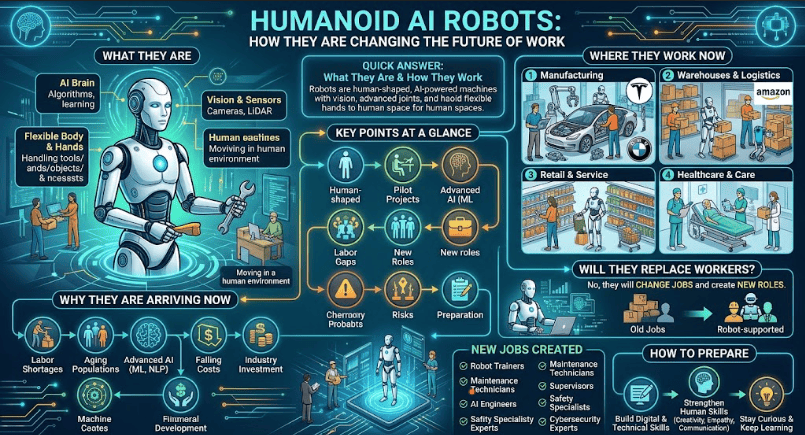
Quick Answer: Humanoid AI robots are machines shaped like humans and powered by artificial intelligence. They can walk, see, pick up objects and learn tasks in spaces built for people. They are changing the future of work by taking over repetitive, heavy and dangerous jobs in factories, warehouses, logistics, retail and healthcare, mainly to fill labor shortages. They are unlikely to replace most workers soon. Instead, they will change many jobs and create new roles such as robot trainers, maintenance technicians and safety specialists. Workers who learn digital, technical and people skills will benefit the most.
Key Points at a Glance
- What they are: Human-shaped robots that use AI, cameras and sensors to understand their surroundings and act.
- Where they work now: Mostly in pilot projects in car factories, warehouses and logistics centers.
- Why companies want them: Aging populations, labor shortages and the need to keep people away from dangerous tasks.
- Effect on jobs: Repetitive manual work will shrink, while technical, creative and caring roles will grow.
- Main risks: Job loss in some areas, high costs, safety concerns and cybersecurity threats.
- Best preparation: Learn to work with AI and machines instead of competing against them.
What Are Humanoid AI Robots?
A humanoid robot has a body similar to a person’s: a head, a torso, two arms and usually two legs. Older industrial robots are fixed arms that repeat one movement inside a cage. A humanoid is built to move around and work in places designed for humans, using the same stairs, doors, shelves and tools we use.
What makes the new generation different is artificial intelligence. Modern humanoids combine three things:
- Vision and sensors: Cameras and depth sensors help the robot see objects, people and obstacles.
- AI “brains”: Machine learning models let the robot understand instructions, plan steps and improve with practice.
- Flexible hands and bodies: Advanced joints and grippers allow it to pick up boxes, parts or tools of different shapes.
Because a humanoid fits into existing workplaces, a company does not have to rebuild its factory or warehouse to use one. That is a big reason investors and tech companies are paying so much attention to them. If you want to understand the AI side better, read our guide on how artificial intelligence works in everyday life.
Why Humanoid Robots Are Arriving Now
Humanoid robots have appeared in labs for decades, but several trends have come together at the same time:
- Labor shortages: Many countries cannot find enough workers for factories, warehouses, farms and care homes.
- Aging populations: Japan, South Korea, China and parts of Europe have fewer young workers and more retired people every year.
- Better AI: Large AI models now help robots understand language, recognize objects and learn new tasks faster than older programming methods.
- Falling costs: Cheaper sensors, motors and batteries are bringing the price of humanoid robots down step by step.
- Huge investment: Tech firms, carmakers and startups are spending billions to be first in this market.
Industries Using Humanoid Robots
Manufacturing
Car factories are among the first testing grounds. Carmakers such as BMW and Tesla have tested humanoid robots for tasks like moving parts, loading machines and carrying out simple assembly steps. These jobs are repetitive and physically tiring, which makes them a good fit for robots.
Warehouses and Logistics
Humanoid robots in warehouses can move boxes, sort packages and load totes onto conveyor belts. Amazon and logistics companies have tested robots like Agility Robotics’ Digit for exactly this kind of work. With online shopping growing every year, warehouses need extra help, especially during peak seasons.
Retail and Customer Service
Some stores, malls and airports use humanoid robots to greet visitors, answer simple questions and guide people to products or gates. Over time, they may also restock shelves and check inventory overnight.
Healthcare and Elderly Care
In aging societies, robots may help nurses lift patients, deliver medicine and supplies, remind people to take their medicine and keep elderly people company. Human caregivers remain essential, but robots can reduce their physical workload.
Dangerous and Hazardous Work
Humanoids can be sent into places that are risky for people: disaster zones, chemical plants, nuclear facilities, mines and extreme temperatures. This may be one of their most valuable roles, because it protects human lives.
Construction, Hospitality and Homes
Future uses include carrying materials on building sites, cleaning hotel rooms, serving food at events and helping with household chores. Home robots are still at an early stage, but several companies are working toward affordable models.
Will Humanoid Robots Replace Human Workers?
This is the question most people ask. The honest answer is that some jobs will change a lot, and a few tasks will disappear, but full replacement of most workers is not likely in the near future. Here is why:
- Robots replace tasks, not whole jobs: A warehouse worker does many things. A robot may take over the heavy lifting, while the person supervises, solves problems and handles exceptions.
- They are still limited: Today’s humanoids work slowly, need charging, and struggle with unexpected situations that people handle easily.
- Costs are high: Buying, setting up and maintaining a fleet of robots is expensive, so companies start with small pilot projects.
- Human skills still matter: Creativity, empathy, judgment, leadership and complex decision-making are very hard for machines to copy.
The jobs most at risk are those that involve the same physical action again and again, in a predictable environment. The jobs that are safest are those that require human contact, problem-solving and creativity.
New Jobs Created by Humanoid Robots
Every big technology shift creates new types of work. Humanoid robots are expected to create demand for:
- Robot trainers: People who teach robots new tasks by demonstrating them or by preparing training data.
- Robot operators and supervisors: Workers who manage a team of robots on the factory or warehouse floor.
- Maintenance and repair technicians: Skilled workers who keep robots running, replace parts and fix faults.
- AI and robotics engineers: Developers who design robot software, sensors and control systems.
- Safety and ethics specialists: Experts who make sure robots work safely around people and follow the rules.
- Cybersecurity experts: Professionals who protect connected robots from hacking and data theft.
- Human-robot interaction designers: Designers who make robots easy and comfortable for people to work with.
Benefits and Risks of Humanoid Robots in the Workplace
Benefits
- Fewer injuries from heavy lifting and dangerous tasks
- Help for industries that cannot find enough workers
- Round-the-clock productivity in factories and warehouses
- More time for people to focus on skilled, creative and human work
- Support for elderly and disabled people
Risks
- Job displacement: Low-skill manual workers may lose income if they are not retrained.
- Safety: A heavy robot that makes a mistake can hurt someone, so strict safety standards are needed.
- Cybersecurity: A connected robot can be hacked, misused or used to collect private data.
- High costs: Small businesses may struggle to compete with large companies that can afford robots.
- Inequality: Countries and workers without access to training may fall further behind.
How Much Does a Humanoid Robot Cost?
Prices vary widely. Research and industrial humanoids can cost tens of thousands of dollars or more, while some companies, especially in China, are launching cheaper models for research and education. Industry analysts expect costs to keep falling as production grows, much as they did with smartphones and electric cars. Some tech leaders even predict that a home humanoid could one day cost about as much as a small car. For most businesses, the real cost also includes setup, software, training and maintenance.
How to Prepare for Jobs in the Age of AI Robots
You don’t need to be a robotics engineer to stay valuable. These steps can help any worker or student prepare:
- Build digital skills: Learn basic computer skills, data handling and how to use AI tools at work.
- Learn technical basics: Short courses in electronics, mechanics, automation or programming can open new career paths.
- Strengthen human skills: Communication, teamwork, leadership and problem-solving will grow in value.
- Stay curious and keep learning: Technology changes fast. Make learning a regular habit, not a one-time effort.
- Look for growing fields: Healthcare, cybersecurity, AI, renewable energy and skilled trades are expected to need more people.
Many of these skills can be learned online. See our list of high-income skills to learn online, and explore future-proof careers in the AI era.
The Future: Humans and Robots Working Together
The most likely future is not “humans versus robots” but humans working alongside robots. Robots will handle the heavy, repetitive and dangerous parts of the job, while people focus on planning, creativity, care and decision-making. Countries, companies and workers that prepare early will gain the most from this change.
Humanoid AI robots are still at an early stage, and progress will take years, not months. But the direction is clear: work is changing, and the best way to stay ahead is to learn, adapt and use these new tools to your advantage.
Frequently Asked Questions
What is a humanoid AI robot?
It is a human-shaped robot that uses artificial intelligence, cameras and sensors to understand its surroundings and perform tasks in spaces built for people.
Will humanoid robots take away jobs?
They will take over some repetitive and physical tasks, but they are more likely to change jobs than to remove them completely. They will also create new roles.
Which industries use humanoid robots today?
Mainly manufacturing, warehouses, logistics, retail and healthcare, mostly through pilot projects and early deployments.
What jobs are safe from robots?
Jobs that need creativity, empathy, complex judgment and human contact, such as teaching, nursing, management and skilled trades, are the hardest for robots to replace.
When will humanoid robots be common at work?
Wider use is expected over the next decade as costs fall and AI improves. Everyday use in most workplaces will take longer.
How can I prepare for a future with AI robots?
Learn digital and technical skills, build strong communication and problem-solving abilities, and keep learning as technology changes.