

You know the feeling. Your pet has already been seen, you followed the plan, and something still is not adding up. The itching keeps coming back, the limp is worse, the lab work is confusing, or the diagnosis is clear but the treatment is not simple. That is usually the moment when a general veterinarian starts coordinating with a specialist, not because anyone failed, but because some cases need more than one set of trained eyes, whether for complex diagnostics or pet dentistry in Roanoke.
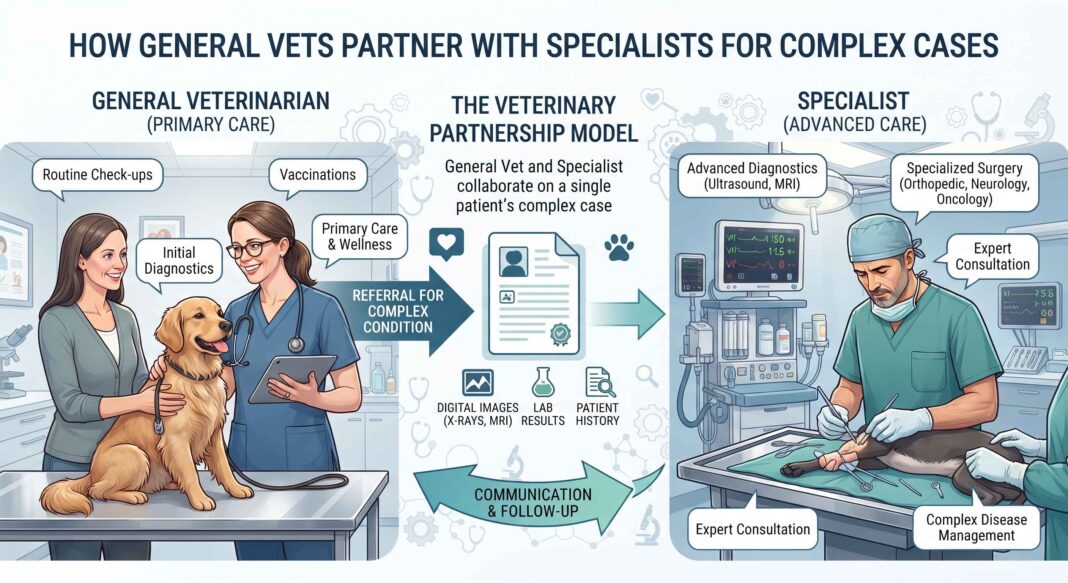
How general vets partner with specialists for complex cases comes down to teamwork, timing, and clear communication. Your regular veterinarian stays central because they know your pet’s history, daily patterns, and your family’s limits. A specialist adds deeper training in one area such as dermatology, internal medicine, surgery, oncology, or cardiology. Together, they build a plan that is more precise and often more efficient than trying to keep guessing.
General veterinarians and specialists solve different parts of the same problem
A general veterinarian is trained to manage a wide range of health concerns. They handle wellness care, common illnesses, preventive medicine, and many urgent issues. They also know when a case has crossed into a level of complexity that needs referral support. That judgment matters. It can save time, reduce repeated testing, and help your pet reach the right treatment sooner.
Specialists focus on narrow areas and see difficult cases every day. A veterinary dermatologist may spot a pattern in chronic skin disease that looks ordinary at first glance. An internal medicine specialist may connect weight loss, vomiting, and bloodwork changes into one diagnosis instead of treating them as separate problems. This kind of veterinary specialist collaboration is not a handoff in the sense of “good luck.” It is shared care.
The strongest partnerships usually look simple from the outside. Your family vet gathers records, exam notes, imaging, lab results, and a timeline of what has already been tried. The specialist reviews that information, examines your pet, and sends recommendations back. In many cases, your general vet continues routine monitoring and follow up care while the specialist guides the advanced part of treatment.
Complex veterinary cases often need a team because one problem affects everything else
Chronic disease rarely stays in one lane. A dog with severe allergies may also have recurring ear infections, sleep disruption, skin infections, and a stressed owner who is exhausted from trying diet changes, shampoos, and medications that only partly help. The case is not just “itching.” It becomes a cycle that affects comfort, cost, and quality of life.
The same pattern shows up with heart disease, cancer, endocrine disorders, neurologic issues, and complicated surgical cases. One symptom leads to another. One medication helps one problem but complicates another. Waiting too long to bring in a specialist can stretch out that cycle.
The opposite can also happen. Some pet owners worry that referral means their regular vet is stepping away, or that specialist care will automatically be out of reach financially. That fear is understandable. In reality, many referrals start with a consultation, not a massive treatment plan. If you want to see how referral support is structured, the University of Illinois Veterinary Teaching Hospital outlines its referral services and also provides consultation forms used to coordinate care between veterinarians and specialty teams.
Skin disease is a good example of why shared care works. Managing canine atopic dermatitis often requires primary care, dermatology input, infection control, owner education, and long term follow up. The University of Illinois described this well in its piece on managing the canine atopic dermatitis patient, where the message is clear. Cases like these improve when multiple people work from the same plan.
Shared care in veterinary medicine balances speed, cost, and continuity
Most families are weighing more than medical facts. You are thinking about time off work, travel, repeat visits, medication costs, and whether your pet can handle more testing. A good referral plan respects that. It does not chase every possible answer at once. It prioritizes the steps that are most likely to change treatment or outcome.
| Care approach | Best fit | Benefits | Limits |
| General vet only | Routine illness, early symptoms, stable chronic conditions | Lower immediate cost, familiar team, easier follow up | May delay advanced diagnosis if the case is not responding |
| General vet with specialist consultation | Cases that are confusing, recurring, or only partly controlled | Targeted expert input, less guesswork, your regular vet stays involved | May still require travel or added testing |
| Direct specialty management | Advanced surgery, cancer care, severe internal disease, emergency referral | Access to advanced procedures and focused expertise | Higher cost, less local convenience, routine care still needs coordination |
Coordinated veterinary care often lands in the middle row because it gives you both continuity and depth. Your pet is not starting over with strangers and the specialist is not working in a vacuum. That tends to lead to better decisions, especially when history matters as much as the current exam.
Three steps help you get more from a specialist referral
Ask what question the referral is meant to answer. A referral works best when the goal is specific. Is the specialist being asked to confirm a diagnosis, suggest a treatment plan, perform a procedure, or take over a portion of care for a period of time? Clear goals keep the process focused.
Bring a simple timeline of symptoms and treatments. Write down when the problem started, what makes it better or worse, which medications were tried, and how your pet responded. This sounds basic, but it can shorten the path to a useful plan. In complex cases, the timeline often matters as much as the test results.
Clarify who handles what after the visit. Before you leave, know whether refills, rechecks, lab monitoring, and urgent questions go to the specialist or your general veterinarian. This is where specialist support for veterinarians protects continuity. Everyone knows their role, and your pet does not get lost between offices.
Good veterinary teamwork gives your pet a better path forward
When a case gets complicated, you do not need more confusion. You need a plan that makes sense, a primary vet who stays engaged, and specialist input that sharpens the next step. That is the real value in how general vets partner with specialists for complex cases. It is not about replacing one doctor with another. It is about building the right team around your pet at the right time.
If your pet’s condition is lingering, worsening, or bouncing between partial fixes, ask your general veterinarian whether a specialist consultation would help. Early collaboration can spare your pet discomfort and spare you weeks of uncertainty.