
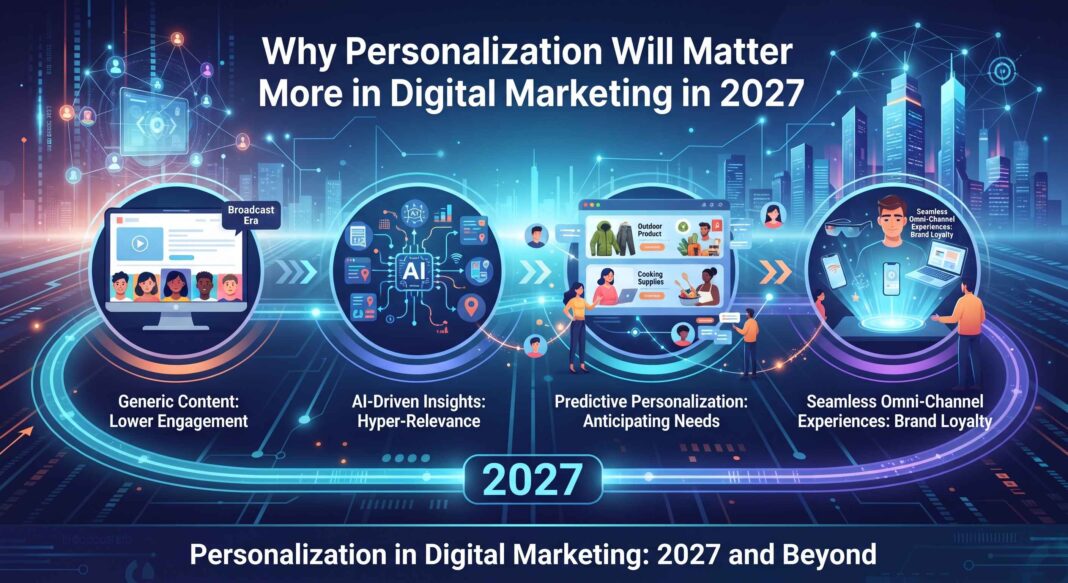

Remember the days when getting a marketing email with your first name at the top felt like the peak of digital customization? Back then, dropping a simple token like [First Name] into a generic broadcast blast was enough to make a brand feel modern.
Those days are long gone.
As we approach 2027, consumer expectations have shifted dramatically. Digital noise is at an all-time high, and generic campaigns are instantly filtered out—not just by spam algorithms, but by human brains exhausted by endless content. In this landscape, personalization is no longer just a nice-to-have marketing tactic or an experimental feature. It is the absolute core baseline of survival for any brand trying to capture and hold attention.
1. The Death of the ‘Average’ Consumer
For decades, traditional marketing relied heavily on broad demographics: targeting people by age brackets, geographic locations, or broad income tiers. But the modern digital ecosystem has proven that two people of the exact same age, living in the same neighborhood, can have completely polar opposite interests, buying habits, and media consumption patterns.
By 2027, the concept of a generalized target audience feels practically outdated. Consumers now operate in hyper-individualized digital bubbles shaped by algorithms, micro-communities, and specialized content feeds. When a user opens an app or searches online, they don’t want to see what is popular “for people like them”—they expect the digital environment to understand what is relevant to them right now.
Brands that continue to speak to a generalized crowd find themselves shouting into a void, while those embracing deep personalization speak directly to an individual’s immediate context.
2. Moving From Static Data to Real-Time Context
A major shift defining digital marketing in 2027 is the evolution of how we personalize. In the past, personalization was historical; it looked backward at what you bought last month or what you clicked on yesterday.
Today, it is entirely contextual and real-time.
-
The Environment Matters: A mobile user browsing a retail app on a rainy Tuesday morning while commuting has a completely different intent than the same user relaxing at home on a Friday night.
-
Dynamic Content Shifts: Modern websites and emails no longer stay static. Landing page headlines, product arrangements, and messaging shift dynamically based on the exact moment of interaction, current user intent, and live behavioral cues.
This means marketing has stopped feeling like a pre-recorded commercial and has started feeling like a fluid, intuitive conversation.
3. The Trust Paradox: First-Party Data and Privacy
Of course, deep personalization requires data, which introduces a delicate balancing act. With the permanent phasing out of third-party cookies and stricter privacy regulations worldwide, brands can no longer rely on sketchy, backdoor data tracking.
Instead, 2027 relies heavily on first-party data—information that customers willingly and transparently share with brands through loyalty programs, preference centers, interactive quizzes, and direct engagement.
This has created a fascinating paradox: consumers are more than willing to share their data, but only if they get immediate, tangible value in return. If a customer gives a brand their preferences, they expect the subsequent experience to be so seamlessly tailored that it saves them time and solves their problems. Personalization has become the currency of trust. When done right, it proves to the customer: “We listen to you, and we respect your time.” When done poorly or invasively, it triggers instant alienation.
4. Cutting Through the AI Content Flood
Let’s address the elephant in the room: the internet is currently flooded with automated, machine-generated content. Because generating text, images, and video has become fast and cheap, volume has exploded. Everyone can produce more content than ever before.
When everyone can produce infinite content, volume loses its value. Relevance is the only antidote to noise.
Personalization acts as a filter against this sea of digital sameness. Even if two people receive content or visit a platform, the presentation, angles, and solutions highlighted are uniquely sculpted to match the user’s specific pain points. Hyper-personalization cuts through the fatigue because it speaks directly to an individual’s current hurdle, rather than offering a generic solution designed for the masses.
Looking Ahead: The Human Touch Behind the Data
Ironically, for personalization to feel truly human in 2027, it requires a delicate blend of advanced predictive tools and genuine human empathy. Technology handles the heavy lifting—processing data patterns and delivering dynamic variations at scale. But human marketers must define the boundaries, ensure ethical data practices, and inject real emotional intelligence into the brand voice.
At the end of the day, people don’t fall in love with algorithms; they connect with brands that make them feel understood. As we move deeper into this era, the companies winning the digital marketing race are those realizing a simple truth: treating your customers like a collective audience is a strategy of the past. Treating them like individuals is the only way forward.