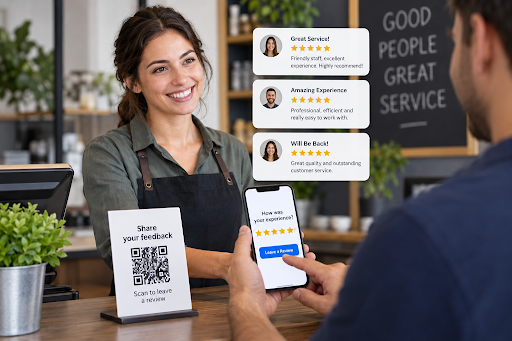
For a local business, reputation is no longer shaped only by word of mouth. Before booking a restaurant, choosing a dentist, visiting a salon, hiring a contractor, or selecting a hotel, customers often research the business online.
Reviews are one of the first things they notice.
A business may offer excellent service, but if its online presence contains very few recent reviews, potential customers may hesitate. At the same time, companies that consistently collect genuine customer feedback can create stronger social proof and better understand what customers expect.
The challenge is building a review strategy that is consistent without making customers feel pressured. Here are several practical ways local businesses can improve the process.
Make Asking for Feedback Part of the Customer Journey
Many businesses depend on employees remembering to ask for reviews.
That usually creates inconsistent results.
One employee may ask every customer, another may forget, and customers may receive the request long after their experience. Instead, businesses should make feedback collection part of their normal customer journey.
For example:
- Restaurants can request feedback shortly after a visit.
- Salons can send a message after an appointment.
- Hotels can follow up after checkout.
- Contractors can request feedback after completing a project.
- Online sellers can follow up after an order has been delivered.
- Clinics can include a feedback request in their normal post-visit communication.
The goal is to create a predictable process rather than relying on employees to remember every time.
Make the Review Process Easy
Customers are more likely to provide feedback when the process requires very little effort.
If someone has to search for the business, locate its profile, find the review section, and then work out where to leave feedback, many people will simply abandon the process.
Businesses can reduce that friction by providing a direct review link through channels customers already use.
This might include:
- SMS
- QR codes
- Receipts
- Appointment cards
- Invoices
- Follow-up messages
For example, a restaurant might place a QR code near the checkout counter, while a home-service company could include a review link in its job-completion email.
Businesses that want to organize these processes centrally can use platforms designed to help them Get More Reviews through structured review-request and customer-feedback workflows rather than manually managing every request.
Reducing the number of steps between the customer and the feedback page can make the entire experience more convenient.
Ask at the Right Moment
Timing can be just as important as the message itself.
Customers are more likely to remember specific details about their experience while it is still fresh.
A hotel asking for feedback several weeks after a stay may receive fewer responses than one following up soon after checkout. Similarly, a salon may get a better response shortly after an appointment than several months later.
Businesses should identify the natural completion point in their customer journey.
- For a restaurant, that may be shortly after the meal.
- For a contractor, it may be when the project is completed.
- For an e-commerce business, it could be after delivery.
The ideal timing differs between industries, but the principle remains the same: ask when the customer can still clearly remember the experience.
Use More Than One Communication Channel
Not every customer communicates in the same way.
Some customers respond quickly to email, while others rarely check it. Many people prefer messaging apps or SMS. Customers visiting physical locations may find QR codes more convenient.
A flexible feedback strategy therefore uses several channels instead of depending entirely on one.
For example, a business might:
- Place a QR code at the physical location.
- Send an email after the transaction.
- Use SMS or messaging for customers who have opted to receive communications.
- Include a direct feedback link on digital receipts.
This gives customers the freedom to respond through the channel that feels most convenient to them.
Keep Review Requests Short
A review request does not need to contain several paragraphs explaining why reviews are important.
Shorter messages generally create a cleaner customer experience.
A simple request can explain that the company values feedback and provide a direct way to respond.
The tone should also match the business.
A professional services company may prefer formal wording, while a café, fitness studio, or salon might use a more conversational style.
Whatever the tone, avoid making customers feel obligated to provide a particular rating. The purpose should be to gather genuine feedback about their experience.
Pay Attention to Customer Feedback, Not Just Ratings
An effective reputation strategy is about more than increasing the number beside the star icon.
Customer feedback contains useful business information.
Repeated comments about slow service may indicate an operational issue. Positive comments about a specific employee, product, or service can reveal what customers value most.
Businesses should regularly analyze feedback for recurring themes such as:
- Service quality
- Waiting times
- Staff behaviour
- Product quality
- Pricing
- Communication
- Delivery
- Cleanliness
- Customer support
Turning these observations into operational improvements can make reputation management part of a broader customer-experience strategy.
Respond Professionally to Reviews
Collecting reviews is only one part of managing an online reputation.
Businesses should also respond appropriately.
Positive reviews provide an opportunity to thank customers and strengthen relationships. Negative reviews provide an opportunity to acknowledge concerns and demonstrate that the company takes customer experiences seriously.
A good response should normally be:
- Polite
- Concise
- Specific
- Professional
- Non-defensive
Arguments with customers rarely improve how a business appears online.
Even when a complaint seems unfair, future customers may judge the company partly by how professionally it responds.
Maintain a Consistent Flow of Recent Feedback
A business with hundreds of reviews may still look inactive if nearly all of them were posted years ago.
Potential customers often want to understand what the experience is like today.
For this reason, review collection should be continuous rather than treated as a one-time marketing campaign.
Instead of aggressively requesting large numbers of reviews for a few weeks and then stopping, businesses can build an ongoing process connected to normal transactions.
A steady flow of genuine customer feedback creates a more natural representation of the business over time.
Agencies Can Turn Review Management Into a Service
The same challenge exists at a larger scale for digital marketing and local SEO agencies.
An agency may manage websites, advertising, search optimization, social media, and lead generation for dozens of local businesses. Once clients begin asking for help with reviews and reputation, manually managing separate systems for each company can become difficult.
This is where centralized review-management systems become useful.
Agencies may prefer a White Label Review Management Software solution that allows them to manage customer-review campaigns for multiple clients while delivering the service under their own agency identity.
This can turn reputation management into an additional recurring service alongside SEO, PPC, website maintenance, social media management, and other digital-marketing services.
Rather than building review-management technology internally, agencies can focus on strategy, client communication, reporting, and improving customer experiences.
Create a Simple Monthly Reputation Routine
Businesses do not need an extremely complicated reputation-management strategy.
A simple monthly routine can include:
- Checking major review profiles.
- Responding to unanswered customer reviews.
- Reviewing recurring complaints.
- Identifying commonly praised services.
- Confirming that review links and QR codes still work.
- Checking whether staff consistently request feedback.
- Comparing review activity with previous months.
- Updating customer communication where necessary.
This routine can help businesses detect reputation problems before they become larger issues.
It also creates accountability. Instead of treating online reviews as something that occasionally gets checked, reputation becomes part of normal business management.
Avoid Shortcuts
Building trust takes time.
Buying fake reviews, creating fabricated customer accounts, or pressuring customers to leave positive ratings can damage credibility and potentially violate the policies of review platforms.
Businesses are better served by improving the customer experience and making it easier for genuine customers to share their opinions.
A smaller number of authentic reviews is more valuable to a long-term brand than a large collection of questionable ones.
Final Thoughts
Online reputation management does not have to be complicated.
The strongest strategies usually come down to a few basic principles: provide a good customer experience, ask for feedback consistently, make responding easy, monitor what customers are saying, and use that information to improve the business.
Technology can automate parts of the process, but it cannot replace good service.
When businesses combine strong customer experiences with a structured review-management process, online reviews become more than a marketing metric. They become an ongoing source of trust, customer insight, and business improvement.