Introduction
The concept of the Space Force Orbital Warship Carrier marks a historic shift in how humanity approaches defense and logistics beyond Earth’s atmosphere. This ambitious project, spearheaded by the U.S. Space Force in collaboration with Gravitics, aims to create a fully operational orbital spacecraft capable of launching and deploying smaller vehicles directly in space. Unlike traditional missions that rely on costly and time-consuming ground launches, the Orbital Carrier will act as a mobile, pre-positioned launch pad stationed in orbit and ready to respond to threats or technical failures in real time.
By blending military innovation with commercial space engineering, this initiative represents a major step toward space-based readiness and national defense superiority. The Orbital Warship Carrier isn’t just a futuristic idea it’s the foundation of a new era in orbital operations.
What Is the Space Force Orbital Warship Carrier?
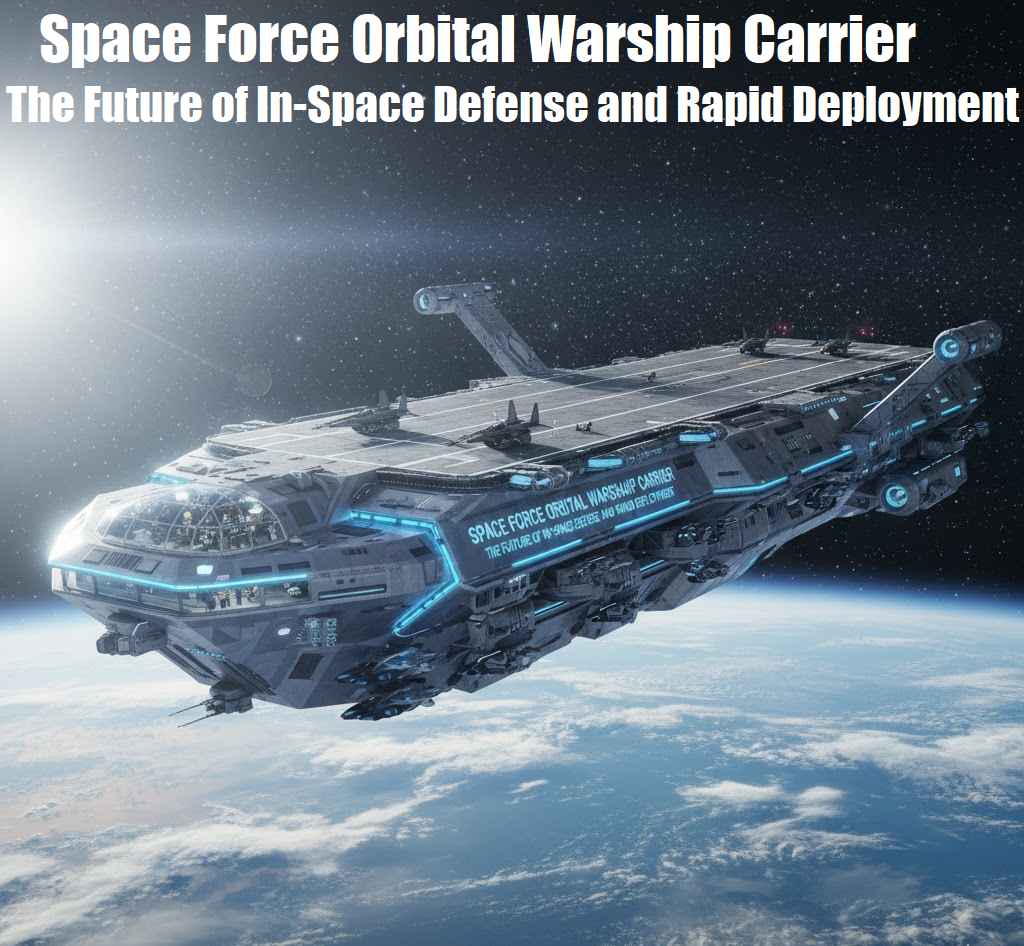
The Orbital Warship Carrier, often called an Orbital Carrier, is designed as a “mothership” spacecraft that remains in orbit, ready to launch smaller satellites, drones, or space vehicles when required. The system would allow the Space Force to maintain operational flexibility without relying on Earth-based launch schedules.
In simple terms, this is the space equivalent of a naval aircraft carrier a self-sufficient base that supports, maintains, and deploys multiple smaller craft to perform different missions. Whether for communication, surveillance, or defensive purposes, the Orbital Carrier is envisioned to operate as an on-demand deployment hub for America’s expanding presence in space.
Key Features and Purpose
The Orbital Warship Carrier is not merely a transport vessel it is a strategic asset designed to protect and sustain U.S. dominance in orbit. Below are the main features and functions that define its purpose:
1. Rapid Response Capability
The carrier allows for immediate response to orbital events. If a satellite fails or an adversary attempts interference, the carrier could launch replacement or countermeasure satellites within minutes. This eliminates delays caused by weather, launch pad scheduling, or logistics on Earth.
2. Satellite Support and Maintenance
The Orbital Carrier will store replacement satellites and other space assets aboard. In case of system failure or damage, these can be deployed directly from orbit, ensuring uninterrupted communication and surveillance networks.
3. Pre-Positioned Launch Pad in Space
Unlike traditional launches that start from Earth, this carrier operates already in orbit, functioning as a ready-to-launch platform. This setup drastically improves speed, mobility, and responsiveness during emergencies or conflicts.
4. Future Capabilities and Expansion
Although its primary role is the deployment of satellites, the future evolution of the Orbital Warship Carrier may include missile intercept systems, drone-based defense, and orbital logistics support for extended space missions. It could eventually serve as a refuelling or repair station for other spacecraft, expanding its strategic role in long-term space operations.
5. Strategic Role in Space Superiority
As global powers increase their investment in orbital defense, the U.S. Space Force aims to secure technological dominance through innovations like this. The carrier will enable the U.S. to rapidly reinforce or replace assets, providing a decisive edge in any potential orbital conflict or competition.
Main Points of the Development
-
Developer: U.S. Space Force in collaboration with Gravitics, a Seattle-based aerospace company.
-
Core Objective: To deploy multiple smaller satellites or vehicles directly from orbit.
-
Funding: Estimated $60 million development contract awarded to Gravitics in early 2025.
-
Design Inspiration: Modeled after a naval aircraft carrier but adapted for the zero-gravity environment.
-
Operational Benefits: Rapid deployment, reduced ground dependence, increased defense flexibility, and orbital sustainability.
Technology and Innovation Behind the Carrier
The Orbital Warship Carrier utilizes modular spacecraft design, allowing flexible reconfiguration for different missions. Gravitics’ StarMax modules serve as the foundation for the design, offering large-scale pressurized environments for equipment storage and crew operations.
The carrier’s propulsion system will likely combine advanced electric thrusters for orbital adjustments with small chemical engines for rapid maneuvering. A sophisticated AI-based control system would oversee launch operations, collision avoidance, and mission logistics, ensuring precision and safety during high-stakes operations.
Additionally, the structure is expected to include solar power arrays, radiation shielding, and autonomous docking ports for visiting spacecraft or resupply missions.
Is the Orbital Aircraft Carrier Real?
While still under development, the Orbital Warship Carrier project is not science fiction. Multiple credible reports, including those from Space.com, Newsweek, and MSN, have confirmed the Space Force’s partnership with Gravitics. Prototypes and conceptual testing are underway, and the first operational model could debut within the next few years if development continues at its current pace.
The U.S. government views this as a strategic necessity, given increasing orbital threats and the growing capabilities of other nations.
Common Questions Explained
Why can’t an F-22 land on an aircraft carrier?
The F-22 Raptor was designed for air superiority, not naval operations. It lacks the reinforced landing gear, tailhook, and wing-folding mechanisms required for carrier landings. Similarly, the Orbital Warship Carrier will deploy spacecraft designed specifically for orbital environments not atmospheric fighters.
Does the Space Force do any fighting?
Currently, the U.S. Space Force focuses on surveillance, communication, cyber defense, and satellite operations. Its role is to ensure freedom of operation in space and to defend American assets against interference or attack. Future missions, however, may expand as space becomes a more contested domain.
Is the Fujian a supercarrier?
Yes, Fujian is China’s most advanced conventionally powered aircraft carrier. While it operates in Earth’s oceans, the concept of the Orbital Warship Carrier takes this idea to the next level positioning a similar strategic capability in orbit rather than at sea.
Strategic Significance
The Orbital Warship Carrier project reflects a larger trend toward militarized space infrastructure. As communication, navigation, and defense systems increasingly depend on satellites, the ability to launch, repair, or replace them instantly becomes vital.
By establishing this orbital platform, the U.S. would not only ensure rapid response capabilities but also deter adversaries through visible technological dominance. The carrier’s potential expansion into logistics and refueling could eventually support crewed missions to the Moon or Mars, further blending military, scientific, and commercial interests.
Conclusion
The Space Force Orbital Warship Carrier represents a transformative leap in space strategy merging the tactical versatility of naval carriers with the vast potential of orbital operations. By enabling rapid satellite deployment, in-space logistics, and future defensive applications, it promises to reshape how nations think about security and readiness beyond Earth.
As prototypes evolve and testing continues, this project may soon define the foundation for a new era of orbital defense, where the first true “warship” in space becomes both a shield and a symbol of technological supremacy.