You would have noticed a moment where prices are rising, but the momentum indicators show weakness. This difference in momentum is a phenomenon called divergence, and it is among the most effective and popular indicators to spot high-quality trading and investing opportunities in financial markets. As traders read the charts of various currency pairs to gain insights, they often detect these patterns, which can be used in trading. Divergences can signal potential reversals, and they can be a very crucial indication that your portfolio is going to experience a downturn. And by using divergence as a signal for exits, you can optimize your investments.
What is divergence in Forex?
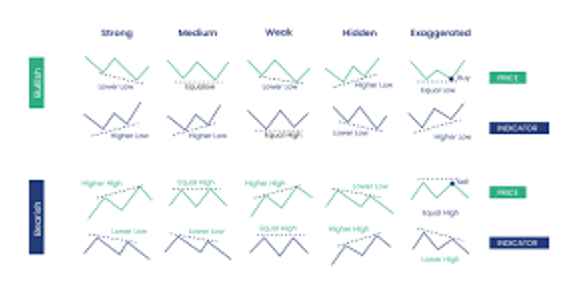
Divergences in trading are when price movement and indicators like RSI, MACD, or Stochastic move in opposite directions. When you see a divergence, the first thought should be that something is not quite right under the surface. For example, when prices rise higher but the Relative Strength Index (RSI) shows lower highs, it usually signals that momentum is fading, which could lead to a potential bearish reversal. On the other hand, if prices are moving lower, making lower lows while the RSI forms higher lows, it is a strong indicator that selling pressure is weakening, which usually hints at bullish reversals.
The best way to use divergences in forex trading is to open the chart, for example, the EUR/USD chart, and add RSI or any other oscillator you are comfortable with. When the indicator disagrees with the price, that’s your divergence. This is the market’s way of warning you that the momentum and price are not on the same side, and this is an excellent early clue that the current trend can be running out of power before the crowd realizes it.
Who can use divergences? Traders vs. investors
Traders actively monitor charts to spot abnormal behavior and patterns. While they use divergences for trading signals, investors can greatly benefit from knowing when reversals might be due. Investors hold Foreign Exchange currencies for longer periods than traders. They can adjust and reassess their portfolios or lock in profits by taking into account divergence signals. If they are long in the dollar and there is a divergence indicating a bearish reversal, it might be a good idea to close the position and wait for the pullback before entering again.
The two main types – regular vs. hidden divergence
Divergences can fall into two categories – regular and hidden, and knowing the difference is key to understanding whether a trend might be ending or simply pausing. The regular divergence usually signals a possible reversal. Imagine the EUR/USD reaching a new high, but the MACD histogram shows a lower peak. This means that the buying force is weakening despite the price still rising. This is a classic sign of a possible bearish reversal.
The hidden divergence, on the other hand, typically indicates trend continuations. If you are in an uptrend and the price makes a higher low but the RSI shows a lower low, this confirms that the momentum is on the trend’s side. This is a hidden divergence, and since the price action rules first, we follow the price’s patterns. Hidden divergences are trickier to spot and memorize, while the regular ones are easier to master and equally as powerful.
Spotting divergences – A step-by-step guide
The simple process to spot divergences and use them in trading and investing:
- Step 1. Find your preferred indicator that can show divergences: RSI, MACD, Stochastic, or On-Balance Volume (OBV)
- Step 2. Attach the indicator to the instrument you want to invest in or trade
- Step 3. Find recent swing highs or lows on your price chart
- Step 4. Compare them to the highs and lows on your chosen indicator – if they don’t match, you might have a divergence
Apart from detecting divergences, you also need to confirm them via trendlines, volume data, or other methods for extra reliability. The key here is to be patient and use divergences as early warning signs and not 100% guaranteed signals. Divergences are very robust patterns that can be used in any market by both traders and investors. However, as with many other patterns and signals, they work better on higher timeframes like 1-hour, 4-hour, and daily.