Measuring the Success of Salesforce Training: Essential Metrics to Track


Table of Contents:
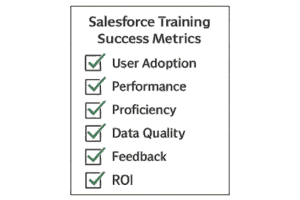
- User Adoption Rate
- Performance Improvement
- Time to Proficiency
- Data Quality and Accuracy
- Employee Feedback and Satisfaction
- Return on Investment (ROI)
- Conclusion
Salesforce is a significant investment for organizations, but it is not enough to guarantee sustained success. Continuous training and skills development are crucial for meaningful business transformation. Leaders must ensure Salesforce is used to its full potential, focusing on actionable data and metrics. By tracking the right metrics, organizations can track the effectiveness of Salesforce training programs and identify areas for improvement. Organizations may struggle to justify additional investments or highlight successes without solid performance-based metrics. Understanding which metrics matter most provides actionable insights for continuous improvement and a robust return on investment (ROI).
User Adoption Rate
User adoption is a key indicator of Salesforce training success. Organizations should track employee log-ins and interactions with the platform. High adoption rates indicate successful training programs, while low may indicate hesitancy or knowledge gaps. Focusing on behaviors like consistent use of key features, timely workflow completion, and user reliance on Salesforce can help identify power users, highlight successful strategies, and identify areas needing further training. This analysis is essential for evolving training programs and aligning them with the organization’s needs.
Performance Improvement
Organizations invest in Salesforce to enhance efficiency, agility, and productivity. Effective training programs lead to improved operational results, such as increased leads, conversion rates, sales pipeline acceleration, and deal closure. Regular performance data comparison helps leaders identify the impact of upskilling initiatives. A Salesforce-commissioned IDC study shows that businesses with well-trained Salesforce users enjoy greater agility and outperform competitors. To maintain continuous improvement, set benchmarks, monitor KPIs, and communicate wins to the organization, ensuring training is an ongoing contributor to business success.
Time to Proficiency
The success of a Salesforce training program is measured by the time to proficiency, which measures the speed at which employees transition from onboarding to using Salesforce effectively. A shorter time to proficiency indicates an effective training program. Organizations should track proficiency milestones, such as mastering advanced features or achieving productivity metrics. Identifying bottlenecks helps refine training materials and methods, creating a smoother onboarding experience and ensuring operational continuity as the organization grows or changes.
Data Quality and Accuracy
Salesforce’s value lies in its data integrity, which requires training beyond technical knowledge. Maintaining consistent, accurate, and up-to-date information is crucial, as this leads to reliable analytics, better customer insights, and informed decision-making. Metrics to track include frequency of incomplete records, errors in data field entries, and reduction of outdated or redundant data. A decrease in duplicate entries, missing fields, and reporting errors indicates users follow best practices learned in training. Superior data quality ensures CRM-driven business decisions are built on reliable information.
Employee Feedback and Satisfaction
Understanding user perceptions and satisfaction levels is crucial for evaluating Salesforce training. Gathering honest employee feedback through surveys, focus groups, or interviews provides context beyond numbers. This helps identify confusing content, curriculum gaps, preferred delivery formats, or hands-on practice needs. A recent study found 75% of organizations seek better metrics for training programs. Prioritizing user input improves training initiatives, fosters a culture of continuous learning, and promotes engagement, ownership, and better adoption.
Return on Investment (ROI)
Business leaders must justify Salesforce training expenses by calculating ROI. This involves evaluating all program expenses, including staffing, software licenses, and training time, relative to measurable benefits like increased sales, improved efficiencies, reduced error rates, and lower support costs. A positive ROI validates the training program’s efficacy and is a tool for future training initiatives. Consistent tracking of metrics ensures the value of initial investment and long-term results.
Conclusion
Salesforce training programs are crucial for digital transformation and organizational growth. Leaders can monitor adoption rates, performance metrics, time to proficiency, data integrity, employee satisfaction, and ROI to optimize training efforts and guide long-term strategy. These metrics help organizations maximize the value of their Salesforce investment, foster continuous improvement, and empower teams to excel in a fast-paced business environment. Focusing on these metrics is the clearest path to innovation.