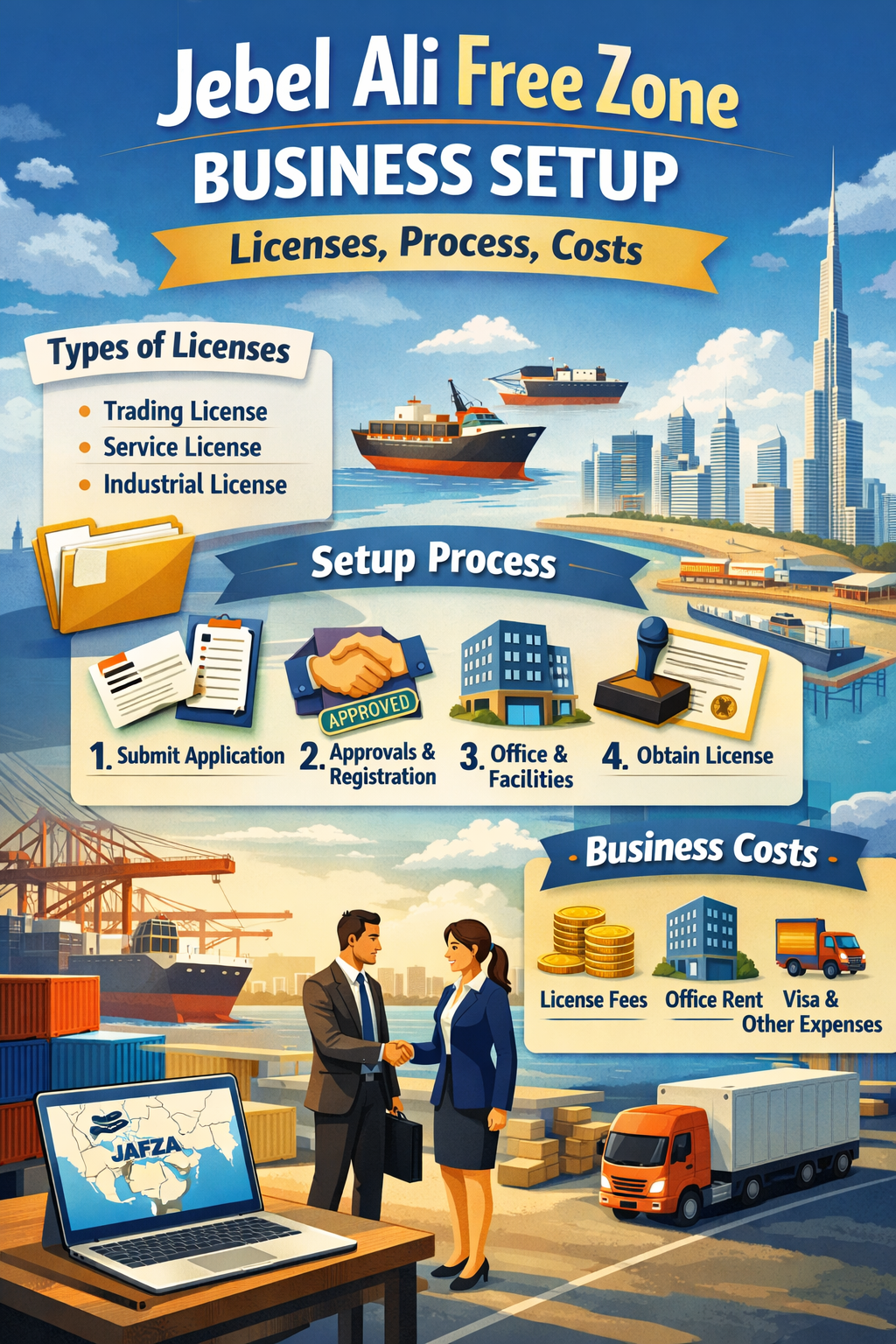
Jebel Ali Free Zone Business Setup is one of the most established and internationally recognised ways to enter the UAE market and operate on a global scale. Since its launch in 1985 as the country’s first free zone, JAFZA has evolved into the largest of its kind, hosting thousands of companies from more than 100 countries. Its strategic location next to Jebel Ali Port and close to Al Maktoum International Airport makes it a natural choice for trade, logistics, and manufacturing businesses that depend on seamless global connectivity.
Why Choose Jebel Ali Free Zone Business Setup?
The main advantage of Jebel Ali Free Zone business setup lies in its infrastructure and credibility. Unlike smaller zones focused mainly on consultancies or startups, JAFZA was designed as a full-scale industrial and logistics hub. Companies can lease offices, warehouses, or even large production facilities under a single authority.
Being situated beside the busiest container port in the Middle East gives businesses direct access to international shipping routes. At the same time, proximity to a major international airport strengthens multimodal transport options. For investors, operating in the same zone as global multinationals enhances reputation and commercial trust.
In addition, customs procedures are streamlined, digital portals simplify incorporation, and remote registration is possible. Although it is not the lowest-cost jurisdiction in the UAE, the infrastructure and scale justify the investment for companies that require serious operational capacity.
About Jebel Ali Free Zone Company Formation
Established by the Government of Dubai in 1985, JAFZA became a cornerstone of the emirate’s international trade strategy. Today it is managed by DP World, one of the world’s leading port operators, providing the zone with strong institutional backing and worldwide recognition.
Jebel Ali Free Zone company formation is particularly attractive for industrial and logistics-driven enterprises. The zone connects directly to Jebel Ali Port’s container terminals and benefits from DP World’s global network of more than 150 ports. This integration allows companies to manage trade flows efficiently while remaining under a stable regulatory framework that has been tested for decades.
Business Activities in UAE Jebel Ali Free Zone Company Setup
UAE Jebel Ali free zone company setup focuses primarily on trade, logistics, and industrial operations. Businesses can import, export, re-export, manufacture, assemble, store, and distribute goods within the same ecosystem.
The four main licence categories are:
- Trading Licence – For import, export, and distribution of goods.
- Industrial Licence – For manufacturing, processing, and assembly operations.
- Service Licence – For consultancies, agencies, and support services related to supply chains.
- Logistics Licence – For freight forwarding, warehousing, and transportation management.
Certain regulated sectors such as food production, chemicals, or pharmaceuticals require additional approvals. One of JAFZA’s key strengths is the ability to combine trading, storage, and manufacturing activities within one jurisdiction while handling customs directly through the adjacent port.
Step-by-Step Jebel Ali Free Zone Company Formation
The process of Jebel Ali Free Zone company formation is structured and regulated by the free zone authority, with clearly defined stages from application to licence issuance.
The registration procedure typically includes the following steps:
- Selection of business activity and legal structure: the investor determines the type of activity (trading, industrial, service, or logistics) and chooses the appropriate legal form — FZE, FZCO, Branch, PLC, or Offshore Company.
- Trade name reservation and initial approval: the proposed company name is submitted for approval, and preliminary consent is obtained from JAFZA to proceed with incorporation.
- Submission of documents: personal and corporate documents are filed with the authority, including incorporation documents (if applicable), charter documents, board resolutions, and UBO disclosure.
- Lease agreement and facility selection: the company selects a flexi-desk, office, warehouse, or land plot. The lease agreement is prepared and signed as part of the incorporation package.
- Payment of fees and licence issuance: after document approval and payment of the required fees, JAFZA issues the business licence and incorporation documents.
- Visa processing (if required): if residence visas are needed, the company registers in the e-channel system and initiates entry permits, medical tests, Emirates ID issuance, and visa stamping.
The selected legal structure determines liability, capital requirements, and compliance obligations, while the overall timeline depends on the activity type and whether additional regulatory approvals are required.
Required Documents and Timeline
To complete incorporation, JAFZA requires both personal and corporate documentation.
Personal documentation generally includes passport copies, proof of residence, and (if applicable) an entry permit for relocation to the UAE.
For corporate shareholders, the authority typically requests the Certificate of Incorporation, Charter (Articles of Association / Statute), Memorandum and Articles of Association (MOA and AOA), a Share Register, a Resolution on the Establishment of the Company, a Company Incorporation Application, and a Board Resolution approving the new entity. In some cases, a Certificate of Good Standing may also be required. Disclosure of Ultimate Beneficial Owners (UBO) is mandatory under UAE compliance regulations.
Simple trading or service companies may receive a licence in under two weeks. Industrial or manufacturing projects usually require three to four weeks due to additional regulatory approvals. If residence visas are included, the timeline may extend further, as medical testing and Emirates ID procedures run in parallel with the company registration process.
Remote Jebel Ali Freezone Business Setup in UAE
A key advantage of Jebel Ali freezone business setup in UAE is the ability to complete most incorporation steps remotely, with setup packages starting from AED 11,500 depending on the selected licence and facility type. Applications can be submitted online, and identity verification may be conducted via secure video calls. Licensed service providers are permitted to represent investors during document submission and attestation.
In certain cases, original documents must still be couriered to Dubai, particularly when a corporate shareholder is involved. However, the majority of the process remains digital, enabling founders to register the company before physically relocating. Personal travel is generally required only at the stage of residence visa stamping, if visas are included in the package.
Understanding Jebel Ali Freezone Business License Cost
The Jebel Ali freezone business license cost depends on three main factors: the type of licence, the facility leased, and the number of visas required.
A flexi-desk arrangement provides a smaller visa quota, while leasing a physical office increases the allocation. Warehouses and industrial units offer significantly larger visa quotas due to higher staffing needs.
Additional mandatory costs include registration in the UAE’s e-channel system for visa processing. Each residence visa also involves entry permit fees, medical testing, Emirates ID issuance, and health insurance. Renewal costs remain relatively stable once the structure and facility are defined.
Corporate Tax, VAT, and Customs
Companies operating under Jebel Ali Free Zone business setup follow the UAE’s federal tax framework. Since June 2023, a 9% corporate tax applies to profits exceeding AED 375,000. However, qualifying free zone companies that meet substance and activity requirements may continue to benefit from a 0% rate on eligible income.
VAT is charged at 5% once turnover exceeds the federal threshold. Goods stored within JAFZA or re-exported abroad benefit from VAT suspension, while VAT applies when goods enter the UAE mainland.
Customs advantages remain one of JAFZA’s strongest benefits. Goods imported into the zone are exempt from customs duty, and re-exports are duty-free. Duty applies only when products move into the local UAE market, making the zone especially advantageous for international trading and manufacturing supply chains.
Who Should Choose Jebel Ali Free Zone Business Setup?
Jebel Ali Free Zone business setup is ideal for:
- Import–export traders requiring port access
- Manufacturers needing production facilities
- Logistics operators managing regional distribution
- Corporations seeking higher visa quotas and industrial infrastructure
- E-commerce businesses with warehousing needs
It may not be suitable for freelancers, solo consultants, or small service firms looking for minimal setup costs. Businesses without a need for port connectivity or large facilities may find lighter free zones more cost-efficient.
Conclusion
For nearly four decades, Jebel Ali Free Zone business setup has represented the benchmark for large-scale commercial operations in the UAE. Its direct access to Jebel Ali Port, proximity to Al Maktoum International Airport, and integration with global shipping networks provide unmatched logistical strength.
While it is not the cheapest jurisdiction, it is one of the most robust. Companies that require warehousing, manufacturing space, higher visa allocations, and international credibility will find JAFZA to be one of the most strategic options in the region.
Before proceeding, it is advisable to define your activity, staffing needs, and facility requirements clearly. Professional guidance ensures that the registration process moves smoothly, compliance obligations are met, and your Jebel Ali Free Zone company formation is completed without unnecessary delays.