Estate agents operate at the heart of the property market. You deal with high-value transactions, large payments, and new clients every week. That position comes with responsibility, because property is often targeted by criminals who want to move or hide money through legitimate-looking deals.
This is why estate agents are part of the UK’s anti-money laundering framework. A key part of that framework is the Suspicious Activity Report, commonly known as a SAR.
For many negotiators and branch teams, SARs can feel intimidating. People worry about “getting it wrong”. Others delay reporting because they are not sure the situation is suspicious enough. But SARs are not about proving criminal behaviour. They are about reporting concerns when something does not add up.
This guide explains what SARs are, what triggers suspicion in estate agency work, and how to handle reporting correctly in 2026.
What is a SAR?
A SAR is a formal report that shares information about suspected money laundering or criminal funds. In the UK, SARs are submitted to the UK Financial Intelligence Unit (UKFIU), part of the National Crime Agency (NCA).
These reports help authorities identify patterns, investigate serious crime, and prevent funds from being moved through UK businesses. For estate agents, SARs sit within wider AML responsibilities, alongside due diligence and record keeping.
It’s important to be clear on one thing. Submitting a SAR is not the same as accusing a client of a crime. It is simply an official way of reporting concern where the behaviour appears suspicious.
Why SARs matter for estate agents
Property is attractive for money laundering because it can absorb large sums of money quickly and convert it into an asset. Once the asset is purchased, it can be sold later, remortgaged, or used as a store of value.
Estate agents are often the first professionals to spot warning signs. You might be the first person to meet the buyer, the first to notice unusual behaviour, or the first to see suspicious funding arrangements. Because of that, SARs matter not only from a legal point of view, but also for protecting your agency.
A failure to report correctly can lead to consequences such as regulatory scrutiny, penalties, and reputational damage. It can also place the agency at risk if the transaction later becomes linked to crime. This is why SAR reporting sits under key estate agency regulations and must be handled carefully.
When must an estate agent report suspicious activity?
This is the question most teams struggle with.
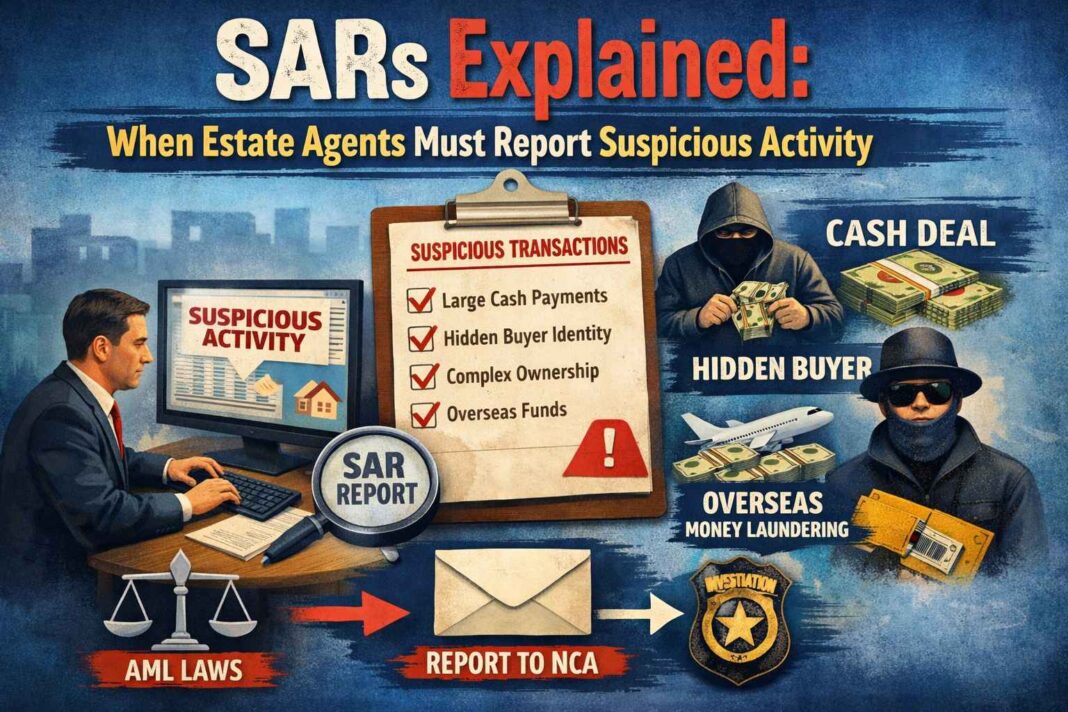
Estate agents must submit a report when they know, suspect, or have reasonable grounds to suspect money laundering.
That means you do not need proof. You do not need to be certain. You also do not need to “investigate” beyond your normal compliance process. If something feels inconsistent and you cannot reasonably explain it, suspicion may be present.
A common mistake is waiting too long. People feel they need more information before escalating. But suspicion is often based on patterns and behaviour, not one single document.
If your agency has a Money Laundering Reporting Officer (MLRO), which many do, all SAR-related concerns should be escalated internally to them immediately. The MLRO then decides whether a SAR should be submitted.
You are not expected to investigate
This point is important for negotiators and branch staff.
You are not a crime investigator. Your job is not to chase a client, confront them, or try to uncover the “truth” beyond normal checks. Your job is to identify risk, apply due diligence properly, and raise concerns when something appears wrong.
If you see enough risk indicators that suspicion feels reasonable, you escalate. That’s the process.
It is also why staff training matters. Without it, negotiators may either ignore warning signs or panic unnecessarily.
What suspicious activity looks like in property transactions
Suspicion in estate agency often shows up through inconsistencies.
For example, a buyer’s story may change repeatedly, or they may struggle to explain where funds are coming from. They may refuse to provide documents, delay endlessly, or become defensive whenever compliance checks are mentioned. In many cases, it is the behaviour around due diligence that becomes the strongest warning sign.
Suspicion can also be linked to how the purchase is being funded. If funds are arriving from several unrelated sources, or if third parties suddenly appear in the transaction without a reasonable explanation, it creates risk. The same applies when funds are being transferred through overseas accounts without a clear reason, or when a buyer insists on using complex arrangements that don’t match the deal.
Another common indicator is urgency that feels artificial. Many legitimate buyers want a fast purchase, but suspicious urgency often comes with pressure to bypass normal checks. If someone demands immediate progress but refuses to provide basic evidence, the situation should be escalated.
It is also worth paying attention when the buyer profile does not match the purchase. This does not mean that wealthy buyers are suspicious. But where income, occupation, or background does not align with the purchase value, and the explanation is vague, it can create reasonable grounds for suspicion.
Finally, keep an eye on unusual ownership behaviour. If the identity of the buyer keeps changing, or the person paying is not the same person purchasing, or the client is unclear about who the property is for, this increases risk.
The SAR process in an estate agency (simple workflow)
A good SAR process is structured and calm.
First, the staff member identifies concerns and documents them clearly. Next, the concern is escalated internally to the MLRO along with key facts and any supporting evidence. The MLRO then reviews the information and decides whether it meets the threshold for suspicion.
If a SAR is needed, it is submitted through the appropriate route. The agency should keep an internal record of what happened, including the decision process and any actions taken.
The key point is this: the SAR process should be confidential and controlled. It should never be treated like a branch discussion topic.
Tipping off: the risk many teams overlook
One of the most serious mistakes in SAR situations is “tipping off”.
This means telling the person involved that you have submitted a SAR, or that you are planning to submit one. Even hinting at it can create legal risk and may compromise investigations.
So staff should never say:
- “We might have to report this.”
- “You’re flagged as suspicious.”
- “This is going to the authorities.”
Instead, communication must remain neutral and professional. The correct approach is to say that certain documents are required for compliance, and that the transaction cannot progress without verification.
If you are unsure what to say, escalate to the MLRO before responding.
Record keeping: what your agency must document
If a case is reviewed later, investigators will look at what your agency did and why.
This is why record keeping is essential. You should keep clear internal notes covering what raised concern, what checks were carried out, what evidence was requested, and what decision was made.
Even if a SAR is not submitted, it is good practice to keep a record that explains why the MLRO decided it was not necessary. That evidence can protect the agency later.
Final thoughts: SARs protect your agency as much as the market
SARs exist to protect the property market from being used to move or hide criminal funds. But they also protect estate agencies.
When you report correctly, you reduce legal exposure, strengthen compliance, and show professional responsibility. Most importantly, you protect your agency from being involved in transactions that could later become serious problems.
The strongest agencies treat SAR awareness as part of professional standards. Staff are trained, concerns are escalated without fear, and the MLRO process is clear.
In 2026, this is not optional. It is part of running a trusted and resilient estate agency.