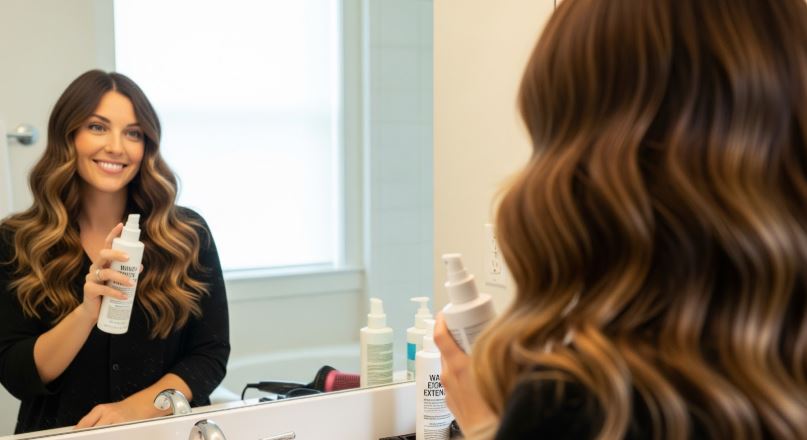
The ability to have lasting wave effects following a hair treatment is not a secret really but a product of time, gentle handling, and the appropriate selection of the type of moisture + heat (in the correct order). The idea is to maintain the hair’s shape as you style it so that you are still sporting waves on day one and still good on day three.
Why Your Waves Fade So Fast
The reason waves drop normally depends on whether the hair is still settling (a), drying out and frizzing (b) or (c) the hair is being overstressed by heat, brushing or rough washing. The treatments can make hair more porous or more coated and both these cases transform the hair’s memory of a bend.
A basic manner of thinking about it: waves hold because hair is flexible (so it is able to learn), and it supports (so it is able to hold). Too soft and slippery? The wave slides out. Too dry and brittle? The wave appears swollen, blurred and falls into fuzz.
The common wave-killers of which people are not conscious are these:
- Excessive conditioning immediately before the styling process (the hair is too buttery to be held).
- Thick oils in the foundations (waves drop out at a slow pace).
- Brushing the pattern out before it is cooled (you essentially reverse the set).
- The tendency to constantly touch hair in the daytime (natural oils and friction, so you can create limp waves).
Aftercare Rules for Perms and Keratin Treatments
The rules to various treatments are not the same and obeying them is among the quickest methods that can be taken to stop wasting time on waves that will not stick.
Provided that you have had a perm (or perm-like procedure):
It is advised to wait 48-72 hours after leaving the salon before shampooing because the curl pattern will have settled in.
Within such a window, hair must be handled like a delicate fabric: minimum handling, not hard aggressive brushing plus it should not be soaked simply because it seems heavy with product.
Provided you have received a keratin/smoothing treatment:
Much of the aftercare instructions is to use sulfate-free and sodium-chloride-free products to aid in extending the results.
There are also guides stating that with proper aftercare, the results of keratin last months (usually quoted as 4-6 months).
Keratin is typically now rather smooth, rather than waves, so the trick here is to get waves that appear soft and smooth, rather than crunchy and overdone.
Pragmatic lesson learned: waves should be kept in place after a smoothing treatment and when created with controlled amounts of heat and with the help of light styling products (think airiness and not hard hairspray).
Best Heat Tools and Protection for Wavy Hair
The heat can either become your best companion when it comes to long lasting waves… or the cause of your ends to fry and your wave pattern not to act.
The reason why a heat protectant is helpful is that it forms a coating between hair and heat which could minimize moisture loss and heat damage caused during styling.
It is that barrier effect that has made waves tend to appear shinier and last longer when you do not skip protection- healthy hair has a shape that is better than that of a stressed hair.
Some real life advice that has a larger impact than some might think:
- Allow hair to dry completely before curling (even damp hair becomes limp within seconds).
- Turn it down and leave it to cool. The setting phase is essentially the cooling phase.
- When your hair is fine or freshly oiled, and goes flat too easily, it is better to get a smaller portion size than you imagine you require.
The tool selection is also important due to the fact that the same temperature and smooth plates/barrels will decrease snagging and uneven heating. In case you are the kind of person who prefers to have one trusted device, and does not want to agonize about it every morning, a device like a veaudry curling iron can fall into the category of repeatable results, and you do not have to be in a struggle against your own hair.
A Step-by-Step Routine for Holding Waves
It is the stage that most people would skip, the waves do not begin with the curling tool, they begin in the shower and in the towel and within the first five minutes of styling.
Shower Tips for Volume and Hold
- Apply a cleanser which does not leave thickening deposits (especially when you have a dropping wave at the crown).
- Apply conditioner from the mid-lengths to the ends of your hair just in case it becomes straight away.
- Rinse well. Not squeaky clean–but the remnant of conditioner film is the silent wave-flattener.
Styling Prep Immediately After Washing
- Don’t rub with a towel. Push or blot (friction = frizz + fuzz).
- When blowing dry, make air run downwards and maintain the nozzle in motion.
- Select one, not five, support products. For example:
- Mousse hold/bounce, lightweight, or
- A medium-hold styling gel when you have more control than volume in your hair.
Setting Techniques for Long-Lasting Curls
- Curl back behind the face on the front (usually more flattering, and it does not fall so quickly).
- Only pin a few curls when they cool down in case you want to have them long lasting- especially on special occasions.
- When cold breaks with fingers or wide tooth comb (over-manipulating makes them wild and messy).
Night Maintenance: How to Sleep with Waves
- In loose pineapple hair or bun.
- Use a smoother pillowcase (the less friction the less frizz = waves better preserved) as possible.
- Wet in the morning with a small drop of water mist + little product on the mid-lengths and not the roots.
The health of the scalp can affect the behavior of the hair in old age. Oiliness, shedding, irritation, and breakage are all differences in the feel of styleable hair. Considering the use of a derma roller for hair as part of scalp care, it’s important to remember that this is a medical/skin procedure, and professional advice should be sought before proceeding.
Conclusion: The Secret to Waves That Last
The trick to these lengthy waves following hair treatments is actually a threefold one, respect the settling length of the treatment, safeguard the hair against the undue heat strain, and construct hold with clever preparation (no heavy layering). When the hair is not greasy but it is moist and intentionally styled and given time to cool and settle, the waves cease being a daily struggle and begin to be predictable.