Introduction
By 2026, lifecycle marketing reaches a decisive inflection point. CRM platforms, customer data, and artificial intelligence are no longer evolving in parallel—they are converging into a single, intelligent operating layer for growth. Marketing is no longer limited by human reaction time, manual execution, or rigid automation flows built months in advance. Instead, decisions are happening in real time, across every touchpoint, driven by systems that observe, reason, and act continuously. Agentic AI marks the shift from carefully planned customer journeys to autonomous decision engines that determine the next best action for every customer, in every moment. In this new reality, growth is no longer won by who runs the most campaigns or adopts the most tools, but by who designs the smartest decision systems. And that’s where agencies emerge as the real power players—not as platform operators, but as architects of intelligence that turns data into action at scale.
From Campaigns to Continuous Decisions: Why Lifecycle Marketing Is Being Rewritten
Traditional lifecycle marketing relied on fixed campaigns and pre-defined journeys—welcome emails, nurture sequences, and renewal reminders planned weeks or months in advance. But customers don’t behave in straight lines anymore. A buyer might research on mobile, talk to support, abandon a trial, and return through a different channel—all in the same week. Static flows can’t keep up. Modern lifecycle marketing requires constant decisions: when to reach out, what to say, and which channel to use at that exact moment. This is where a lifecycle marketing agency plays a critical role. Agentic AI makes this possible by powering always-on decision systems. Instead of following rigid rules, AI evaluates real-time signals and automatically chooses the next best action—sending an offer, triggering support, or pausing outreach—across the entire lifecycle, at scale.
When AI Stops Suggesting and Starts Acting
Assistive and generative AI help marketers work faster by suggesting ideas, writing content, or summarizing data—but humans still decide and execute every step. Agentic AI goes further. You give it a goal, like increasing trial-to-paid conversions, and it plans what to do next, chooses the right tools inside the CRM, and takes action on its own. For example, it can detect low engagement, trigger a personalized message, notify sales, and adjust timing based on results. This changes marketing operations completely. AI is no longer a helper waiting for instructions—it becomes an active operator embedded in lifecycle systems, making real-time decisions and executing the next best action automatically.
Letting Algorithms Own the “Next Best Action” Across the Customer Lifecycle
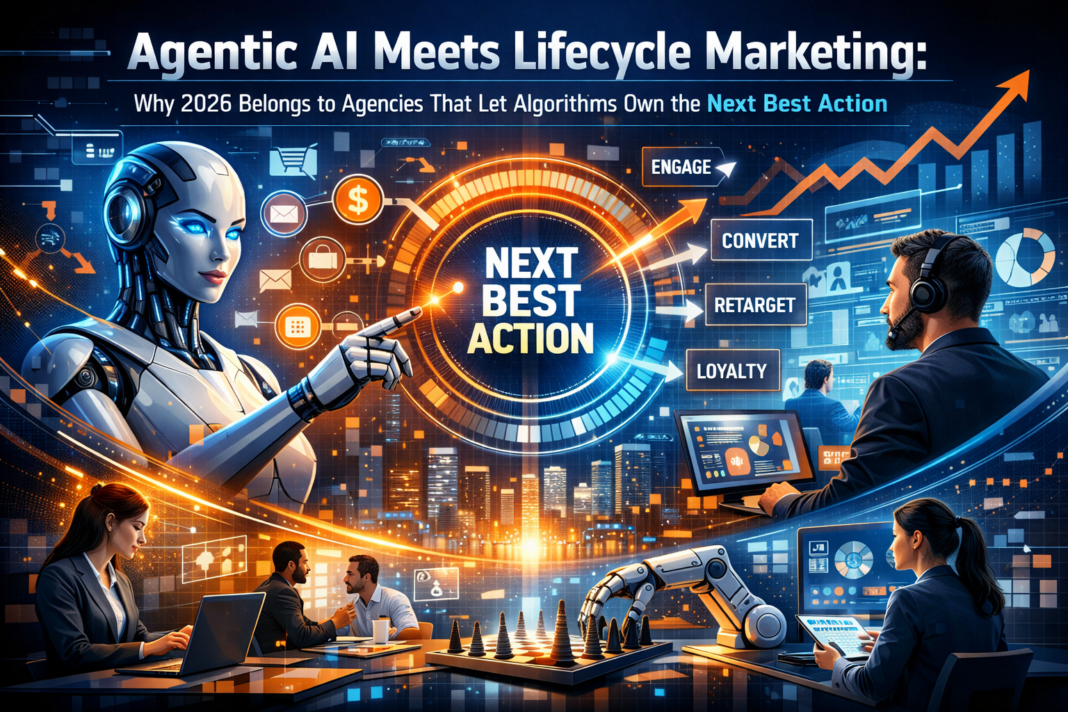
Letting algorithms own the next best action means trusting AI to decide what should happen next for each customer, in real time. Agentic AI looks at signals from CRM data, website behavior, support tickets, and buying intent all at once. For example, it can qualify a lead by spotting high-interest activity, speed up nurturing with timely messages, or prevent churn by triggering help when usage drops. It can also choose the best moment to suggest an upgrade or follow up after a purchase. These actions happen automatically, learning from outcomes and adjusting over time—turning lifecycle marketing into a system that improves itself.
Why CRM, Data, and Trust Are the Real Competitive Moats
Agentic lifecycle marketing only works when the foundation is strong. AI needs a unified CRM, clean data, and real-time data hubs to understand customers clearly and act correctly. If data is scattered, outdated, or incomplete, even the smartest algorithms make poor decisions. But technology alone isn’t enough—trust matters most. Brands must see why AI chose a specific action, approve critical decisions, and track every change through clear audit trails. Human-in-the-loop controls and strong governance give teams confidence to let AI operate autonomously. In the end, the agencies that win are the ones that build systems brands can trust, not just automate.
The New Agency Playbook: From Operators to Orchestrators
In the agentic AI era, agencies are no longer just campaign operators—they become system orchestrators. Instead of managing emails, ads, or workflows, agencies design how intelligent systems make decisions across the customer lifecycle. This includes defining goals, building lifecycle logic, shaping data strategy, and designing AI agents that act inside CRM platforms. Agencies also set governance rules, approval layers, and optimization loops so systems improve over time without losing control. Those who master this shift move beyond execution work and become long-term strategic partners—trusted to design the engines that drive growth, not just press the buttons.
Why 2026 Belongs to Agencies That Embrace Autonomous Marketing Systems
Autonomous marketing is reaching a tipping point. Brands are adopting agentic AI faster because manual decision-making can’t keep up with customer speed or complexity. They want outcomes—higher conversion, better retention, faster growth—not endless approvals and handoffs. Agencies that enable autonomous decision-making can act in real time, scale without adding headcount, and continuously improve results. Those that resist autonomy will move slower, cost more, and deliver less impact. In this new landscape, letting algorithms own execution isn’t risky—it’s the advantage. The real risk is holding on to manual control while competitors move ahead.
Conclusion
Lifecycle marketing success will no longer be measured by how well teams manage campaigns, workflows, or tools—it will be defined by who controls the next best action. Agentic AI shifts marketing from execution-heavy operations to intelligent systems that continuously decide, act, and optimize across the customer lifecycle in real time. This evolution doesn’t diminish human value; it amplifies it. Humans move upstream—designing the goals, guardrails, data foundations, and trust frameworks that guide autonomous decision-making. For agencies, this is the moment of reinvention. The winners will be those who stop selling effort and start engineering intelligence—building autonomous marketing systems that learn faster, act smarter, and deliver growth at a scale no human team can match alone.