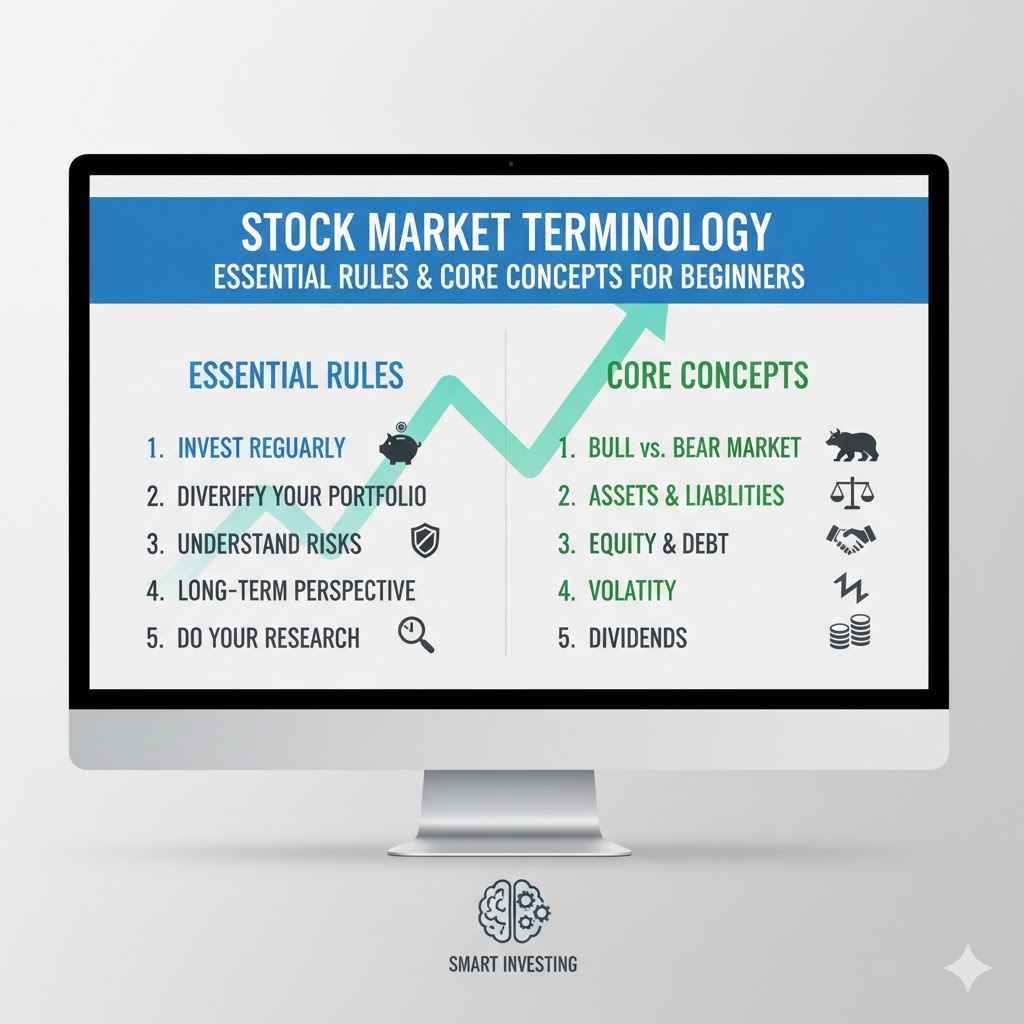
The stock market speaks its own language, one shaped by numbers, behavior, price movements, and human emotion. Beginners often find themselves surrounded by unfamiliar vocabulary. Understanding this terminology is the first step toward becoming a confident trader or investor. This guide breaks down essential stock market terms along with well-known trading rules such as the Rule of 7 and the Rule of 90.
Whether you are preparing to invest for the first time, planning to start trading, or simply strengthening your financial knowledge, mastering these basics will help you interpret market behavior with clarity rather than confusion.
What Are the Basic Terminology of the Stock Market?
The stock market includes hundreds of concepts, but several foundational terms appear frequently across trading platforms, research tools, and financial news. Understanding them helps you evaluate opportunities, risks, and price movements.
Here are the essential terms:
Ask
The lowest price at which a seller is willing to sell a stock. It represents the supply side of the trade.
Bid
The highest price a buyer is willing to pay for a stock. It represents the demand side.
Capitalization (Market Cap)
The total value of a company’s outstanding shares. Market cap classifies companies into categories such as small-cap, mid-cap, and large-cap.
Arbitrage
Buying and selling the same asset simultaneously in different markets to profit from price differences.
Averaging Down
Buying additional shares at a lower price than your original purchase to reduce the overall cost per share.
Blue Chip Stocks
Shares of well-established, financially stable companies known for consistent performance.
IPO (Initial Public Offering)
The process through which a private company becomes publicly traded by offering shares to the public for the first time.
Dividend
A payment made by a company to its shareholders, typically derived from profits.
Volatility
A measure of how much a stock’s price fluctuates. High volatility means larger price swings.
Liquidity
How quickly a stock can be bought or sold without affecting its market price.
Market Order
An order to buy or sell a stock immediately at the best available price.
Limit Order
An order to buy or sell a stock at a specific price or better.
What Is the 7 Rule in Stocks?
The Rule of 7 is rooted in compound growth. It is not a guarantee but a simplified way to understand long-term returns.
The idea is based on the historical tendency of broad markets to grow at an annual average rate of 10 percent. Using the principles of compounding, money invested at such a rate roughly doubles every seven years. This pattern is connected to the “Rule of 72,” a calculation used to estimate how long an investment will take to grow based on its rate of return.
The Rule of 7 encourages long-term thinking and helps investors appreciate the power of compounding. Rather than focusing on short-term fluctuations, it highlights how time multiplies growth.
What Are the Four Main Parts of a Stock?
A stock represents ownership in a company, and this ownership is defined by several components. These four parts form the structural foundation of any equity investment:
1. Stock Price
The current value at which the stock is traded in the market.
2. Shares Outstanding
The total number of shares a company has issued to the public.
3. Market Capitalization
Calculated by multiplying the stock price by the number of outstanding shares. It reflects the company’s overall value.
4. Ownership Rights
These include the right to vote in shareholder meetings, receive dividends (if declared), and participate in company growth.
Understanding these four elements helps investors analyze a company’s size, valuation, and potential.
What Is the 90% Rule in Trading?
The Rule of 90 is one of the most widely mentioned truths in trading communities. It illustrates the challenging nature of short-term speculation.
According to this rule:
90 percent of new traders lose 90 percent of their money in the first 90 days of trading.
This rule is not a formal regulation but a statistical observation. It highlights several key realities:
-
Most new traders lack experience.
-
Emotional decisions often replace strategy.
-
Risk management is typically ignored.
-
Overtrading leads to rapid capital loss.
-
Expectations are often unrealistic.
The Rule of 90 serves as a warning that day trading requires discipline, education, and a structured approach. It also encourages beginners to start slowly, use risk controls, and build strategy before scaling.
Why Understanding Stock Market Terminology Matters
Investing without understanding terminology is like traveling without knowing the language of the region. Each term you learn strengthens your ability to evaluate reports, analyze market news, understand charts, and make informed decisions.
Key benefits include:
-
Better interpretation of price movement
-
Accurate reading of financial statements
-
Improved understanding of risk
-
More confident trading and investing
-
Ability to avoid common beginner mistakes
Stock market terminology becomes powerful when combined with patience and long-term strategy.
Conclusion
Entering the stock market begins with mastering the vocabulary that shapes it. Understanding the basic terminology, recognizing the meaning behind the Rule of 7, identifying the core parts of a stock, and appreciating the caution provided by the Rule of 90 gives new investors a stronger foundation. Markets reward knowledge, patience, and preparation. With these core concepts in hand, you can move from uncertainty to clarity as you continue your investing journey.