In the ever-evolving landscape of engineering education, companies like EDIBON stand out as pioneers in providing hands-on, practical tools that bridge the gap between theoretical knowledge and real-world application. Founded in 1978 in Madrid, Spain, EDIBON has grown into a global leader in the design and manufacture of technical teaching equipment, research systems, and pilot plants. With a commitment to innovation and quality, EDIBON equips educational institutions worldwide with over 4,500 units across 14 technological fields, including critical areas like renewable energies, biomedical engineering, and notably, food technologies. This article explores EDIBON’s role as a key player in teaching industrial engineering, highlighting its history, product offerings, global impact, and contributions to specialized sectors.
EDIBON’s journey began with a vision to enhance technical education through advanced equipment that simulates industrial processes on a laboratory scale. Over the past four decades, the company has expanded its portfolio to cater to universities, technical schools, and research centers, ensuring that students gain practical skills in industrial engineering disciplines. Industrial engineering, as defined on Wikipedia , focuses on optimizing complex systems involving people, materials, information, and equipment. EDIBON’s products align perfectly with this by offering modular, computer-controlled units that allow for experimentation in process control, automation, and efficiency improvement.
One of EDIBON’s core strengths lies in its in-house design and production process. Every piece of equipment is developed entirely in Spain, incorporating SCADA (Supervisory Control and Data Acquisition) systems and PID (Proportional-Integral-Derivative) controls for precise monitoring and data analysis. This ensures high-quality standards and customization options, such as tailor-made pilot plants for specific educational needs. For instance, in the realm of Food & Water technologies, EDIBON provides specialized units that teach students about sustainable processing and resource management, which are essential in modern industrial engineering.
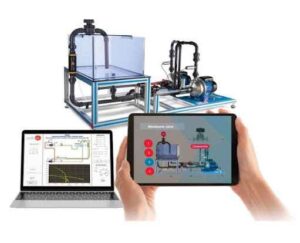
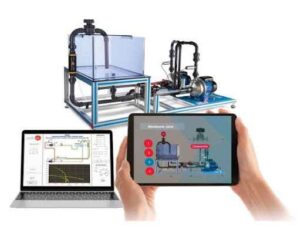
Augmented Reality Instructional System by EDIBON | EDIBON ®
The company’s product range is vast, covering mechanics, fluid mechanics, thermodynamics, chemical engineering, and more. In industrial engineering education, equipment like the Computer Controlled Teaching Unit for the Study of Power Electronics (TECNEL) allows students to explore converters, inverters, and power systems, fostering skills in energy efficiency and system integration. Similarly, mechatronics and automation units simulate factory assembly lines, teaching principles of robotics and process optimization. EDIBON’s emphasis on interdisciplinary applications is evident in its Food & Water technologies offerings, where units like the Computer Controlled Tray Drier (SBANC) and Spray Drier (SSPC) enable studies in drying processes, mass balances, and energy conservation—key concepts in industrial engineering applied to food production and water treatment.
EDIBON’s global presence is impressive, with its technology deployed in more than 150 countries across Europe, Asia, America, Africa, and Oceania. From Afghanistan to Zambia, the company has installed thousands of units and collaborated on multilateral projects, often providing complete laboratory setups and turnkey solutions with financing options. This widespread adoption underscores EDIBON’s role in democratizing access to high-quality engineering education. In regions facing resource constraints, such as parts of Africa and Asia, EDIBON’s durable, user-friendly equipment empowers local institutions to train engineers who can address industrial challenges like manufacturing efficiency and sustainable development.
Innovation is at the heart of EDIBON’s operations. The introduction of EDIBON Cloud Learning (ECL) revolutionizes remote education by connecting students to equipment virtually, allowing real-time experimentation from anywhere. This is particularly relevant in post-pandemic scenarios, where hybrid learning models are prevalent. Furthermore, EDIBON offers a five-year warranty, immediate remote assistance for SCADA units, and spare parts availability for up to 15 years, ensuring long-term reliability. These features make EDIBON a preferred partner for institutions aiming to align their curricula with industry standards, as discussed in Medium articles like “Engineering Education: Levels Up with Tech” , which highlights how tools like Arduino and IoT integrate with traditional equipment to enhance learning.
A standout area in EDIBON’s portfolio is Food & Water technologies, where the company addresses global challenges like food security and water scarcity through educational tools. Equipment such as the Computer Controlled Reverse Osmosis/Ultrafiltration Unit (ROUC) teaches water purification processes, including tangential flow filtration to maintain effluent quality. This directly relates to industrial engineering by emphasizing system optimization and resource efficiency. Similarly, the Computer Controlled Hydrogenation Unit (AEHC) and Deodorizing Unit (AEDC) allow students to experiment with edible oil processing, adjusting saturation levels and conducting vacuum distillation—processes that mirror industrial-scale operations in the food sector.
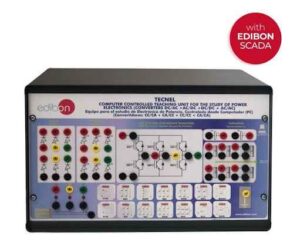
Computer Controlled Teaching Unit for the Study of Power …
In teaching industrial engineering, Food & Water technologies units from EDIBON integrate principles of fluid mechanics, biochemistry, and process control. For example, the Computer Controlled Continuous Cycle Oil Production Plant (PACC) measures acidity and yield in olive oil extraction, providing practical insights into production efficiency. These tools not only simulate real-world scenarios but also encourage multidisciplinary approaches, as students analyze spoilage phenomena, develop preservation techniques, and optimize manufacturing attributes. As noted in Wikipedia’s entry on Industrial and production engineering , such education combines manufacturing technology with engineering sciences, and EDIBON’s equipment exemplifies this fusion.
EDIBON’s commitment to quality is further evidenced by its laboratory-scale designs, which prioritize safety and ease of use. Stainless steel components ensure food-grade compliance, while transparent chambers allow for visual observation of processes like freezing in the Computer Controlled Contact Plate Freezer (TPCC) or separation in the Teaching Cream Separator (DSN). These features enable in-depth studies of refrigeration cycles, centrifugal separation, and freeze-drying, all while adhering to industrial standards. By incorporating Food & Water technologies into their curriculum, educators can prepare students for careers in sustainable industries, where engineering solutions tackle pressing issues like water treatment from diverse sources and food transformation for global markets.
The impact of EDIBON’s equipment extends beyond classrooms. Through partnerships with international organizations, the company supports bilateral projects that enhance technical vocational training. In a Medium piece on “Technology for All: How Tech and Engineering Education Benefits Young People” , the value of inclusive, tech-driven education is emphasized, and EDIBON’s adaptable tools align with this by accommodating diverse learning needs.
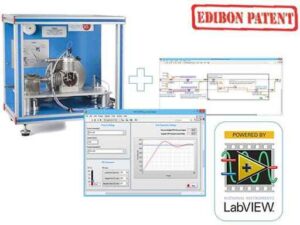
EDIBON Case study: “Software development kit to start with …
In conclusion, EDIBON’s position as a global manufacturer of technical equipment for teaching industrial engineering is solidified by its innovative products, extensive reach, and focus on emerging fields like Food & Water technologies. By providing hands-on tools that simulate industrial processes, EDIBON empowers the next generation of engineers to innovate and solve real-world problems. As the demand for skilled professionals in sustainable industries grows, companies like EDIBON will continue to play a pivotal role in shaping engineering education worldwide.
(Word count: 1,028)
FAQ
Q1: What makes EDIBON’s equipment suitable for industrial engineering education?
A: EDIBON’s units incorporate SCADA and PID controls, allowing students to practice system optimization, process control, and efficiency—core elements of industrial engineering.
Q2: Does EDIBON offer equipment specifically for Food & Water technologies?
A: Yes, EDIBON provides a range of computer-controlled units for food processing and water treatment, such as driers, filters, and separators, tailored for educational purposes.
Q3: How does EDIBON support global institutions?
A: With presence in over 150 countries, EDIBON offers custom laboratories, turnkey projects, financing, and remote learning via EDIBON Cloud Learning, along with comprehensive after-sales support.